
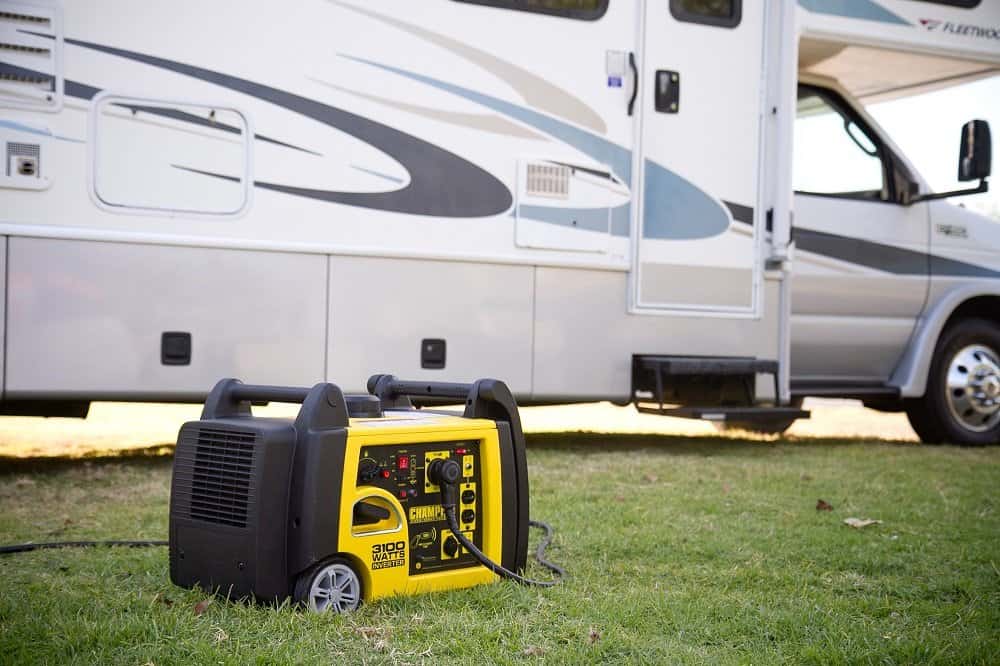
For a 30-amp travel trailer, the Westinghouse iGen4500 is the best single-unit RV generator for 2026: 4,500 starting watts, 3,700 running watts, 52 dBA, built-in TT-30R, and remote start. The Champion 76533 is the value dual-fuel pick, a paired Honda EU2200i setup is the quiet campground answer, and 50-amp rigs should shop in the 9,000W class.
The air-conditioner math drives the whole decision. A 13,500 BTU RV AC needs roughly 2,800-3,000 starting watts and up to about 1,500 running watts, while a 15,000 BTU unit needs more; Champion specifically rates the 76533 as able to start a 15,000 BTU RV AC.
This rebuild replaces a 2023 list where several models were discontinued, hard to find, or no longer the best buy. We compared current manufacturer spec sheets and production status in July 2026, then kept the old picks in a separate section so shoppers can still make sense of closeout units.
How much generator your RV needs
A 30-amp RV has a 120V service with a 3,600W maximum, so one strong 4,500W-class portable inverter is the cleanest fit for most trailers. That does not mean the RV can use all starting watts forever; it means the generator has enough surge to start the air conditioner and enough running wattage to carry the AC plus normal loads.
If you want the full 30-amp sizing breakdown, start with our guide to what size generator for a 30-amp RV. The short version is this: for one rooftop AC, stay near or above the 3,000W starting target, and give yourself margin if you also want the converter, fridge controls, microwave, or battery charger running.
The RV receptacle matters as much as the wattage. The TT-30R outlet is the standard 30-amp RV plug. An L5-30R twist-lock is not the RV plug, so you’ll need the right adapter if the generator only gives you L5-30R.
A 50-amp RV is a different animal. It has 120/240V service and up to 12,000W available, so one small suitcase inverter won’t act like shore power. For those rigs, look at a large inverter such as the GENMAX GM9000iED or a properly paralleled setup with the right adapter.
| Rig type | AC size | Starting watts target | Best fit from this list |
|---|---|---|---|
| Small camper or pop-up | No rooftop AC | Below AC-starting range | Champion 200961 |
| 30-amp travel trailer | 13,500 BTU | 2,800-3,000W | Westinghouse iGen4500 |
| 30-amp travel trailer | 15,000 BTU | More than 13,500 BTU | Champion 76533, per Champion’s AC claim |
| 50-amp fifth wheel or motorhome | Large AC load | 9,000W class | GENMAX GM9000iED |
If you’re buying for a travel trailer specifically, our travel trailer generator guide covers the same sizing problem by trailer type and camping style.
Best RV generators for 2026 compared
The best RV generator is not always the biggest one. A quiet 30-amp inverter is easier to live with than an oversized open-frame unit, but propane capability, electric start, and the right outlet can matter more than a few extra watts.
The published figures below are manufacturer specs cross-checked in July 2026. If a spec was not part of the verified data, we leave it blank instead of guessing.
| Model | Start/run W on gas | Propane output if dual-fuel | Noise | RV outlet | Weight class |
|---|---|---|---|---|---|
| Westinghouse iGen4500 | 4,500/3,700 | Not dual-fuel | 52 dBA | TT-30R | Portable inverter |
| Champion 76533 | 4,750/3,800 | 4,275/3,420 | Not listed in verified data | TT-30R + L5-30R | Open-frame |
| Champion 200988 | 4,500/3,500 | 3,150 running | 61 dBA | RV-ready | Open-frame inverter |
| Honda EU2200i pair | Each unit: 2,200/1,800 | Not dual-fuel | 48-57 dBA | TT-30R with Honda RV parallel kit | 47.4 lb each |
| Champion 200961 | 2,500/1,850 | 1,665 running | Not listed in verified data | Small-rig portable | 39 lb |
| GENMAX GM9000iED | 9,000W class | Dual-fuel | Not listed in verified data | 50-amp class | Large inverter |
| Cummins Onan RV gensets | Built-in RV class | Depends on installation | Depends on installation | Factory-installed RV power | Dealer-installed |
Westinghouse iGen4500: best overall for a 30-amp RV
The Westinghouse iGen4500 is the cleanest single-generator answer for most 30-amp trailers. Its published 4,500 starting watts and 3,700 running watts clear the normal 13,500 BTU AC starting target, and the built-in TT-30R means you are not building your setup around adapters.
The 52 dBA rating is a big reason it stays at the top. Campground noise rules vary, but a quieter inverter is easier to place, easier on neighbors, and less annoying when the AC cycles overnight.
Remote start is the other RV-friendly feature. If the generator is placed safely away from the rig, you can start it without walking outside every time the air conditioner or battery charging routine needs power.
The limitation is fuel choice: this pick is not dual-fuel in the verified data. If you want propane storage and gasoline flexibility, the Champion options below make more sense.
Check the Westinghouse iGen4500 price on Amazon →
Champion 76533: best value dual-fuel RV generator
The Champion 76533 is the value pick for RV owners who want gasoline and propane in one open-frame machine. Champion publishes 4,750 starting watts and 3,800 running watts on gasoline, or 4,275 starting watts and 3,420 running watts on propane.
Those numbers give it more surge than the typical 13,500 BTU AC target, and Champion states that the 76533 can start a 15,000 BTU RV air conditioner. That claim matters because a 15,000 BTU unit asks more from the generator than the common 13,500 BTU rooftop AC.
The outlet package is practical: TT-30R for the RV cord, L5-30R twist-lock for non-RV use with the right adapter, and two 5-20R household outlets. The L5-30R is useful, but again, it is not the RV plug.
Runtime is strong for boondocking. Champion lists 9 hours at 50% load from the 3.4-gallon gasoline tank and 10.5 hours at 50% load from a 20-lb propane tank. You also get electric start with battery, an Intelligauge meter, and a 3-year warranty.
It is still an open-frame generator, so don’t buy it expecting suitcase-inverter manners. Buy it because the watts, dual-fuel capability, RV outlet, and price-to-output balance make sense.
For more propane-capable options, see our guide to the best dual-fuel inverter generators.

Champion Power Equipment 76533 4750/3800-Watt Dual Fuel RV Ready Portable Generator with Electric Start
Check the Champion 76533 price on Amazon →
Champion 200988: best dual-fuel open-frame inverter
The Champion 200988 sits between a quiet enclosed RV inverter and a louder value open-frame unit. It gives you 4,500 starting watts and 3,500 running watts on gasoline, with 3,150 running watts on propane.
That output is right for many 30-amp RVs with one rooftop AC. It also gives propane users enough running capacity to treat propane as more than an emergency backup fuel.
Champion’s published 61 dBA rating is not as quiet as the Westinghouse figure, but it is still a reasonable number for an open-frame inverter. If your campground has strict quiet hours, check the rules before counting on any generator overnight.
The 200988 is RV-ready, which keeps the setup simpler than using a construction generator and a pile of adapters. It is a good middle choice if you want inverter power, dual-fuel flexibility, and enough output for a standard 30-amp trailer.
Check the Champion 200988 price on Amazon →
Honda EU2200i pair: quietest path to 30-amp service
A single Honda EU2200i is not the right answer for starting most rooftop RV air conditioners. Each unit is rated at 2,200 starting watts and 1,800 running watts, which falls short of the 2,800-3,000W starting target for a 13,500 BTU RV AC.
Two EU2200i generators paralleled with Honda’s RV parallel kit are the quiet, premium way to feed a TT-30R. Each unit weighs 47.4 lb, so the pair is easier to lift and store than one large machine.
Honda’s published noise range is 48-57 dBA, and the EU2200i is rated at less than 3% THD. It also includes CO-MINDER, which is the kind of safety feature you want around RVs, campgrounds, and sleeping people.
This setup costs more than a single value generator, but it solves two real problems: noise and handling. It also gives you flexibility, since one unit can run lighter loads when you do not need the air conditioner.
If you’re considering this route, read our guide to parallel generators before buying cords, kits, or adapters.
Check the Honda EU2200i price on Amazon →
Champion 200961: lightest dual-fuel pick for small rigs
The Champion 200961 is the small-rig pick, not the rooftop-AC pick. Champion publishes 2,500 starting watts and 1,850 running watts on gasoline, or 1,665 running watts on propane, so it does not meet the normal 13,500 BTU AC starting target.
For pop-ups, teardrops, battery charging, lights, fridge controls, fans, and electronics, it makes a lot more sense. At 39 lb, it is the easiest generator on this list to move by hand.
The propane runtime is the standout spec. Champion lists up to 34 hours at 25% load on a 20-lb propane tank, which is why this model is a multi-day boondocking cheat code for low-load campers.
Do not buy it to start a rooftop AC unless your rig has a special low-start setup not covered by the verified data here. Buy it because it is light, dual-fuel, and efficient for small electrical loads.
Check the Champion 200961 price on Amazon →
GENMAX GM9000iED: best single-unit answer for 50-amp rigs
The GENMAX GM9000iED is the 50-amp-class portable pick here because it is a 9,000W-class dual-fuel inverter with electric start. That puts it in a different category from the 4,500W 30-amp picks.
A 50-amp RV can have up to 12,000W of service available, so no portable in this class should be treated as a perfect replacement for full campground shore power. The point is to run major loads with more headroom than a 30-amp generator can provide.
This is the right lane for larger fifth wheels and motorhomes where one AC, battery charging, and normal coach loads can stack up fast. If you are trying to run everything exactly as you do on shore power, you need to manage loads carefully.
There is also a built-in alternative: Cummins Onan RV gensets. Cummins builds Onan RV generator sets in its Minnesota and Indiana facilities, and those are the factory-installed units many motorhomes carry. They are a different product class, usually dealer-installed, while this guide focuses on portables.
Check the GENMAX GM9000iED price on Amazon →
What happened to this page’s old picks
The Westinghouse iGen2200 was a good small inverter, with 2,200 starting watts, 1,800 running watts, 52 dBA, 46.3 lb weight, and 12 hours of runtime at 25% load. Several dealers now mark it discontinued or hard to find, and it was never an AC generator anyway. It is still fine for lights-and-fridge camping if you find one at the right price.

Westinghouse Outdoor Power Equipment 2200 Peak Watt Super Quiet & Lightweight Portable Inverter Generator, Gas Powered, Parallel Capable, Long Run Time
Check remaining Westinghouse iGen2200 stock on Amazon →
The WEN 56200i, rated at 2,000 starting watts and 1,600 running watts, is still sold by WEN but has been superseded by the 56203i. It is a small-camp generator, not a rooftop-AC solution.

WEN 56200i 2000-Watt Gas Powered Portable Inverter Generator, CARB Compliant,Black & Orange
Check the WEN 56200i price on Amazon →
The Honda EU3000iS is discontinued and does not belong in the main 2026 lineup. Honda’s newer portable RV conversation has moved on, and we cover that shift in our Honda EU3200i review.
The Generac GP3500iO still appears on Generac’s site, but a major dealer marks it discontinued. Its 3,500 starting watts and 3,000 running watts can still be useful, and PowerRush gives it an RV-relevant angle, but this is now an end-of-line deal hunt rather than a primary recommendation.

Generac 7128 GP3500iO 3,500-Watt Portable Generator - PowerRUSH Technology for Increased Starting Capacity, Quieter & Lighter Design, True Power Technology, RV Ready, Enhanced Convenience
Check remaining Generac GP3500iO stock on Amazon →
The Yamaha EF2200iS is rated at 2,200 starting watts and 1,800 running watts and is still sold. Yamaha exited generators in 2023 through the Willbe transfer, so shoppers should treat it as an end-of-line product, not a long-term platform.

Check remaining Yamaha EF2200iS stock on Amazon →
The Briggs & Stratton P2400 remains current and still makes sense as a budget suitcase inverter. It is rated at 2,400 starting watts and 1,800 running watts, includes CO Guard, and has a parallel port, so pairing is the real path to 30-amp service.

Briggs & Stratton P2400 PowerSmart Series Inverter Generator with Quiet Power Technology and CO Guard, 2400 Starting Watts 1800 Running Watts, Black (030758)
Check the Briggs & Stratton P2400 price on Amazon →
The Briggs & Stratton P4500 is still listed at retailers and remains a viable RV-ready model on paper. Its 4,500 starting watts and 3,700 running watts match the wattage class we like for 30-amp trailers, and electric start keeps it RV-friendly.
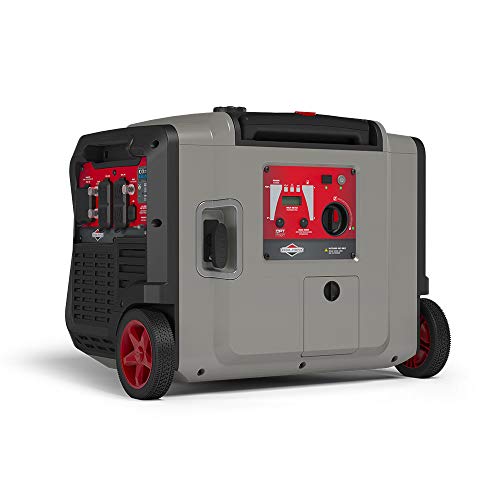
Briggs & Stratton 30795 P4500 PowerSmart Series, Electric Start, Powered Engine Inverter Generator, 4500-Watt, Gray
Check the Briggs & Stratton P4500 price on Amazon →
The DuroMax XP2200EH is still at Lowe’s and remains the cheap dual-fuel suitcase option. It is rated at 2,200 starting watts and 1,800 running watts, weighs 46 lb, and belongs in the small-load category rather than the AC-starting category.
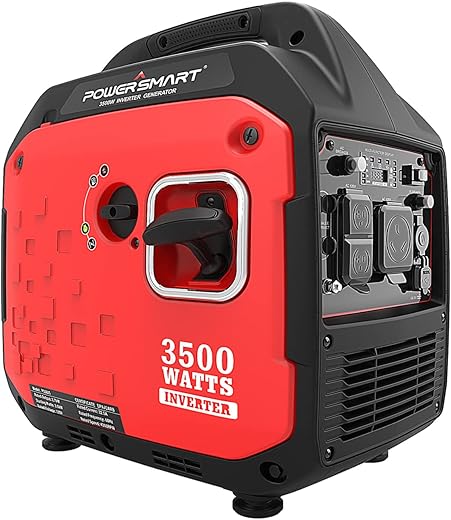
PowerSmart 3500-Watt Portable Inverter Generator Gas Powered, Super Quiet Outdoor Generator RV Ready for Home Use, CARB Compliant
Check the DuroMax XP2200EH price on Amazon →
Running an RV generator right
Generator runtime claims usually use light-load or half-load conventions, so read them carefully. A 25% load runtime is useful for battery charging and low-draw camping, while a 50% load figure is closer to real RV use with heavier appliances cycling.
Propane is convenient for boondocking because tanks store cleanly and many RV owners already carry them. The Champion 200961’s up-to-34-hour propane figure at 25% load is excellent for small loads, while the Champion 76533’s 10.5-hour figure at 50% load on a 20-lb propane tank is more realistic for larger RV demand.
Quiet hours can matter more than the spec sheet. The quiet picks here range from 52 dBA for the Westinghouse iGen4500 to 61 dBA for the Champion 200988, while the Honda EU2200i is published at 48-57 dBA per unit. Even then, a campground can still ban generator operation during certain hours.
Carbon monoxide placement is not optional. Keep the generator at least 20 ft from the RV, never under the awning, and never near windows, doors, or vents. Point exhaust away from people and from neighboring rigs.
Features also matter in RV use. Remote start, electric start, CO shutoff systems, a true TT-30R, and parallel capability can make daily camping easier than raw wattage alone. Our camping generator features guide covers those buying details before you spend money.
If you are still comparing size, fuel, outlet, and noise tradeoffs, our guide to selecting a camping generator is the broader checklist.
Bottom line
Buy the Westinghouse iGen4500 if you own a typical 30-amp RV and want one quiet, simple, TT-30R-equipped portable generator. Buy the Champion 76533 if dual-fuel value matters more than enclosed-inverter quiet.
Choose the Honda EU2200i pair if campground noise and easy lifting are worth the premium. For 50-amp rigs, skip the small-generator compromises and shop the 9,000W class, starting with the GENMAX GM9000iED.
Frequently asked questions
What size generator do I need for a 30-amp RV?
A 30-amp RV uses 120V service with a 3,600W maximum, so a 4,500W-class portable is the sweet spot for most rigs with one rooftop AC. The Westinghouse iGen4500 gives 4,500 starting watts and 3,700 running watts with a built-in TT-30R.
Will a 2,000-watt generator run an RV AC?
No, not for a typical rooftop RV air conditioner. A 13,500 BTU RV AC needs roughly 2,800-3,000 starting watts and up to about 1,500 running watts, so a 2,000W generator falls short on startup.
What generator do I need for a 50-amp RV?
A 50-amp RV has 120/240V service and up to 12,000W available, so you need a big inverter or a paralleled setup with the right adapter. The GENMAX GM9000iED is the 9,000W-class single-unit pick in this guide.
Are dual-fuel generators good for RVs?
Yes, especially for boondocking. The Champion 200961 can run up to 34 hours at 25% load on a 20-lb propane tank, while the Champion 76533 is rated for 10.5 hours at 50% load on a 20-lb propane tank.
How quiet does an RV generator need to be?
It depends on the campground, but quieter is always easier to live with. The quiet picks here range from 52 dBA for the Westinghouse iGen4500 to 61 dBA for the Champion 200988, while each Honda EU2200i is rated at 48-57 dBA.
Can I parallel two small inverters for my RV?
Yes, if the generators support paralleling and you use the correct kit. Two Honda EU2200i units with Honda’s RV parallel kit can feed a TT-30R, making them a quiet path to 30-amp RV service.
Is the Honda EU3000iS still available?
The Honda EU3000iS is discontinued, so it should not be a main 2026 shopping target. Honda replaced that slot with the EU3200i, which is the current model to research.
Do I need an inverter generator for an RV?
You do not strictly need one, but an inverter generator is usually the better RV choice because it is quieter and better suited to campground use. Open-frame dual-fuel models like the Champion 76533 can still be a good value if noise rules and campsite spacing allow it.


