

The Westinghouse WGen9500DF is the best 50-amp RV generator for most owners because it gives you 9,500 running watts on gas, dual-fuel operation, and a real 14-50R outlet for your RV cord. The Champion 100891 is the better value pick, and the GENMAX GM9000iED is the quiet inverter choice for owners who care more about clean power and noise than maximum wattage.
A 50-amp RV with two air conditioners does not need a portable generator that “fills” the full 12,000-watt shore-power ceiling. It needs enough real running watts to handle both ACs, the converter, the fridge, and normal house loads, which puts most fifth-wheel and Class A owners in the 7,500-9,500 running-watt class.
What 50-amp RV service actually needs
RV 50-amp service is 120/240V split-phase power. That means two 120V legs at 50A each, for a 12,000W theoretical ceiling at the pedestal.
That number confuses a lot of shoppers because almost no portable generator is a perfect stand-in for full campground shore power. You’re not trying to run every load in the coach at once; you’re trying to run the loads that matter without tripping the generator or starving one leg.
The big draw is air conditioning. A typical 13,500 BTU RV AC needs about 2,800-3,000W to start and about 1,200-1,700W to run, and a 15,000 BTU unit needs more. Add a residential RV fridge at 400-800W with surge, a converter/charger at 500-1,000W, a microwave at 1,000-1,500W, and a water heater element at 1,400W, and the math gets real fast.
That’s why two ACs starting staggered plus normal house loads points to the 7,500W-plus running class. If you want to pencil out your exact rig, use our generator wattage calculator and use the higher end of the range for appliances that surge.
The outlet matters as much as the wattage. A 14-50R outlet lets you plug a 50-amp RV cord directly into the generator, assuming the generator is properly set up for that receptacle.
An L14-30R with a 50-to-30 adapter is not the same thing. That adapter setup caps you at the 30A/120V-leg reality, which is 7,200W, so it may run a lot of the coach but it is not the same as having a 14-50R on the generator.
If your rig is smaller or you’re trying to understand the step down from 50A service, our guide to what size generator for a 30-amp RV explains that lower-power setup. If you’re thinking about pairing smaller units instead of dragging one big frame, read our parallel generator guide before buying cables and adapters.
Best 50-amp RV generators compared
| Model | Start/run W on gas | Propane output | 50A outlet | Noise | Weight |
|---|---|---|---|---|---|
| Westinghouse WGen9500DF | 12,500 / 9,500 | 11,200 / 8,500 | 14-50R | 74 dBA | 211 lb |
| Champion 100891 | 9,375 / 7,500 | 8,400 / 6,750 | 14-50R | — | — |
| DuroMax XP12000EH | 12,000 / 9,500 | 10,200 / 8,075 | 14-50R | 74 dBA | 224 lb |
| GENMAX GM9000iED | 9,000 / 7,600 | Dual fuel; LP rating per GENMAX’s label | 120/240V 50A locking outlet | 62 dB(A) | — |
| Pulsar G12KBN | 12,000 / 9,500 | 10,800 peak on LP | Sold as RV ready | — | — |
The table shows why outlet details matter. The Westinghouse, Champion, and DuroMax give you the 14-50R connection that most 50-amp RV owners want, while the GENMAX lists a 120/240V 50A locking outlet, so you need the right adapter for your 14-50 cord.
The Pulsar G12KBN stays in the list because it remains a budget 12kW-class option and has long been one of this page’s picks. It is still sold and marketed as transfer-switch and RV ready, but support and refinement expectations should be different than with the bigger-name options above.
Westinghouse WGen9500DF: best 50-amp RV generator overall
The Westinghouse WGen9500DF is the safest overall recommendation for a 50-amp RV because it checks the boxes that matter: 9,500 running watts on gas, 8,500 running watts on propane, and a 14-50R receptacle. That combination fits the real-world target for two ACs plus house loads better than lower-output RV portables.
Per Westinghouse’s published specs, the WGen9500DF makes 12,500 peak watts and 9,500 running watts on gasoline. On propane, it makes 11,200 peak watts and 8,500 running watts, which is still enough for many 50-amp RV owners who manage big loads instead of running every appliance at once.
The outlet panel is the main reason it belongs at the top. Westinghouse lists two 5-20R GFCI duplexes, an L14-30R, and a 14-50R, so a 50-amp RV cord can plug straight in without stepping down through a 30A adapter.
Runtime is strong for boondocking and outage use. The 6.6-gal gas tank is rated for 8 hr at 50% load, which works out to about 0.83 gal/hr, and a 20-lb propane tank is rated for 7 hr at 50% load.
The engine is a 457cc unit with a cast-iron sleeve, and Westinghouse includes electric start plus remote start. Those details matter when the generator is sitting outside the rig and you want power without walking out every time.
The tradeoff is that this is a big, loud open-frame generator. Westinghouse lists 211 lb and 74 dBA, so it’s not the unit you buy for whisper-quiet campground loops.
Power quality also deserves a plain warning. GeneratorBible’s published figure lists total harmonic distortion under 23%, so sensitive electronics should be run through the RV’s converter/inverter setup, or you should choose an inverter generator if clean output is your top concern.
For most fifth-wheel and Class A owners, the WGen9500DF is the right compromise. It has the 14-50R outlet, enough gas running wattage for the common two-AC load plan, propane backup, and a 3-year warranty.

Westinghouse Outdoor Power Equipment 12500 Peak Watt Dual Fuel Home Backup Portable Generator, Remote Electric Start, Transfer Switch Ready, Gas and Propane Powered, CARB Compliant
Check the Westinghouse WGen9500DF price on Amazon →
Champion 100891: best value dual-fuel generator with 14-50R
The Champion 100891 is the value pick because it gives 50-amp RV owners the right outlet and enough wattage for managed two-AC use at a lower output class than the biggest 12kW-style frames. Champion’s published figures list 9,375 starting watts and 7,500 running watts on gasoline.
On propane, Champion lists 8,400 starting watts and 6,750 running watts. That propane number is a step down, so owners running both ACs should be more careful about microwave use, electric water heat, and charger demand.
The outlet setup is exactly what this category needs. Champion lists four 5-20R GFCI outlets, an L14-30R, and a 14-50R, so your 50-amp RV cord has a proper generator-side receptacle instead of relying only on a 30A locking outlet.
The 7.7-gal gasoline tank is rated for 10 hr at 50% load. On a 20-lb propane tank, Champion’s published figure is 5.5 hr at 50% load, which is useful for short stops but not as relaxed as gasoline for overnight heavy AC use.
The 439cc engine has electric start with a battery, and Champion includes Cold Start. That matters for owners who use the same generator for RV travel, shoulder-season camping, and home backup.
Champion also lists EPA/CARB 50-state compliance and a 3-year warranty. That helps if you travel across state lines or want one generator that can legally follow the RV rather than sit at home.
The 100891 is the practical successor to Champion’s discontinued 201004 in this power band. If you liked the older Champion 7,500W remote-start formula but want a current model with a 14-50R, this is the cleaner buy.
Check the Champion 100891 price on Amazon →
DuroMax XP12000EH: max muscle dual-fuel pick
The DuroMax XP12000EH is the muscle pick for owners who want 9,500 running watts on gas and a broad outlet panel. It matches the Westinghouse gas running wattage at 9,500W while leaning into the big open-frame, dual-fuel home-backup style.
Per DuroMax’s published figures, the XP12000EH makes 12,000 peak watts and 9,500 running watts on gasoline. On propane, it makes 10,200 peak watts and 8,075 running watts.
The outlet set is one of its strengths. DuroMax lists a 5-20R GFCI duplex, an L5-30R, an L14-30R, and a 14-50R, giving RV owners the direct 50A receptacle they should be shopping for.
Runtime is in line with the big-output class. The 8.3-gal gas tank is rated for about 8 hr at 50% load, and DuroMax also lists 19 hr at 25% load.
The downside is bulk. DuroMax lists 224 lb, which makes this a wheel-kit-and-ramp generator, not something most owners will casually lift into a truck bed.
Noise is also open-frame territory. DuroMax lists 74 dBA, the same published figure used for the Westinghouse WGen9500DF, so campground placement and quiet-hour rules matter.
The XP12000EH makes the most sense if the RV generator will also serve home backup duty. If that’s your plan, our best 12,000-watt generator guide compares this size class from the house-backup angle.
For RV-only use, the DuroMax is easy to recommend when you want maximum gasoline running watts and a 14-50R. Just make sure you’re ready to live with the weight, fuel burn, and open-frame noise.
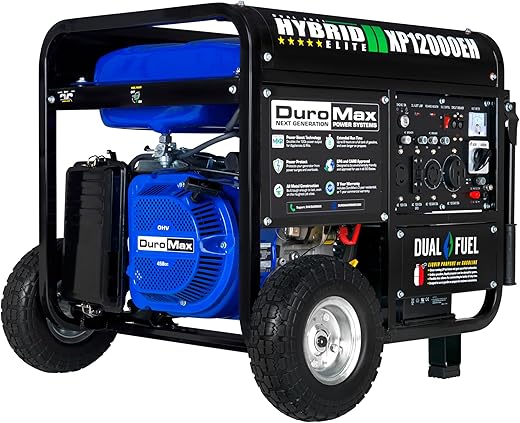
DuroMax XP12000EH Generator-12000 Watt Gas or Propane Powered Home Back Up & RV Ready, 50 State Approved Dual Fuel Electric Start Portable Generator, Black and Blue
Check the DuroMax XP12000EH price on Amazon →
GENMAX GM9000iED: quiet inverter option for 50-amp RV owners
The GENMAX GM9000iED is the quiet-campground play in this group. GENMAX advertises 62 dB(A), which puts it in a notably quieter class than the 74 dBA open-frame picks listed above.
It is also the inverter pick, which matters if your RV has sensitive electronics, a residential fridge, chargers, entertainment gear, or an inverter/charger system you’d rather not feed with rougher open-frame power. Clean inverter power is the main reason to accept less running wattage than the biggest conventional generators.
GENMAX lists 9,000 peak watts and 7,600 running watts. That places it right in the lower end of the 50-amp RV target range for staggered-start two-AC use and normal house loads.
The GM9000iED is dual fuel and uses a 458cc engine, per GENMAX’s published specs. GENMAX doesn’t pair a separate propane wattage with the listing we checked, so propane buyers should confirm the fuel-specific rating on the unit’s label before choosing it as their primary AC-running setup.
The outlet panel includes four 5-20R GFCI outlets, an L14-30R, and a 120/240V 50A outlet. GENMAX’s sheet lists that 50A connection as a locking outlet, so pack the correct adapter for your RV’s 14-50 cord rather than assuming a straight plug-in.
Remote start is included, and GENMAX lists CO Detect shutoff. That feature is a safety backup, not permission to run the generator in a bad location, but it’s still worth having around an RV.
The GM9000iED is the one to buy if noise and power quality matter more than absolute wattage. If that’s the direction you’re leaning, our dual-fuel inverter generator guide covers the category in more detail.

GENMAX Portable Inverter Generator, 9000W Super Quiet Gas Propane Powered Engine with Parallel Capability, Remote/Electric Start, Ideal for Home backup power.EPA Compliant (GM9000iED)
Check the GENMAX GM9000iED price on Amazon →
Pulsar G12KBN: budget 12kW-class 50-amp RV generator
The Pulsar G12KBN remains the budget 12kW-class pick because it still delivers the headline wattage many 50-amp RV owners search for. Pulsar lists 12,000 peak watts and 9,500 rated watts on gasoline.
On propane, Pulsar publishes 10,800 peak watts; a propane running-watt figure isn’t part of the published pair. Propane shoppers should verify the unit’s label before depending on it for both air conditioners.
The G12KBN has electric start and is CARB-compliant. Pulsar also sells it as transfer-switch and RV ready, which is why it has stayed on this page as a budget option.
The honest warning is refinement and support. At this price point, don’t expect the same dealer footprint, finish, or ownership polish as the major-brand picks above.
That doesn’t make it a bad buy. It means the Pulsar is best for owners who want 9,500 rated watts on gas and are comfortable trading some brand confidence for upfront savings.
If your RV generator will be used often, the Westinghouse, Champion, DuroMax, or GENMAX will usually be easier to recommend. If it’s occasional backup power and the price is right, the Pulsar still belongs on the list.

Pulsar G12KBN Heavy Duty Portable Dual Fuel Generator - 9500 Rated Watts & 12000 Peak Watts - Gas & LPG - Electric Start - Transfer Switch & RV Ready - CARB Compliant
Check the Pulsar G12KBN price on Amazon →
Two discontinued Champions still worth a look at closeout prices
Champion’s discontinued models matter here because both were credible 50-amp RV candidates, and remaining stock still shows up. The key is not to overpay for a discontinued generator when a current replacement is available.
Champion 201004
The Champion 201004 was the wireless-remote 7,500W unit many RV owners liked. Champion has discontinued it, but remaining stock still sells.
Its spiritual successor in the current lineup is the Champion 100891 above. If the 201004 is priced close to the 100891, buy the current model unless the older unit’s remote-start setup is the exact feature you want.

Champion Power Equipment 201004 9375/7500-Watt Portable Generator, Wireless Remote Start
Check remaining Champion 201004 stock on Amazon →
Champion 100485 PRO EFI
The Champion 100485 PRO EFI is the more interesting discontinued model. Champion’s published figures listed 11,500 starting watts and 9,200 running watts, a 459cc EFI engine, CO Shield, electric start, up to 11.5 hr runtime, and a 3-year warranty.
EFI means no carburetor to gum up and better altitude-friendly fueling than a conventional carb setup. That’s genuinely useful for RV owners who move between elevations and don’t want stale-fuel carb problems after storage.
The catch is simple: it’s discontinued. If you find remaining stock at a clear discount, it can still be worth grabbing; if the price is high, buy a current-production model with easier long-term support.

Champion Power Equipment 100485 PRO 11,500/9,200-Watt Portable Generator with Carburetor-Free Electronic Fuel Injection (EFI) Engine and CO Shield
Check remaining Champion 100485 EFI stock on Amazon →
Living with a big portable at the campsite
Big 50-amp RV generators are not casual carry gear. The listed open-frame units we have weights for are 211 lb for the Westinghouse and 224 lb for the DuroMax, so plan on wheel kits, ramps, and two-person handling.
Think about where the generator rides before you buy it. A fifth-wheel basement, truck bed, rear cargo tray, or toy-hauler garage all create different lifting and tie-down problems.
Noise is the next campsite issue. Westinghouse and DuroMax both list 74 dBA, while GENMAX advertises 62 dB(A) for the GM9000iED, so the inverter option is the obvious choice if you camp around neighbors.
Quiet hours can matter more than raw specs. A generator that is acceptable in a remote boondocking site may be a problem in a campground loop, especially when both air conditioners are cycling at night.
Fuel planning is just as important as wattage. The Westinghouse’s 6.6-gal tank is rated for 8 hr at 50% load, about 0.83 gal/hr, while the Champion 100891’s 7.7-gal tank is rated for 10 hr at 50% load.
Propane is cleaner to store, but the runtime numbers show the tradeoff. Westinghouse lists 7 hr at 50% load on a 20-lb propane tank, while Champion lists 5.5 hr at 50% load on a 20-lb propane tank.
That makes propane great for backup, shoulder-season use, and shorter runs. For heavy summer AC loads, gasoline usually gives you longer runtime before you’re swapping bottles or refueling.
Don’t plug the RV into the generator before the generator is started and stable. Start the generator first, let it settle, then connect the RV and bring major loads on one at a time.
Load management is still part of owning a 50-amp RV generator. Stagger the air conditioners, avoid running the microwave and electric water heater during AC startup, and watch the converter if the batteries are low.
If you’re still comparing RV-specific options beyond this 50-amp list, our broader best RV generators roundup covers other campsite setups. For smaller towables and lighter loads, our travel-trailer generator guide may be a better fit than a big 50-amp frame.
Bottom line
Buy the Westinghouse WGen9500DF if you want the best overall 50-amp RV generator: 9,500 running watts on gas, 8,500 on propane, and a true 14-50R outlet. Choose the Champion 100891 if value matters most and 7,500 gas running watts fits your load plan.
Pick the DuroMax XP12000EH if you want maximum open-frame muscle, and choose the GENMAX GM9000iED if quiet inverter power is the priority. The Pulsar G12KBN still works as a budget 12kW-class option, but go in with realistic expectations on support and refinement.
Frequently asked questions
What size generator do I need for a 50-amp RV?
Most 50-amp RV owners should shop in the 7,500-9,500 running-watt class. A full 50-amp RV pedestal can theoretically provide 12,000W, but a portable generator mainly needs to run both ACs plus the converter, fridge, and normal house loads.
Will a 3,500-watt generator run a 50-amp RV?
A 3,500-watt generator can power some of a 50-amp RV through an adapter, but it will not run the whole coach like shore power. Expect one air conditioner at most, with careful load management and major appliances turned off during AC startup.
What outlet does a 50-amp RV generator need?
The best outlet is a 14-50R because it accepts a 50-amp RV cord directly. An L14-30R with a 50-to-30 adapter is capped at the 30A/120V-leg reality, which is 7,200W, so it is not the same as a true 14-50R setup.
Can I run both RV air conditioners on a portable generator?
Yes, if the generator is in the right class and you stagger the starts. A typical 13,500 BTU RV AC needs about 2,800-3,000W to start and about 1,200-1,700W to run, so two ACs plus house loads usually call for 7,500W or more.
Are any 50-amp RV generators quiet?
Yes, but the quieter choices are usually inverter models. The GENMAX GM9000iED is the quiet option here, with GENMAX advertising 62 dB(A), while the Westinghouse WGen9500DF and DuroMax XP12000EH are listed at 74 dBA.
Is gas or propane better for RV backup?
Gas usually gives better heavy-load runtime in this class, while propane stores cleaner and is convenient for backup. The Westinghouse WGen9500DF is rated for 8 hr at 50% load on its 6.6-gal gas tank and 7 hr at 50% load on a 20-lb propane tank.
Is the Champion 201004 discontinued?
Yes. Champion has discontinued the 201004, though remaining stock still sells, and the Champion 100891 is the closest current successor in this lineup.


