
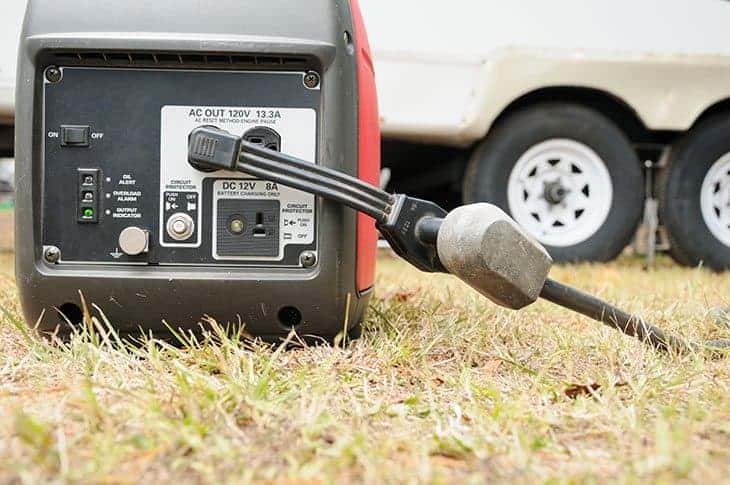
A 30-amp RV can draw at most 3,600 watts, because 120V x 30A = 3,600W. The practical sweet spot is a 3,000-4,500-watt inverter generator, and the best generator for RV 30 amp use for most owners is the Westinghouse iGen4500 with 4,500 peak watts, 3,700 running watts, and a built-in TT-30R RV outlet.
That size range gives you enough starting power for a rooftop air conditioner without buying a generator so large that the RV plug can’t use the extra output. If you camp on propane, run the air conditioner in hot weather, or want fewer load-management headaches, stay near the upper end of the range.
The 30-amp RV math
A standard 30-amp RV hookup is a 120V connection. Multiply 120V by 30A and you get 3,600 watts. That’s the ceiling your RV can draw through its TT-30 plug, even if the generator sitting outside is much larger.
That number is the hard limit, but it’s not the whole sizing answer. Generators have running watts and starting watts. Running watts cover the steady load after appliances are already operating, while starting watts handle the short compressor surge from equipment like a rooftop air conditioner.
The rooftop air conditioner is usually the load that decides the generator size. The standard wattage worksheet lists a 13,500 BTU RV air conditioner at 700 running watts plus 1,500 starting watts, but many real-world RV units run closer to 1,200-1,600 running watts depending on model, age, and conditions. Check the nameplate on your own air conditioner before you buy.
Other common RV loads add up fast. A converter or battery charger may use about 300-800 watts, an RV refrigerator on AC may use about 150-400 watts, a microwave can be 1,000 watts or more, and TV, lights, and chargers may land around 100-300 watts. Those are planning figures, not a substitute for the labels on your gear.
Here’s the practical example: air conditioner at up to about 1,500 running watts, refrigerator at 300 watts, converter at 500 watts, and miscellaneous loads at 200 watts. That’s about 2,500 running watts before the air conditioner compressor kicks on again.
That compressor surge is why a generator below about 2,800 rated watts can be frustrating with the air conditioner and other loads running. It may run the RV, but you’ll be watching the microwave, charger, fridge, and AC cycles like a hawk. A 3,000-4,500W inverter generator gives you a much better margin.
Going far above 4,500W doesn’t make the 30-amp plug deliver more than 3,600W. It can still make sense if you want headroom, plan to run on propane, or use the generator for non-RV jobs, but it doesn’t increase the RV’s 30-amp shore-power limit.
A built-in TT-30R outlet means the generator is RV-ready for a standard 30-amp RV cord. That’s cleaner than using an adapter, and it removes one more weak point in the setup.
An inverter generator is strongly preferred for this job. The picks below are built around low total harmonic distortion, with listed figures at 3% or less where published, which is friendlier to RV electronics. Inverters also help with campground noise and fuel use because they can run in economy modes instead of roaring at one speed all day.
Best generators for a 30-amp RV compared
We compared manufacturer-published specs for current-production RV inverter generators, plus one discontinued Yamaha model that is still sold while retailer stock lasts. The best fit depends on whether you value maximum 30-amp margin, propane capability, price, low weight, or hard-start air conditioner support.
| Model | Peak/Rated watts | Noise | Weight/notes | RV outlet | Fuel |
|---|---|---|---|---|---|
| Westinghouse iGen4500 | 4,500 peak / 3,700 running | 52 dBA | 98 lb; remote electric start | Built-in TT-30R | Gasoline |
| Champion 200988 4500W Dual Fuel Inverter | 4,500 starting / 3,500 running gas; 3,150 running propane | 61 dBA | 103 lb; electric start and Cold Start | RV-ready 30A outlet | Gasoline / propane |
| WEN 56380i | 3,800 surge / 3,400 rated | 57 dB at quarter load | Electric start; digital load display | Built-in TT-30R | Gasoline |
| Honda EU3200i | 3,200 max / 2,600 rated | 58 dB(A) at rated load; 54 at quarter load | 59.1 lb; CO-MINDER CO shutoff | Not listed in verified specs | Gasoline |
| Yamaha EF3000iSEB | 3,000 max / 2,800 rated; 3,500 starting with Boost | 53-60 dBA | Discontinued, limited stock; CO sensor | Not listed in verified specs | Gasoline |
Best overall: Westinghouse iGen4500
Check current price on Amazon →
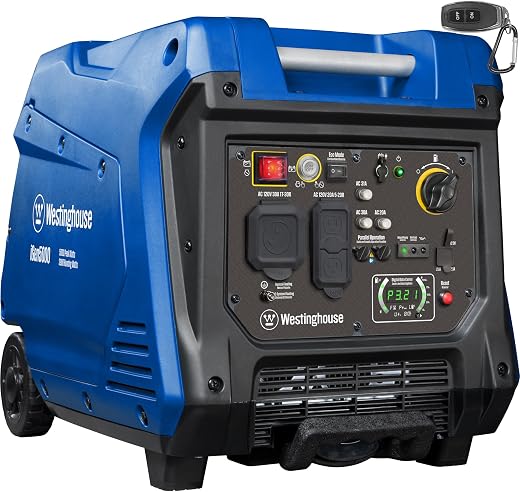
The Westinghouse iGen4500 is the cleanest all-around answer for most 30-amp RV owners. Per Westinghouse’s published specs, it makes 4,500 peak watts and 3,700 running watts, which lands right where a 30-amp RV generator should be: strong enough for air conditioner surge, but not pointlessly oversized for the 3,600W RV plug limit.
It also checks the convenience boxes that matter at a campsite. The built-in TT-30R outlet lets your RV cord plug in without an adapter, the remote electric start uses a fob, and the telescoping handle helps with moving a generator that still weighs 98 lb. Westinghouse lists noise at 52 dBA, total harmonic distortion at 3% or less, a 3.4-gal tank, and up to 18 hours at 25% load.
The main tradeoff is fuel choice. This pick is the gasoline iGen4500, even though a dual-fuel version exists, so propane campers should look at the Champion below. For a gasoline inverter with RV-ready output, quiet specs, and enough running wattage to suit a 30-amp trailer, this is the top pick.
Pros
- 4,500 peak watts and 3,700 running watts match 30-amp RV needs well.
- Built-in TT-30R outlet plugs straight into a standard 30-amp RV cord.
- 52 dBA published noise rating is the quietest listed figure in this group.
- Remote electric start with fob is a real comfort feature at camp.
- 3% or less THD, per Westinghouse’s spec sheet.
- EPA and CARB listed.
Cons
- 98 lb is not light.
- Gasoline only in this exact pick.
- More generator than you need if you never run the rooftop AC.
Best dual fuel: Champion 200988 4500W Dual Fuel Inverter

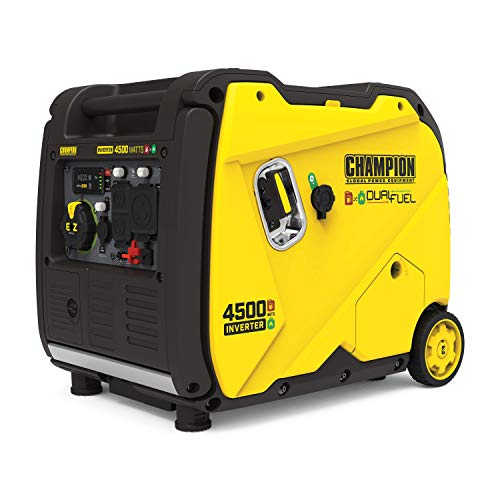
Champion Power Equipment 200988 4500-Watt Dual Fuel RV Ready Portable Inverter Generator, Electric Start
Check current price on Amazon →
The Champion 200988 is the best fit if you want gasoline and propane in one RV-ready inverter. Champion’s published figures list 4,500 starting watts and 3,500 running watts on gasoline, with 3,150 running watts on propane. That propane rating is still useful for a 30-amp RV, but it proves why propane derate matters.
The RV-ready 30A outlet provides about 29 amps available, so this is a genuine 30-amp-class unit rather than a small inverter with an adapter. Champion lists 61 dBA, electric start, Cold Start, less than 3% THD, EPA and CARB compliance, and a 3-year warranty. Runtime is listed at 21 hours at 25% load on a 20-lb propane tank.
Plan your fuel around how you camp. Propane output drops about 10%, so a load that feels easy on gasoline can feel tighter on propane with the air conditioner cycling. If you’re trying to estimate tank changes before a long trip, use our guide to how much propane a generator uses and leave margin for hot-weather AC use.
Pros
- Runs on gasoline or propane.
- 4,500 starting watts and 3,500 running watts on gas.
- 3,150 running watts on propane is still in the useful RV range.
- RV-ready 30A outlet with about 29 amps available.
- 21 hours at 25% load on a 20-lb propane tank, per Champion’s figure.
- Parallel-capable with a 50-amp kit.
Cons
- 103 lb is the heaviest pick here.
- Propane output drops about 10%.
- 61 dBA is louder than the quietest listed models.
Best budget RV-ready: WEN 56380i

WEN 56380i Super Quiet 3800-Watt RV-Ready Portable Inverter Generator with Fuel Shut-Off and Electric Start
Check current price on Amazon →
The WEN 56380i is the cheapest way in this list to get a true RV-ready inverter generator in the right size class. WEN lists 3,800 surge watts and 3,400 rated watts, which gives a 30-amp RV enough usable power for the common AC-plus-basics setup, assuming you manage the microwave and other heavy loads.
The built-in TT-30R RV outlet is the key feature. You also get electric start, a fuel shutoff, a digital load display, and a 212cc engine. WEN lists noise at 57 dB at quarter load, under 1.2% THD, a 2.2-gal tank, over 8.5 hours at half load, and a 2-year warranty.
This is the value pick, not the strongest pick. Compared with the Westinghouse and Champion, you give up some surge and running margin. For a smaller travel trailer, careful AC use, and a tighter budget, it’s a smart buy.
Pros
- 3,800 surge watts and 3,400 rated watts fit the core 30-amp RV range.
- Built-in TT-30R RV outlet.
- Electric start and digital load display.
- Under 1.2% THD, per WEN’s published spec.
- Fuel shutoff helps with storage.
- Over 8.5 hours at half load from a 2.2-gal tank.
Cons
- Less headroom than the 4,500W peak models.
- Gasoline only.
- You’ll need more load discipline with a rooftop AC and microwave.
Premium lightweight: Honda EU3200i
See Honda EU3200i listings on Amazon →
The Honda EU3200i is the pick for owners who care more about weight, noise, and Honda build quality than maximum 30-amp headroom. Honda lists 3,200 max watts and 2,600 rated watts, powered by a Honda GX130 130cc OHC engine. The standout spec is weight: just 59.1 lb.
That low weight changes how the generator gets used. A lot of RV owners can move a 59.1-lb inverter without turning every fuel stop into a lifting problem. Noise is listed at 58 dB(A) at rated load and 54 at quarter load, and Honda includes CO-MINDER CO shutoff.
The caveat is honest and serious: 2,600 rated watts means careful load management with a 13.5k AC on hot days. If the converter is charging hard, the fridge is on AC, and the microwave gets started at the wrong time, you can run out of margin. Read our full Honda EU3200i review if you’re deciding whether the lighter carry weight is worth the tighter wattage window.
Pros
- Only 59.1 lb, the clear lightweight standout here.
- 3,200 max watts is usable for many RV setups with load management.
- Honda GX130 130cc OHC engine.
- 58 dB(A) at rated load and 54 at quarter load.
- CO-MINDER CO shutoff.
Cons
- 2,600 rated watts is below the most comfortable range for a 30-amp RV with AC.
- Not the best choice if you want to run several loads while the air conditioner cycles.
- Verified specs provided here do not list a built-in TT-30R outlet.
Discontinued but still sold: Yamaha EF3000iSEB
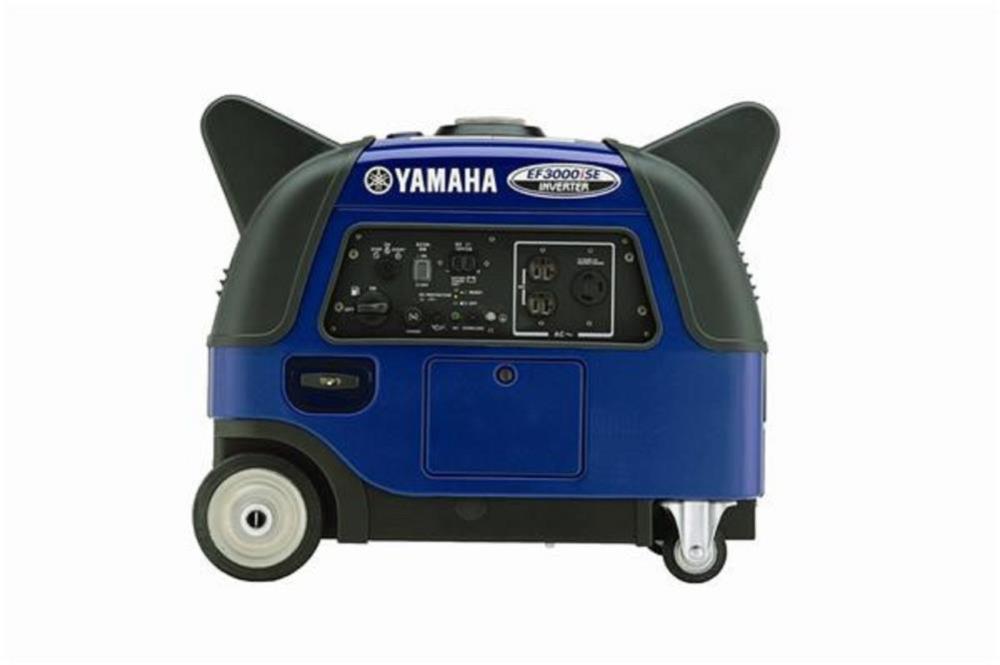
Yamaha 3000-Watt Inverter Gas Generator
 Acme Tools
Check remaining Yamaha EF3000iSEB stock on Amazon →
The Yamaha EF3000iSEB is a special case. Yamaha no longer produces it, but it is still sold while remaining retailer stock lasts. Its appeal is Boost Technology, which adds battery power for up to 10 seconds of extra surge to help with hard air conditioner compressor starts.
The published output is 3,000 max watts and 2,800 rated watts, with Boost helping it reach 3,500 starting. That is exactly the kind of short surge support that can make an older or stubborn rooftop AC less annoying. Yamaha lists 53-60 dBA, up to 19 hours at 1/4 load, a CO sensor, and 50-state legal status.
The risk is the orphaned-model parts situation. A discontinued generator can still be a good buy if the price and support path make sense, but you should not treat it the same as a current-production model. Buy it for the Boost feature and quiet operation, not because it’s the easiest long-term ownership bet.
Pros
- Boost Technology adds battery power for up to 10 seconds.
- 3,500 starting support helps with hard AC compressor starts.
- 2,800 rated watts is right at the lower edge of the practical RV range.
- 53-60 dBA published noise range.
- Up to 19 hours at 1/4 load.
- CO sensor and 50-state legal listing.
Cons
- Discontinued; remaining stock only.
- Parts and long-term support deserve extra scrutiny.
- Less running-watt margin than the larger RV-ready picks.
A parallel pair is the other smart route for owners who don’t want one heavier generator. A Honda EU2200i plus the Companion model combines to 4,400 watts with a 30A outlet on the Companion, giving you the two-small-units setup instead of one larger machine. If that sounds better for loading and storage, read our parallel generators guide before you buy cables or a kit.
What about noise? Campground rules
Generator noise matters because many campgrounds cap generator noise around 60 dBA and restrict operating hours. The picks here range from 52-61 dBA based on published figures, so they sit in the range RV owners usually shop for. That doesn’t guarantee every campground will allow every unit in every spot, but it’s the right class to start with.
Inverter generators have the advantage here. They can vary engine speed with load, so they’re usually less annoying while running chargers, lights, and small electronics. A conventional open-frame generator with the same wattage rating can be a poor campground neighbor.
Placement still matters. Keep the generator away from sleeping areas, follow the owner’s manual, and never run it in or near an enclosed space. CO shutoff features help, but they don’t replace safe setup.
Sizing checklist before you buy
Use the math, then check your actual labels. RVs with the same plug can behave very differently depending on AC size, battery charger behavior, refrigerator mode, and how often you use the microwave.
- Check the nameplate on your rooftop AC. A 13,500 BTU unit may be listed much lower on a worksheet, but many real units run around 1,200-1,600 watts.
- Add the running loads you’ll use together. Include the converter at about 300-800W, fridge on AC at about 150-400W, microwave at 1,000W or more, and small loads at about 100-300W.
- Add the single largest surge on top. For most 30-amp RVs, that’s the air conditioner compressor starting while other loads are already running.
- Account for propane derate if you choose dual fuel. The Champion listed above drops from 3,500 running watts on gas to 3,150 running watts on propane.
- Prefer a built-in TT-30R outlet. RV-ready output means your 30-amp RV cord plugs straight in with no adapter.
If you want to run your own appliance list, use our generator wattage calculator and compare the result against both running watts and starting watts. Don’t size only to the average load; size to the moment the AC compressor restarts.
Can you use a bigger generator?
Yes, you can plug a 30-amp RV into a bigger generator if the outlet and connection are correct. The RV draws only what it needs, up to the 3,600W limit of the 30-amp shore-power connection. A bigger generator doesn’t force extra power into the RV.
The downside is that you pay for capacity your 30-amp plug can’t use. Bigger units usually bring more weight, more fuel use, and more noise. If your only job is powering a 30-amp RV, the 3,000-4,500W inverter class is the better target.
A 50-amp RV is a different animal. It can support far more total load than a 30-amp RV, and the sizing conversation changes with the plug, panel, and appliances. Don’t size a generator for a 50-amp rig using 30-amp math.
Bottom line
For most 30-amp RV owners, buy a 3,000-4,500W inverter generator and don’t overthink it. The Westinghouse iGen4500 is the best overall pick because its 3,700 running watts, 4,500 peak watts, 52 dBA rating, and built-in TT-30R outlet fit the job cleanly.
Choose the WEN 56380i if you want the budget RV-ready option, or the Champion 200988 if propane matters. If lifting one larger unit is the dealbreaker, the Honda EU2200i plus Companion parallel setup gives you the two-small-generators alternative with 4,400 watts and a 30A outlet.
Frequently asked questions
What size generator do I need for a 30-amp RV?
A 30-amp RV can draw at most 3,600 watts because 120V x 30A = 3,600W. The practical sweet spot is a 3,000-4,500W inverter generator. That range gives you room for rooftop AC startup without buying a generator the 30-amp plug can’t fully use.
Will a 3,500-watt generator run a 30-amp RV with AC?
Yes, with load management. If the AC is using up to about 1,500 running watts, plus a 300W fridge, 500W converter, and 200W in small loads, you’re around 2,500 running watts before AC surge. Avoid running the microwave or other big loads while the compressor starts.
Can I plug my 30-amp RV into a bigger generator?
Yes, as long as the connection is correct. The RV only draws what it needs, up to the 3,600W limit of the 30-amp plug. The tradeoff is that a much larger generator usually adds weight, noise, and fuel use without giving the RV more usable power through that plug.
What is a TT-30R outlet?
A TT-30R is the RV-standard 120V 30A receptacle used by many 30-amp travel trailers and motorhomes. If a generator has a built-in TT-30R outlet, your RV cord can plug straight in without an adapter. That’s why “RV-ready” matters.
How quiet does a campground generator need to be?
Many campgrounds cap generator noise around 60 dBA and also restrict generator hours. The picks in this guide range from 52-61 dBA based on published specs. Always check the campground’s rule before you run any generator.
Is the Yamaha EF3000iSEB discontinued?
Yes. Yamaha no longer produces the EF3000iSEB, but it is still sold while remaining retailer stock lasts. Its Boost Technology adds battery power for up to 10 seconds of extra surge, which is useful for hard AC compressor starts.
Can two small generators run an RV AC?
Yes, if they are designed to run in parallel and the combined output is high enough. A Honda EU2200i plus Companion setup combines to 4,400 watts and provides a 30A outlet on the Companion. That route can be easier to lift and store than one larger generator.
Best Generators for RV & Camping (2026)
As an Amazon Associate we earn from qualifying purchases. Prices and availability are accurate as of the date/time indicated and are subject to change.
For more options, see our full guide: best quiet generators.


