
For most 30-amp travel trailers with a 13,500 BTU rooftop air conditioner, a quiet 3,000-4,500W inverter generator with a TT-30R outlet is the sweet spot. Our overall pick is the Westinghouse iGen4500; choose the Champion 200988 if you want dual-fuel flexibility for camping and storm season.

A travel-trailer generator has to do two jobs well: start the air conditioner without tripping out, and run quietly enough that your campsite doesn’t become the problem site. We compared manufacturer spec sheets and retailer listings checked July 2026, then matched the picks to how RV owners actually camp: full-hookup backup, boondocking, no-AC weekends, and emergency house power.
How much generator does a travel trailer need?
A 30-amp travel trailer can draw at most 3,600 watts because 120V multiplied by 30A equals 3,600 watts. That ceiling matters because buying a generator far beyond 4,500W peak does not give a 30A rig more usable power at the RV inlet.
The air conditioner decides the generator size. A typical 13,500 BTU rooftop AC uses up to about 1,500 running watts, but it needs roughly 2,800-3,000 starting watts for the compressor surge unless a soft-start kit is installed.
If you camp without AC, you can go much smaller. A converter, refrigerator, lights, chargers, and TV are often in the 1,000-1,500W total range, so a 2,000-2,500W inverter generator can make sense for lighter trailers and no-AC weekends.
| Travel trailer load | Running watts | Starting watts |
|---|---|---|
| 13,500 BTU rooftop AC | Up to about 1,500 | Roughly 2,800-3,000 |
| Converter/charger | 300-500 | Not usually the deciding load |
| Fridge on AC power | 300-700 | Not usually the deciding load |
| Microwave | 1,000 | Not usually the deciding load |
| TV, lights, and chargers | 200-400 | Not usually the deciding load |
For a trailer with AC, shop in the 3,000-4,500W class or run a parallel pair of 2,200W inverters. For a no-AC setup, the smaller 2,000-2,500W class is easier to lift, store, and live with at camp.
The practical cap is still the RV’s 30A service. If you want the full math for air conditioners, converters, microwaves, and surge load planning, use our 30-amp RV generator sizing guide before buying more generator than your trailer can use.
Gasoline or dual fuel?
Gasoline gives you the full rated output on dual-fuel generators. That matters if you’re trying to start a 13,500 BTU AC and still leave room for battery charging or a few small loads.
Propane’s advantage is storage. It doesn’t go stale in the carburetor between trips, so it’s easier to leave a generator ready for the next camping weekend or the next outage.
The trade-off is output. The Champion 200988, for example, is rated at 3,500 running watts on gasoline and 3,150 running watts on propane, per Champion’s published figures. That propane number is still useful, but it leaves less headroom than gasoline.
Runtime can also favor propane if you already carry cylinders for the trailer. The same Champion is listed for 14 hours at 25% load on gasoline from its 2.25-gal tank, or 21 hours at 25% load on a 20-lb propane tank.
If your trailer already carries propane and you want to understand fuel planning, read our guide to how much propane a generator uses. If you’re comparing more models beyond this roundup, our best dual-fuel inverter generator guide covers that category in more detail.
Noise: the campground rule
Most campgrounds enforce quiet hours, and many neighbors will judge your generator long before a ranger gets involved. Inverter generators in the 50-60 dBA band are usually the difference between neighbors who wave and neighbors who complain.
Open-frame generators are a different animal. The DuroMax XP4400E is rated at 69 dBA, and that level is not campground-friendly in a tight loop even if the wattage looks right on paper.
Noise also changes how you use power. A quiet inverter can charge batteries, run the AC during allowed generator hours, and keep the peace. A louder conventional unit is better suited to remote land, jobsite-style use, or storm backup at the house.
The 5 best travel trailer generators for 2026
These picks are based on verified manufacturer specs and retailer listings checked July 2026. We weighted the list toward 30-amp travel trailers because that’s where most buyers in this category land.
Westinghouse iGen4500: best overall travel trailer generator
| Spec | Westinghouse iGen4500 |
|---|---|
| Fuel | Gasoline |
| Output | 4,500 peak / 3,700 running watts |
| Noise | 52 dBA |
| Weight | 98 lb |
| Tank | 3.4 gal |
| Runtime claim | Up to 18 hours at 25% load |
| RV connection | Built-in RV-ready TT-30R outlet |
The Westinghouse iGen4500 is the cleanest fit for most 30-amp travel trailers with a 13,500 BTU AC. Its 4,500 peak watts and 3,700 running watts give it enough surge capacity for the rooftop unit while staying in the useful range for a 30A rig.
It also gets the camping details right. Per Westinghouse’s spec sheet, it’s rated at 52 dBA, has remote electric start, includes a built-in TT-30R outlet, and uses a telescoping handle with wheels to make its 98 lb weight less annoying around the campsite.
The limit is weight and fuel type. At 98 lb, this is not a small grab-and-go generator, and it’s gasoline only, so you’ll need to manage fuel storage between trips.
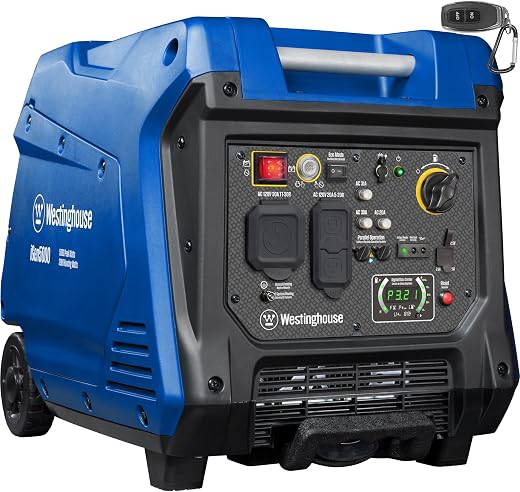
Westinghouse Outdoor Power Equipment 4500 Peak Watt Super Quiet Portable Inverter Generator, Remote Electric Start with Auto Choke, Wheel & Handle Kit, RV Ready, Gas Powered, Parallel Capable
Check current price on Amazon →
Champion 200988 4500W Dual Fuel Inverter: best dual fuel pick
| Spec | Champion 200988 |
|---|---|
| Fuel | Gasoline / propane |
| Gasoline output | 4,500 starting / 3,500 running watts |
| Propane output | 3,150 running watts |
| Noise | 61 dBA |
| Weight | 103 lb |
| Gas tank | 2.25 gal |
| Runtime claim | 14 hr at 25% on gas / 21 hr at 25% on a 20-lb propane tank |
| RV connection | RV-ready 30A outlet |
The Champion 200988 is the best choice here if you want one generator for camping and outage prep. It gives you gasoline output when you need maximum starting power, and propane operation when you want cleaner storage between trips.
Champion’s published figures put it at 4,500 starting watts and 3,500 running watts on gasoline, with 3,150 running watts on propane. That’s enough for many 30-amp travel trailers with a 13,500 BTU AC, especially if you manage the microwave, converter, and other loads instead of running everything at once.
The honest knock is noise. At 61 dBA, it sits above the 50-60 dBA band that many campers prefer, though it is still far more campsite-friendly than a 69 dBA open-frame unit.

Champion Power Equipment 200988 4500-Watt Dual Fuel RV Ready Portable Inverter Generator, Electric Start
Check current price on Amazon →
Honda EU2200i: best small-trailer and pairable generator
| Spec | Honda EU2200i |
|---|---|
| Fuel | Gasoline |
| Output | 2,200 starting / 1,800 running watts |
| Noise | 48-57 dBA |
| Weight | 47.4 lb |
| Tank | 0.95 gal |
| Runtime claim | 3.2-8.1 hr |
| Pairing option | 4,400W combined when two are paralleled |
| Typical listed price | $1,179-$1,299 |
The Honda EU2200i is the premium small-generator pick for campers who don’t need to run AC from one unit. At 47.4 lb, it is much easier to move than the 98 lb and 103 lb inverter generators in this roundup.
One EU2200i is a strong fit for converters, lights, chargers, a TV, and light no-AC camping. Honda’s published 2,200 starting watts and 1,800 running watts are not enough to confidently start a typical 13,500 BTU rooftop AC by themselves.
The upgrade path is the reason RV owners still love this model. You can parallel two units for 4,400W combined, or use the EU2200i Companion with its 30A outlet; we cover that model in our Honda EU2200i Companion review, and our parallel generators guide explains how pairing works.
Check current price on Amazon →
WEN 56203i: best budget quiet generator
| Spec | WEN 56203i |
|---|---|
| Fuel | Gasoline |
| Output | 2,000 starting / 1,700 running watts |
| Engine | 79cc |
| Noise | 51 dBA at quarter load |
| Weight | 39 lb |
| Tank | 1 gal |
| Runtime claim | Up to 10.8 hours at quarter load |
| Power quality | Under 1.2% THD |
| Outlets | Two 120V outlets, 12V DC, and two USB |
The WEN 56203i is the budget quiet pick for no-AC camping, battery charging, and small travel trailers. It is rated at 51 dBA at quarter load, weighs 39 lb, and is typically a fraction of the Honda’s price.
Its 2,000 starting watts and 1,700 running watts are not the right match for a 13,500 BTU AC. Treat it as a quiet utility generator for lights, chargers, a converter, TV use, and modest loads rather than a full RV air-conditioner solution.
The storage feature is a real plus for occasional campers. WEN lists a fuel shutoff that runs the carb dry for storage, and the unit is CARB compliant with under 1.2% THD.
Check current price on Amazon →
DuroMax XP4400E: budget big power with a noise caveat
| Spec | DuroMax XP4400E |
|---|---|
| Generator type | Conventional open frame, not an inverter |
| Fuel | Gasoline |
| Output | 4,400 peak / 3,500 running watts |
| Engine | 208cc |
| Noise | 69 dBA |
| Weight | 116 lb |
| Tank | 4 gal |
| Runtime claim | About 8 hr at 50% load |
| Start | Electric start |
The DuroMax XP4400E is here for one reason: low-cost wattage. Its 4,400 peak watts and 3,500 running watts can run an RV air conditioner for less money than many enclosed inverter models.
The caveat is big enough to decide the purchase. This is a conventional open-frame generator, not an inverter, and its 69 dBA rating is not campground-friendly around close neighbors.
Power quality is the other concern. Because it is not inverter-clean, it’s a better fit for storm backup at the house or remote sites without neighbors than for modern campsite use with sensitive electronics.

DuroMax XP4400E Gas Powered Portable Generator-4400 Watt Electric Start-Camping & RV Ready, 50 State Approved, Blue/Black
Check current price on Amazon →
Comparison table
If you’re buying for a 30-amp trailer with AC, start with the Westinghouse and Champion. If you camp without AC or want a pairable setup, the Honda and WEN make more sense than dragging around a bigger machine.
| Model | Watts | Fuel | Noise | Weight | RV outlet | Runtime claim |
|---|---|---|---|---|---|---|
| Westinghouse iGen4500 | 4,500 peak / 3,700 running | Gasoline | 52 dBA | 98 lb | Built-in TT-30R | Up to 18 hours at 25% load |
| Champion 200988 | 4,500 starting / 3,500 running on gas; 3,150 running on propane | Gasoline / propane | 61 dBA | 103 lb | RV-ready 30A outlet | 14 hr at 25% on gas; 21 hr at 25% on a 20-lb propane tank |
| Honda EU2200i | 2,200 starting / 1,800 running | Gasoline | 48-57 dBA | 47.4 lb | Companion model adds 30A outlet | 3.2-8.1 hr |
| WEN 56203i | 2,000 starting / 1,700 running | Gasoline | 51 dBA at quarter load | 39 lb | No TT-30R listed | Up to 10.8 hours at quarter load |
| DuroMax XP4400E | 4,400 peak / 3,500 running | Gasoline | 69 dBA | 116 lb | Not listed in verified data | About 8 hr at 50% load |
Using a generator with your travel trailer safely
Keep the generator well away from windows, doors, vents, and the awning area. Carbon monoxide can drift into a trailer even when the generator is outside, so never run one indoors, in a truck bed with a cap, under the trailer, or in any partially enclosed space.
Use the outlet setup the generator was built for. A travel trailer with a 30A cord is best served by a generator with a TT-30R or RV-ready 30A outlet, not a chain of sketchy adapters.
Use a short, outdoor-rated RV cord in good condition. Long, undersized cords waste voltage as heat, and low voltage is rough on air conditioners and other appliances.
Load management matters even with the right generator. If the AC is starting, don’t also ask the microwave and converter to pull hard at the same moment unless you know the generator has the headroom.
Between trips, deal with fuel before the generator sits. Gasoline left in the carburetor is a common reason a generator won’t start next season, so follow a storage routine like the one in our generator winterizing guide.
Bottom line
For most 30-amp travel trailers with a 13,500 BTU AC, buy the Westinghouse iGen4500 if you want the best all-around fit with a quiet rating and built-in TT-30R outlet. Pick the Champion 200988 if propane storage and storm-season flexibility matter more than staying in the quietest band.
For no-AC camping, choose the Honda EU2200i if you want the premium pairable path, or the WEN 56203i if you want a light, quiet budget unit. Use the DuroMax XP4400E only where 69 dBA open-frame noise won’t bother neighbors.
Frequently asked questions
What size generator do I need for a 30-amp travel trailer?
For a 30-amp travel trailer with a 13,500 BTU air conditioner, shop in the 3,000-4,500W class. A 30A RV can draw at most 3,600 watts because 120V x 30A = 3,600 watts, so a generator much beyond 4,500W peak is usually wasted on the trailer inlet.
Will a 2,000-watt generator run a travel trailer?
Yes, a 2,000-watt generator can run a travel trailer without the air conditioner if you’re using modest loads like the converter, lights, chargers, TV, and maybe the fridge on AC power. It is not the right single-generator size for a typical 13,500 BTU rooftop AC. For AC use, move up to the 3,000-4,500W class or parallel two 2,200W inverter generators.
How many watts does a 13,500 BTU RV air conditioner need?
A typical 13,500 BTU rooftop RV air conditioner uses up to about 1,500 running watts and roughly 2,800-3,000 starting watts. A soft-start kit can reduce the starting surge, which may let a smaller generator handle the compressor more easily.
What is the quietest generator for camping?
From these picks, the quietest ratings are the Honda EU2200i at 48-57 dBA, the WEN 56203i at 51 dBA at quarter load, and the Westinghouse iGen4500 at 52 dBA. For AC-capable 30-amp trailer use, the Westinghouse is the strongest quiet pick here.
Are dual fuel generators worth it for travel trailers?
Yes, if you want easier storage and fuel flexibility. Propane does not gum up a carburetor between trips, while gasoline gives the Champion 200988 its full 3,500 running watts compared with 3,150 running watts on propane. Champion lists 14 hr at 25% load on gasoline and 21 hr at 25% load on a 20-lb propane tank.
Can I run my generator during campground quiet hours?
Usually no. Most campgrounds set quiet hours, and even a quiet inverter generator may be banned during those times. Use the campground’s posted rules, and choose a 50-60 dBA inverter generator for allowed daytime operation.
How far from the trailer should a generator be?
Keep the generator well away from windows, doors, vents, and occupied areas; at least 20 feet is common safety guidance. Never run a generator indoors, under the trailer, under the awning, or in any partially enclosed space because carbon monoxide can build up fast.


