A 5,000-watt generator can run storm essentials with room to spare: a refrigerator/freezer, sump pump, microwave, fan, chargers, and radio add up to about 2,975 running watts with about a 5,175-watt peak. That fits the real 5,000-watt class, which spans about 4,500-5,300 running watts and 5,500-6,500 starting watts.
It is not a whole-house generator. Central air, an electric water heater, and a full breaker panel can consume most or all of this budget by themselves, so the job is picking loads and respecting the two-number rule: running watts plus the single largest starting surge.
The two numbers that decide everything
Generator sizing is not just the big number on the box. Running watts are what the generator can carry continuously, while starting watts are the short burst it can handle when a motor starts.
The worksheet method is simple: add the running watts of everything you want on at the same time, then add the single largest additional starting surge. You do not stack every motor’s surge, because a fridge, sump pump, RV air conditioner, and saw do not all start at the same instant in normal use.
This is where the “5,000-watt generator” label gets slippery. The class runs about 4,500-5,300 running watts with about 5,500-6,500 starting watts, so a badge that says 5,500 watts can still mean only 4,500 running watts.
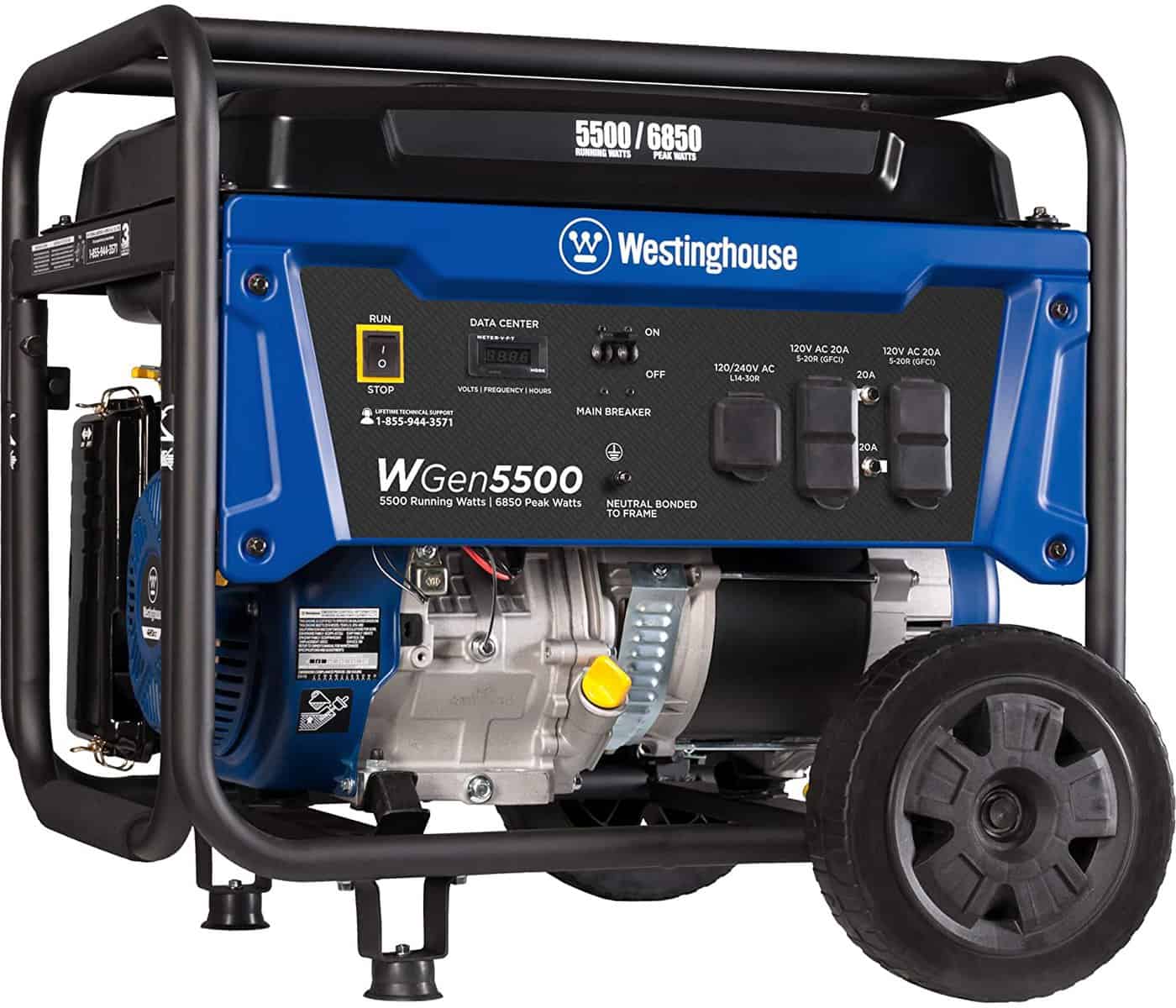
For example, Westinghouse publishes the WGen5300DFv at 6,500 peak and 5,300 running watts on gasoline, or 5,800 peak and 4,800 running watts on propane. DuroMax lists the XP5500HX at 5,500 starting and 4,500 running watts on gasoline, or 5,225 starting and 4,275 running watts on propane. WEN lists the GN5602X at 5,600 starting and 4,500 running watts on gasoline.
If you want to run your own appliance list, use our generator wattage calculator and enter both the running watts and the additional starting watts. The math is more useful than guessing from the generator name.
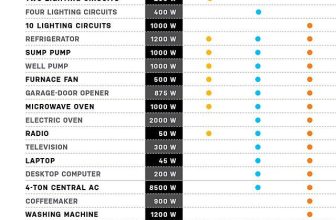
What a 5,000-watt generator can run: the load table
| Appliance or tool | Running W | Additional starting W | On a 5,000W-class unit? |
|---|---|---|---|
| Refrigerator/freezer | 700 | 2,200 | Easy |
| Sump pump 1/2 HP | 1,050 | 2,150 | Yes — watch the surge |
| Microwave 1000W | 1,000 | 0 | Yes |
| Coffee maker | 1,000 | 0 | Yes |
| Space heater | 1,800 | 0 | Yes — heavy load |
| Computer with monitor | 800 | 0 | Yes |
| Box fan | 100 | 0 | Easy |
| Cell phone charger | 25 | 0 | Easy |
| RV air conditioner 13,500 BTU | 700 | 1,500 | Easy |
| Circular saw 7-1/4″ | 1,400 | 2,300 | Yes — watch the surge |
| Miter saw 10″ | 1,800 | 3,300 | Yes, one at a time |
| Table saw 10″ | 2,000 | 2,000 | Yes, one at a time |
| Air compressor 1 HP | 1,400 | 3,600 | Yes, one at a time |
The table shows why a 5,000-watt-class generator feels bigger than a small inverter but still needs discipline. Low-draw items like a box fan, phone charger, humidifier, and radio barely move the needle, while a space heater or big saw can take a serious bite out of the budget.
The surge column matters most on motors. A refrigerator/freezer only runs at 700 watts once it is going, but the worksheet figure includes an extra 2,200 watts at startup. A sump pump is similar: the running draw is manageable, but the extra 2,150-watt starting demand has to be reserved somewhere in your plan.
Resistance heat is different. A space heater has no starting surge in this worksheet, but it pulls 1,800 watts the whole time it is on. That steady draw is why a heater can be harder to live with than a short microwave cycle.
Storm-outage plan: what fits at the same time
A practical storm plan starts with the loads that protect food, keep water out, and handle short cooking tasks. Using the worksheet figures, a refrigerator/freezer at 700 watts, a 1/2 HP sump pump at 1,050 watts, a microwave at 1,000 watts, and small loads like a fan, chargers, and radio at about 225 watts total about 2,975 running watts.
Now add the largest single starting surge. In this plan, the refrigerator/freezer’s additional 2,200 watts is the largest surge, so peak demand is about 2,975 plus 2,200, or about 5,175 starting watts. That fits the class.
The Westinghouse WGen5300DFv, with Westinghouse’s published 6,500-watt gasoline peak rating, carries that plan with clear surge room. The 5,500-starting-watt units also clear the math, but you should time the microwave around compressor starts when the generator is already loaded.
That timing tip is simple. If the fridge or sump pump just kicked on, wait before starting a microwave cycle. You are not trying to baby the generator; you are keeping starting surges from landing on top of a heavy running load.
For storm planning beyond a basic appliance list, our hurricane generator sizing guide walks through backup priorities and load management. The same rule applies: keep the running load reasonable, and leave room for the biggest motor to start.
The comfort add-on is where many people overbuy appliances and underbuy generator. Add a 1,800-watt space heater to the same storm essentials and the running load jumps to about 4,775 watts. That is over the 4,500-running-watt units and inside the WGen5300DFv’s 5,300-watt gasoline running rating with almost nothing to spare.
The better rule is one space heater or the microwave alongside essentials, not both on most of this class. Resistance heat eats generator capacity fast because the draw is continuous, not a short startup burst.
Jobsite and RV loads
A 5,000-watt-class generator is a useful jobsite size because it can handle common saws and support loads without stepping into big standby territory. The sample tool plan is a 7-1/4″ circular saw at 1,400 watts, a halogen work light at 1,000 watts, and a 1/2″ hand drill at 600 watts.
Add those running loads and you get 3,000 watts. The largest single surge is the circular saw’s additional 2,300 watts, so the peak demand is 5,300 watts. That fits the class, including the models with 5,500 starting watts.
The problem comes from pairing big motors. A 10″ miter saw uses 1,800 running watts with an additional 3,300-watt surge, while a 1 HP air compressor uses 1,400 running watts with an additional 3,600-watt surge. Together, they cross the line the moment both motors spin up, so run big motors one at a time.
The same advice applies to a 10″ table saw. Its 2,000 running watts and additional 2,000-watt starting demand fit, but it should not be treated like a phone charger that can be ignored in the background. Let the saw or compressor have the generator when it starts.
For RV use, a 13,500 BTU RV air conditioner is easy work for this class. The worksheet figure is 700 running watts plus 1,500 additional starting watts, which leaves thousands of watts for other managed loads on a 5,000-watt open-frame generator.
The real RV question is usually not watts. It is noise, outlet setup, and whether an open-frame unit is acceptable where you camp. From a pure load standpoint, the air conditioner itself is not the hard part.
Three real 5,000-watt-class generators
If you are shopping this size, compare the running rating, the starting rating, the fuel you plan to use, and the outlet layout. Our 5,000-watt generator roundup is the better place for full model-by-model buying advice, but these three published spec sheets show how wide the class really is.
| Model | Gasoline starting W | Gasoline running W | Propane starting W | Propane running W | Published price |
|---|---|---|---|---|---|
| Westinghouse WGen5300DFv | 6,500 | 5,300 | 5,800 | 4,800 | $759 MSRP |
| DuroMax XP5500HX | 5,500 | 4,500 | 5,225 | 4,275 | $629 |
| WEN GN5602X | 5,600 | 4,500 | Gasoline only | Gasoline only | $449.99 |
The Westinghouse WGen5300DFv is the high-output anchor for this class. Westinghouse publishes 6,500 peak and 5,300 running watts on gasoline, plus 5,800 peak and 4,800 running watts on propane, with a $759 MSRP on westinghouse.com. Its dual-fuel setup and 240V flexibility make it the stronger pick when you want more headroom inside this size range.
Check the Westinghouse WGen5300DFv price on Amazon →
The DuroMax XP5500HX is the dual-fuel value example. GeneratorBible’s tracker lists it at $629, and the published figures are 5,500 starting and 4,500 running watts on gasoline, or 5,225 starting and 4,275 running watts on propane. The spec set also includes 69 dBA, electric start, and CO Alert.
Check the DuroMax XP5500HX price on Amazon →
The WEN GN5602X is the gas-only budget anchor. WEN’s own store lists it at $449.99, with 5,600 starting watts and 4,500 running watts. It is a good reminder that the highest badge number does not always mean the highest continuous output.
Check the WEN GN5602X price on Amazon →

What a 5,000-watt generator can’t run
A 5,000-watt generator is not the right tool for central air, an electric water heater, or whole-panel backup. Central air and electric water heaters are 240V nameplate loads that typically consume most or all of this budget on their own, so check the actual nameplate instead of assuming.
Whole-house-panel backup belongs higher in the lineup. If the goal is running many circuits through a transfer setup with fewer sacrifices, read our 10,000-watt generator load guide and plan around a larger class.
Propane also changes the math. Per Westinghouse’s spec sheet, the WGen5300DFv drops from 5,300 running watts on gasoline to 4,800 running watts on propane. If bottles are your storm plan, size the load list against the propane column, not the gasoline column.
Running near the ceiling for hours is not comfortable operation, either. The worksheet method sizes for peak demand, but day-to-day use is better when the generator has breathing room under its running rating. That extra headroom helps when a pump kicks on or somebody starts a microwave without warning.
If your load list is mostly a refrigerator/freezer, a few chargers, a fan, and small electronics, you may not need this much generator. Smaller loads can live fine on the 2,000-watt generator class, especially if you are willing to rotate appliances.
The middle ground is worth checking, too. Our 3,500-watt generator guide covers the step between compact inverter power and this 5,000-watt-class storm or jobsite size.
Bottom line
A 5,000-watt-class generator is an essentials-plus machine: fridge, sump pump, microwave, fan, chargers, and radio fit at about 2,975 running watts with about a 5,175-watt peak. It can also handle a 13,500 BTU RV air conditioner or a useful set of jobsite tools.
Count running watts, add only the single largest starting surge, and run big motors one at a time. If you want central air, an electric water heater, or easy whole-panel backup, move up instead of forcing this class to do work it was not built for.
Frequently asked questions
Will a 5,000-watt generator run a house?
Essentials, yes. A refrigerator/freezer, sump pump, microwave, and small loads come to about 2,975 running watts with about a 5,175-watt peak. A whole panel with central AC is not the job for this class; that belongs in the 9,500W+ territory.
Can a 5,000-watt generator run a refrigerator and freezer?
Easily. The worksheet figure for a refrigerator/freezer is 700 running watts plus 2,200 additional starting watts, which fits with thousands of watts left for other managed loads.
Will a 5,000-watt generator run an air conditioner?
A 13,500 BTU RV air conditioner, yes. It uses 700 running watts plus 1,500 additional starting watts in the worksheet figures. Residential central air is a 240V nameplate load that usually does not fit this class.
Can it run a space heater?
Yes, a space heater is listed at 1,800 watts. On a 4,500-running-watt unit, one heater uses about 40% of the budget. With storm essentials, think heater or microwave, not everything at once.
What size generator do I need for power tools?
A 5,000W-class generator handles a circular saw, work light, and drill together at about 3,000 running watts and 5,300 peak watts. Run miter saws and compressors one at a time because their starting surges can push the total past the class ceiling.
Does a 5,000-watt generator really give you 5,000 watts?
Usually not continuously. This class spans about 4,500-5,300 running watts, with the bigger number often being the starting rating. On propane, output drops further; Westinghouse publishes 4,800 running watts on propane versus 5,300 on gasoline for the WGen5300DFv.
How do I add up my loads correctly?
Add the running watts of everything you want on at the same time. Then add only the single largest additional starting surge. Motors start intermittently, so you do not stack every surge in the worksheet.