Buy Westinghouse if you want big open-frame storm power, tri-fuel flexibility, remote start, and loaded accessory bundles for the money. Buy Champion if you want an inverter generator, a dual-fuel ultralight, or an RV-ready 4500-class unit backed by free lifetime technical support.
Both brands sit in the value-generator lane with 3-year limited warranties, well below Honda money in most shopping comparisons. The right answer isn’t “Westinghouse or Champion, which is better?” across the whole aisle — it’s which lineup fits your job.
Westinghouse vs Champion at a glance
| Dimension | Westinghouse | Champion |
|---|---|---|
| Who’s behind it | Licensed brand operated by MWE Investments, LLC of Columbus, Ohio | Independent company headquartered in Santa Fe Springs, California; founded in 2003; more than 4.5 million generators sold in North America |
| Warranty | 3-year limited | 3-year limited plus free lifetime technical support |
| Signature strength | Big open frames and tri-fuel bundles | Inverter breadth and dual-fuel ultralights |
| CO shutoff | CO sensor on current TFc-class units | CO Shield on current units such as the 201122 and 201319 |
| Verified price anchors | WGen5300DFv at $759 MSRP per Westinghouse’s listing | 201122 at $499-599 per GeneratorBible’s tracker; 4500 class recently high-$800s to $1,100 |
| Our coverage | 1 Westinghouse model reviewed | 14 Champion models reviewed |
Read that table as a split decision, not a brand knockout. Westinghouse looks strongest in the big portable category where raw running watts, 120/240V capability, and fuel flexibility matter. Champion looks strongest in the smaller inverter categories where weight, noise, RV outlets, and support matter more than whole-house surge capacity.
There’s also a business-structure difference. Westinghouse portable generators are a licensed line operated by MWE Investments, LLC of Columbus, Ohio, while Champion Power Equipment is its own generator company based in California. If that background matters to you, our guide to where Westinghouse generators are made breaks down the licensed-brand side in more detail.
Where Westinghouse wins
Westinghouse’s cleanest win is big open-frame storm value. The WGen5300DFv is rated at 6,500 peak watts and 5,300 running watts on gasoline, and 5,800 peak watts and 4,800 running watts on propane, per Westinghouse’s published specs. It also gives you a 120/240V selector, an RV-ready TT-30R outlet, and a 3-year warranty at a $759 MSRP on Westinghouse’s site.
That makes the WGen5300DFv a sharp buy for homeowners who need transfer-switch-friendly 240V capability without jumping into a huge frame. It’s not a quiet inverter and it’s not pretending to be one. It’s a budget storm tool, and that’s why it fits naturally in our best generator under $1,000 roundup.
Westinghouse also has a strong big-storm reputation in the higher-output open-frame lane. The WGen9500DF sits in the 9,500-running-watt gasoline class and is the big storm portable our hurricane coverage leads with. For buyers looking at refrigerators, sump pumps, lights, chargers, and selected hardwired loads, that class is where Westinghouse starts to make more sense than a smaller inverter.
Check the Westinghouse WGen9500DF price on Amazon →
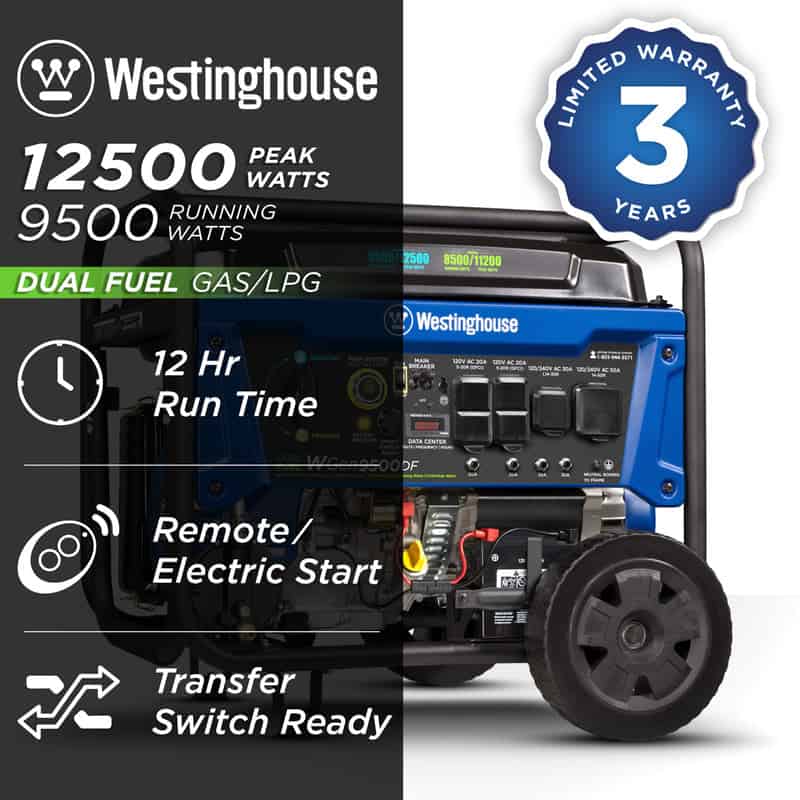
The WGen9500TFc is the best example of Westinghouse’s “box does the accessorizing” approach. Per the published package list, it ships with both a propane hose and a natural-gas hose with NPT adapter, plus funnel, oil, key fob remote, battery charger, and tool kit. The generator itself is rated at 12,500 peak watts and 9,500 running watts on gasoline, and 9,500 peak watts and 7,500 running watts on natural gas.
Those numbers matter if your plan is natural gas during a long outage. Natural gas output is lower than gasoline output on the WGen9500TFc, but it removes the refill problem if your gas service stays live. The 457cc engine, 6.6-gallon tank, up to 12 hours on gasoline, and CO sensor make it a serious storm unit rather than a campsite generator.
Check the Westinghouse WGen9500TFc price on Amazon →
The short version: Westinghouse wins the big-generator shelf in this comparison. If your shopping list says 240V, open frame, storm backup, remote start, and possibly tri-fuel, Westinghouse has the more compelling verified examples here. Just don’t confuse that with inverter dominance; we did not verify Westinghouse iGen inverter specs for this page.
Where Champion wins
Champion’s biggest win is the inverter side, especially the dual-fuel ultralight class. The Champion 201122 is rated at 2,500 starting watts and 1,850 running watts on gasoline, with 1,665 running watts on propane, per Champion’s published figures. It weighs 39 lb, is rated at 53 dBA, and runs up to 11.5 hours at 25% load on its 1.1-gallon gasoline tank or up to 34 hours at 25% load on a 20 lb propane bottle.
That package is hard to beat for tailgates, small trailers, charging, lights, modem/router backup, and light-duty appliance support. It has CO Shield, uses recoil start only, and GeneratorBible’s tracker has recently shown it in the $499-599 range. That’s why our Champion 201122 review treats it as one of the strongest price-floor dual-fuel inverters.
Check the Champion 201122 price on Amazon →
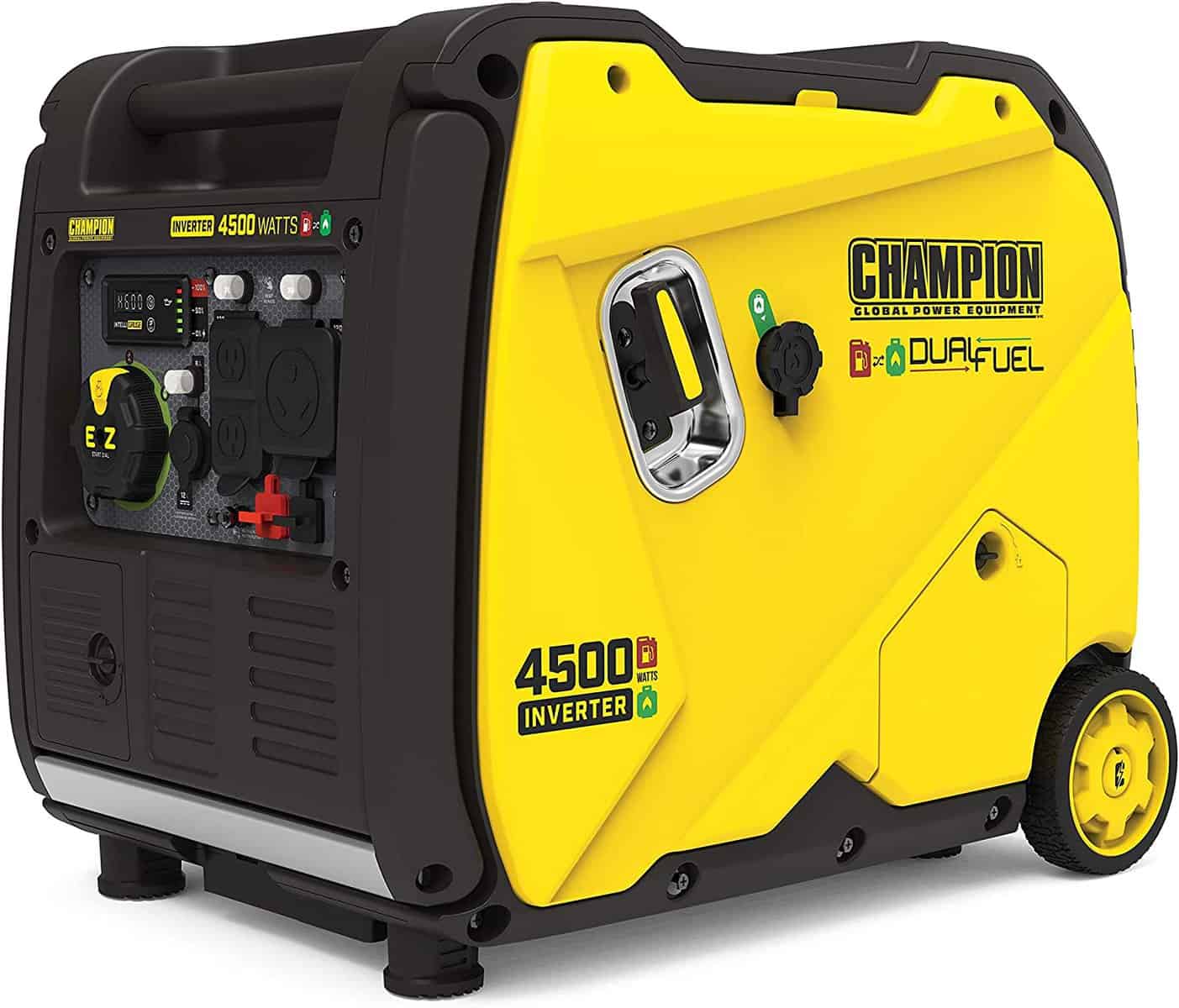
Champion also wins the RV-ready 4500 inverter class in this comparison. The Champion 200988 is rated at 4,500 starting watts and 3,500 running watts on gasoline, with 3,150 running watts on propane. It has electric start, a TT-30R RV-ready outlet, a 61 dBA published sound rating, and published run times of 14 hours at 25% load on gasoline or 21 hours at 25% load on a 20 lb propane bottle.
That’s the class many travel-trailer owners actually need. It’s easier to live with around a campsite than a big open-frame storm generator, and it’s built around RV convenience instead of transfer-switch muscle. Street pricing on the 200988 has recently been in the high-$800s, while Champion’s current-generation 201319 refresh adds CO Shield and is tracked around $905-1,100 by GeneratorBible.
For more detail on that older but still-relevant RV inverter, see our Champion 200988 review. The newer 201319 matters because CO Shield is part of Champion’s current safety story. If you’re buying today, check the exact SKU on the shelf rather than assuming every older box has the same shutoff system.
Check the Champion 200988 price on Amazon →
Champion also publishes a gasoline-only 2500 ultralight sibling, the 200951, rated at 2,500 starting watts and 1,850 running watts in the same 53 dBA class. That gives buyers a lower-complexity door into the ultralight inverter platform if propane isn’t part of the plan. For many campers and homeowners with modest backup needs, that’s more useful than buying far more generator than they’ll ever load.
Champion’s ownership edge is support. Both brands list a 3-year limited warranty, but Champion adds free lifetime technical support. If you’re new to generators, that extra support matters the first time you’re sorting out break-in oil, altitude questions, propane setup, storage, or an outlet issue before a trip.
Head-to-head where both publish numbers
This is where a lot of thin Champion vs Westinghouse comparisons go wrong: they force fake model-for-model fights. We didn’t do that. Where we verified a unit in a class, we show it; where we did not verify a counterpart in this research, we show a dash instead of inventing a rival.
| Use class | Westinghouse verified example | Champion verified example | What the numbers say |
|---|---|---|---|
| Ultralight quiet duty | — | 201122: 2,500 starting watts / 1,850 running watts gasoline; 1,665 running watts propane; 39 lb; 53 dBA | Champion owns the verified ultralight inverter comparison here |
| Big storm watts | WGen9500TFc: 12,500 peak watts / 9,500 running watts gasoline; 9,500 peak watts / 7,500 running watts natural gas | — | Westinghouse owns the verified big tri-fuel storm comparison here |
| Mid open frame | WGen5300DFv: 6,500 peak watts / 5,300 running watts gasoline; 5,800 peak watts / 4,800 running watts propane | — | Westinghouse has the verified watts-per-dollar anchor |
| RV 4500 inverter | — | 200988: 4,500 starting watts / 3,500 running watts gasoline; 3,150 running watts propane; TT-30R; electric start | Champion owns the verified RV inverter comparison here |
The pattern is clear: these brands don’t mirror each other model-for-model in the spec sheets we compared. Westinghouse shows up strongest in open-frame storm machines, while Champion shows up strongest in portable inverter machines. That’s why the honest verdict is split by use case.
We also left out categories we did not verify for this comparison. That includes Westinghouse iGen inverter specs, Champion’s current big open frames, and any unit whose spec sheet we didn’t pull this week. A broader catalog scrape might change some individual matchups, but it wouldn’t change the practical buying split shown here.
Warranty, support and ownership
Warranty terms are close on paper. Westinghouse portable generators carry a 3-year limited warranty through MWE Investments, LLC, according to the warranty statement. Champion also gives a 3-year limited warranty, then adds free lifetime technical support.
That lifetime support is Champion’s clearest ownership advantage. It’s especially useful for inverter buyers, RV owners, and first-time generator owners who may have setup questions long after the purchase receipt is buried in a drawer. A generator that sits most of the year still needs someone to answer questions when it finally has to work.
Westinghouse’s ownership advantage is what comes in the box on the TFc line. The WGen9500TFc ships with both propane and natural-gas hoses, an NPT adapter, oil, funnel, key fob remote, battery charger, and tool kit. Those accessories don’t replace installation planning, but they reduce the pile of add-ons many buyers forget until the storm is close.
CO safety is no longer optional shopping homework. Champion lists CO Shield on current units such as the 201122 and 201319, while Westinghouse lists a CO sensor on the WGen9500TFc. Older or cheaper SKUs in both lineups may lack CO shutoff, so check the exact model number before you buy.
Our own coverage is deeper on Champion. Electric Ninjas has reviewed 14 Champion models and one Westinghouse model, the WGen7500DF. If you’re comparing Westinghouse’s dual-fuel open-frame lane, our Westinghouse WGen7500DF review is the best place to see how we’ve covered that side of the aisle.
Which brand for which buyer
Storm prep on a budget
Pick Westinghouse open frames first. The verified anchor is the WGen5300DFv at 5,300 running watts on gasoline, 4,800 running watts on propane, 120/240V capability, and $759 MSRP. That’s aggressive watts-per-dollar for a homeowner trying to cover outage basics without paying inverter money.
If your load plan includes 240V equipment or a transfer switch, the open-frame Westinghouse side makes more sense than a small Champion inverter. Just be honest about noise, placement, fuel storage, and CO safety. Big open frames belong outdoors, far from doors, windows, vents, and neighbors’ sleeping areas.
RV and travel trailer use
Pick Champion’s 4500 inverter class. The verified 200988 gives you 3,500 running watts on gasoline, 3,150 running watts on propane, electric start, and a TT-30R RV outlet. The 201319 refresh adds CO Shield and sits in the same modern Champion RV-inverter conversation.
That’s the better match for campground life than a large open-frame storm generator. It’s also why Champion shows up often in our dual-fuel inverter generator guide. If your main use is a travel trailer, buy around inverter behavior and RV outlets before chasing maximum surge watts.
Ultralight, tailgate, and quiet backup
Pick the Champion 201122 if you want the smallest verified dual-fuel inverter in this comparison. At 39 lb with a 53 dBA published rating, it fits the jobs where a big generator is more hassle than help. The 34-hour published propane run time at 25% load on a 20 lb bottle is a big deal for low-draw backup.
The catch is capacity. A 2,500-starting-watt inverter is not a whole-house storm machine. It’s for electronics, lights, small appliances, camping loads, and selective emergency use.
Tri-fuel and natural-gas plans
Pick Westinghouse’s TFc line if natural gas is part of your outage plan. The WGen9500TFc is the verified example here, with gasoline, propane, and natural-gas capability, plus the natural-gas hose and NPT adapter in the box. On natural gas, its published rating is 9,500 peak watts and 7,500 running watts.
That setup can make sense for homeowners who don’t want to rotate gasoline cans or haul propane bottles during a long outage. You still need a safe, code-compliant connection and a load plan. The generator being tri-fuel doesn’t magically mean your home’s gas plumbing is ready for it.
Undecided all-rounder
If you’re still stuck, stop choosing by badge and choose by class. Big storm backup points to Westinghouse in this verified comparison. Portable inverter, RV power, and ultralight dual-fuel use point to Champion.
Brand reputation still matters, but class fit matters more. Our broader generator brands guide can help if you’re comparing these value brands against premium and budget alternatives. For this specific Westinghouse vs Champion generator decision, the job should drive the purchase.
Bottom line
Westinghouse vs Champion is a split decision in 2026. Buy Westinghouse for big storm watts, open-frame value, tri-fuel options, remote start, and generous accessory bundles. Buy Champion for inverter generators, dual-fuel ultralights, RV-ready 4500-class models, and free lifetime technical support.
Both are legitimate value brands with 3-year limited warranties. Buy the generator class first and the badge second.
Frequently asked questions
Which is better, Westinghouse or Champion generators?
It’s a split decision. Westinghouse is better for big open-frame storm watts and tri-fuel bundles, while Champion is better for inverters, dual-fuel ultralights, RV-ready 4500-class units, and lifetime technical support. Both carry 3-year limited warranties.
Who actually makes Westinghouse generators?
Westinghouse portable generators are sold under a licensed brand. The line is operated by MWE Investments, LLC of Columbus, Ohio, which is the company named on the warranty statement.
Who makes Champion generators?
Champion generators are made by Champion Power Equipment, an independent company headquartered in Santa Fe Springs, California. Champion was founded in 2003, designs and engineers products in the US, primarily manufactures in China, and has sold more than 4.5 million generators in North America.
Do Westinghouse and Champion have the same warranty?
Both brands offer a 3-year limited warranty. Champion adds free lifetime technical support, while Westinghouse’s TFc line stands out for bundled accessories such as propane and natural-gas hoses, an NPT adapter, oil, funnel, remote, charger, and tool kit.
Are Westinghouse and Champion quality comparable to Honda?
They’re different tiers. Westinghouse and Champion are value brands with strong published specs and CO shutoff on current units, while Honda is the premium benchmark for build pedigree and resale. If you’re shopping strictly for value, Westinghouse and Champion are the more direct comparison.
Which brand is better for an RV?
Champion is the better RV pick in this comparison. Its RV-ready 4500 inverter class includes the 200988 and 201319, with TT-30R RV outlets and electric start. Westinghouse’s verified strength here is larger open-frame and tri-fuel storm units.