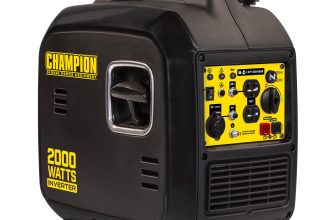
The Champion 201122 is worth buying if you want a storm-kit or tailgate inverter that weighs 39 lb, runs at 53 dBA, and can run up to 34 hours on a 20 lb propane cylinder at 25% load. Big-box pricing moves between roughly $499 and $599, with $599 current at Tractor Supply per GeneratorBible’s price tracker today.
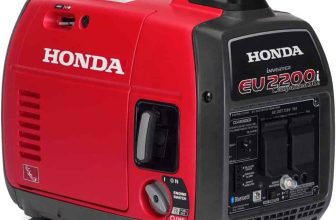
The catch is simple: you get 1,850 running watts on gasoline, 1,665 running watts on propane, one 120V 20A household duplex, no 30A RV outlet, and recoil start only. This is a fridge-and-phones machine, not an RV air-conditioner machine; buy the Champion 200988 if you need RV-ready output and electric start, or the Honda EU2200i if you want the premium gasoline-only benchmark and can stomach the higher price.
Check the Champion 201122 price on Amazon →
Champion 201122 specs at a glance
| Spec | Value |
|---|---|
| Model status | Current CARB-compliant Champion 2500W dual-fuel ultralight platform |
| Gasoline output | 2,500 starting W / 1,850 running W, per Champion’s published specs |
| Propane output | 2,500 starting W / 1,665 running W, per Champion’s published specs |
| Weight | 39 lb |
| Dimensions | 17.3 x 11.5 x 17.7 in. |
| Noise rating | 53 dBA from 23 feet |
| Engine | 79cc Champion OHV four-stroke |
| Start type | Recoil start only |
| Gasoline runtime | Up to 11.5 hours at 25% load on the 1.1-gallon tank |
| Propane runtime | Up to 34 hours at 25% load on a 20 lb propane cylinder |
| Outlets | One 120V 20A household duplex, two 5V/2.1A USB ports, parallel ports |
| Power quality | Less than 3% THD |
| Safety | CO Shield carbon-monoxide auto-shutoff and low-oil shutoff |
| Parallel capability | Parallel capable with Champion’s optional kit, sold separately |
| Warranty and price | 3-year limited warranty plus lifetime technical support; $599 current at Tractor Supply per GeneratorBible’s price tracker today, with a recent range of $499-599 |
The headline specs are the 39 lb weight and the propane runtime. A generator this easy to carry usually gives up fuel flexibility, but the 201122 keeps gasoline and propane in the same small inverter shell.
The power ceiling is still the limiter. Champion’s published 1,850 running watts on gasoline is enough for a refrigerator, lights, chargers, and short appliance use if you manage loads, but it is not enough to act like a full RV pedestal.
Availability is also a little messy online. Amazon commonly stocks Champion’s 2500W ultralight siblings, especially the 200961 non-CO-Shield version and the 201183 Quiet Technology + CO Shield version, rather than a clearly identified 201122 CARB listing. The 201122 itself is easiest to pin down at Champion direct, Lowe’s, Home Depot, or Tractor Supply.
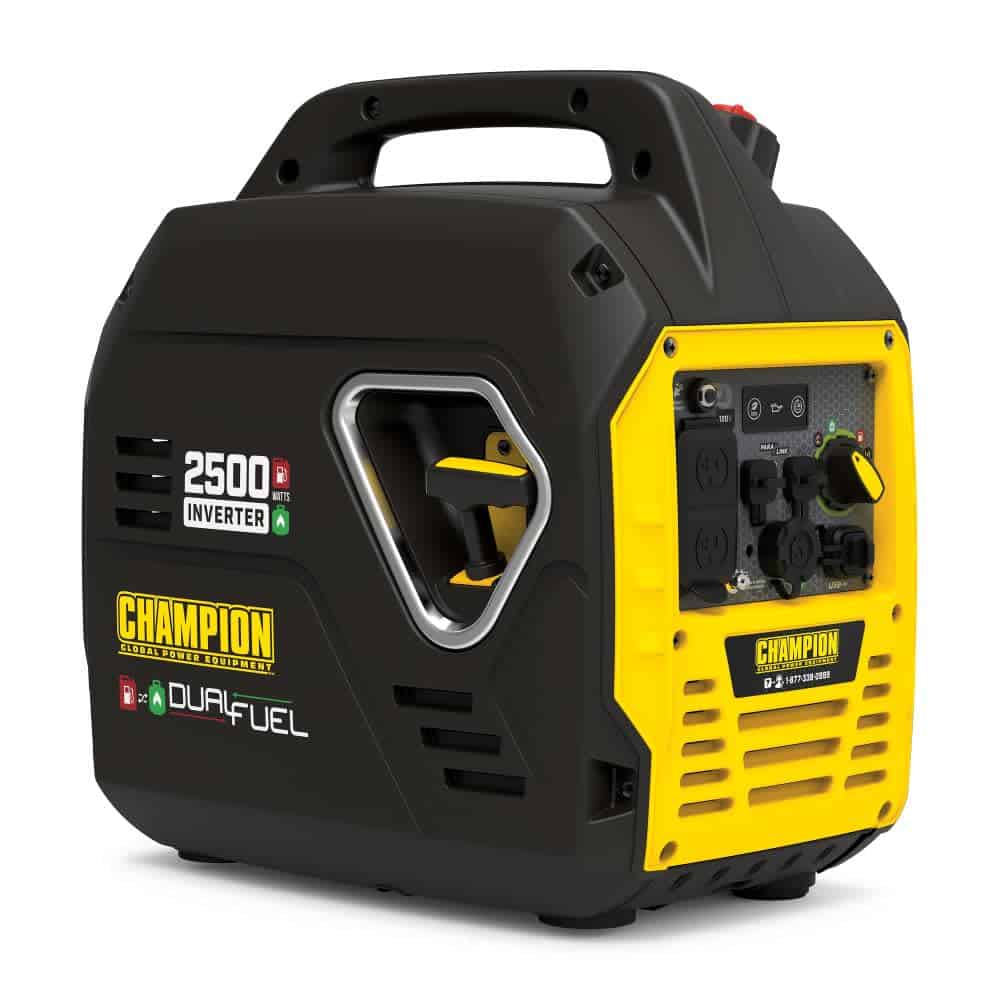
Champion 201122 vs 200951 vs 200988: which Champion should you buy
| Model | Starting/running W gas | Propane running W | Weight | Noise | Start | Key outlet |
|---|---|---|---|---|---|---|
| Champion 201122 | 2,500 / 1,850 W | 1,665 W | 39 lb | 53 dBA | Recoil | 120V 20A household duplex |
| Champion 200951 | 2,500 / 1,850 W | — | — | 53 dBA class | — | — |
| Champion 200988 | 4,500 / 3,500 W | 3,150 W | — | 61 dBA | Electric | RV-ready TT-30R |
The Champion 200951 is the simpler sibling if you want the same gasoline output without the propane hardware. Champion publishes the same 2,500 starting watts, 1,850 running watts, 53 dBA class, and roughly 11.5-hour quarter-load runtime family, and dropping dual fuel usually makes it the cheaper unit on the shelf; no same-day price was verified. Read our Champion 200951 review if you know you will only run gasoline.
Check the Champion 200951 price on Amazon →
The Champion 200988 is the right step-up if your real need is an RV-friendly inverter. Champion’s published specs give it 4,500 starting watts, 3,500 running watts on gasoline, 3,150 running watts on propane, electric start, a TT-30R outlet, a 120V 20A household duplex, and dual USB. It is louder at 61 dBA, but it solves the exact problems the 201122 does not solve.
The 200988 has also recently run in the high-$800s at street pricing, so check the current number before you choose. Champion’s current-generation refresh of that platform is the 201319, which adds CO Shield; both were live at retail when checked today. If you want the bigger Champion, see our Champion 200988 review.
Check the Champion 200988 price on Amazon →
What the Champion 201122 can actually run
| Load | Typical wattage | Verdict on the 201122 |
|---|---|---|
| Refrigerator/freezer | 700 running W + 2,200 additional starting W | Yes, but keep other loads minimal during compressor start |
| Microwave | 1,000 W | Yes, one at a time with room left for small loads |
| Coffee maker | 1,000 W | Yes, one at a time with load discipline |
| Space heater | 1,800 W | Too close on gasoline and over the propane running rating |
| Phone/laptop charging and LED lights | Trivial double-digit loads | Easy fit alongside a managed essential load |
For storm duty, think refrigerator first, then small stuff. By the standard sizing-worksheet figures — 700 running watts plus 2,200 additional starting watts — a refrigerator alone can demand 700 + 2,200 = 2,900 watts for the instant the compressor kicks on, which is over this unit’s 2,500 starting watts on paper. That worksheet surge figure is a conservative reference rooted in older compressors; many current refrigerators start on far less, which is why the 2,000-watt inverter class is sold as fridge-backup gear at all. The honest play is to check your own fridge’s nameplate, keep everything else off when the compressor cycles, and not expect margin.
That is the mistake that gets people into trouble with small inverters. The running watt number looks comfortable until a compressor starts. If you want to model your exact fridge, microwave, coffee maker, and charging loads, use our generator wattage calculator before checkout.
Propane lowers the ceiling. The 201122 drops from 1,850 running watts on gasoline to 1,665 running watts on propane, per Champion’s published specs. A 1,800-watt space heater exceeds the propane running watts on its own, so this is not the generator to run resistance heat from a grill bottle.
The best use pattern is boring and practical: refrigerator, modem or router if needed, LED lights, phones, and short bursts from a 1,000-watt appliance while the fridge is settled. If you want to run a microwave and coffee maker together, or you want heater loads, step up.
Noise, weight, and runtime in the real world
Champion rates the 201122 at 53 dBA from 23 feet. That puts it in quiet-inverter territory for a driveway, campsite edge, or tailgate, as long as you are not parking it right next to a conversation. The sound spec is not as low as Honda’s published EU2200i rating, but it is still much quieter than open-frame jobsite generators.
The 39 lb weight is the reason this machine exists. It is lighter than Honda’s 47.4 lb EU2200i dry weight and far easier to handle than the larger RV-ready Champion class. That matters if the person using the generator has to lift it into a truck bed, move it from a garage shelf, or carry it around the side of the house during an outage.
The runtime numbers are strong, but the load behind them matters. Champion’s gasoline claim is up to 11.5 hours at 25% load on the 1.1-gallon tank. The math is 1.1 gal / 11.5 h = about 0.10 gal per hour at quarter load.
Champion’s propane claim is up to 34 hours at 25% load on a 20 lb propane cylinder. A 20 lb cylinder holds about 4.7 gallons of propane, and 4.7 gal / 34 h = about 0.14 gal per hour at quarter load. On this unit, 25% load is roughly a 460 W draw, so heavier loads shorten runtime substantially.
That propane number is the main storm-kit advantage over a gasoline-only ultralight. Propane stores cleanly, is easy to keep around for a grill, and lets the generator sit ready without relying only on fresh gasoline. For a broader look at the fuel math, read our 20 lb propane runtime guide.
What the 201122 doesn’t have
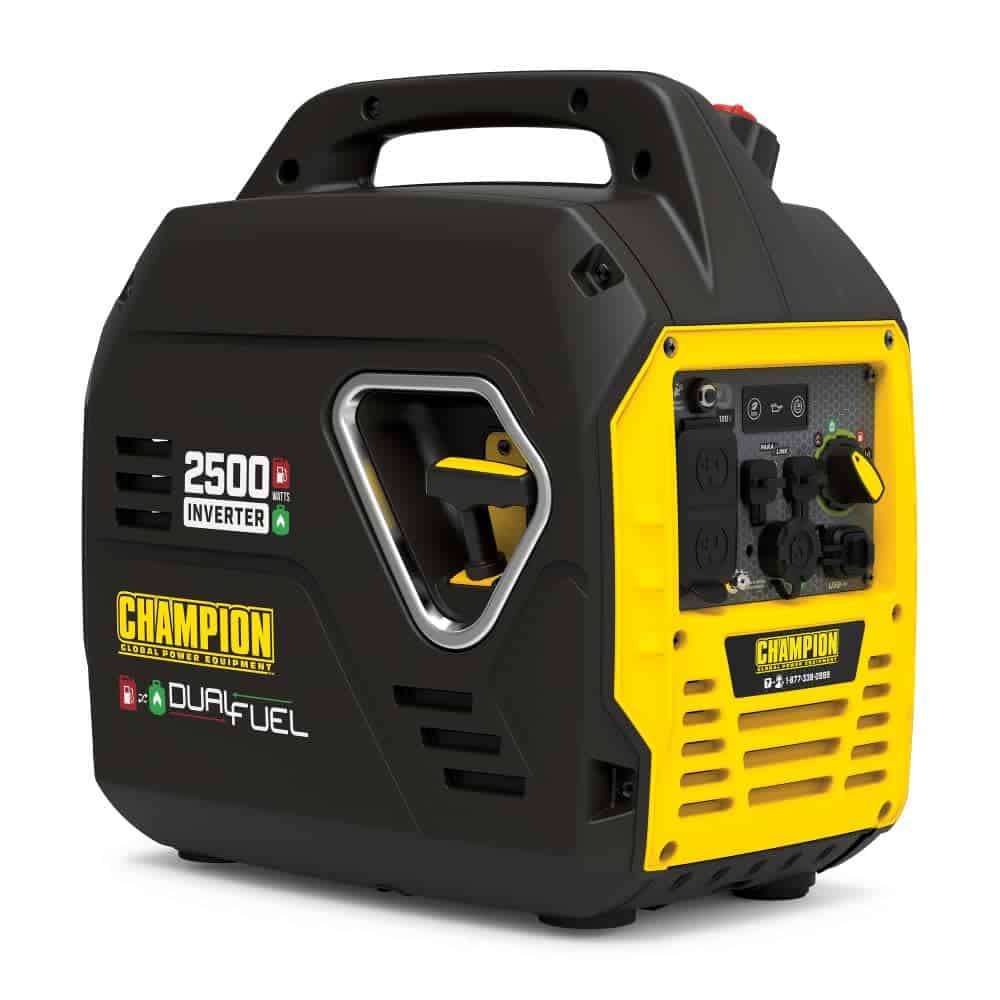
The 201122 does not have electric start. Recoil start keeps weight down and simplifies the package, but it also means you pull the cord every time. If push-button starting matters, the 200988 or 201319 class is the better Champion lane.
It also does not have a 30A RV outlet. The outlet panel gives you one 120V 20A household duplex, two 5V/2.1A USB ports, and parallel ports. That works for extension-cord storm loads and light campsite use, but not for plugging in like a true RV-ready inverter with a TT-30R.
There is no 12V automotive outlet listed in Champion’s published outlet set. That is not a dealbreaker for most homeowners now that the unit has USB ports, but it matters if you still use 12V accessories directly.
The biggest missing feature is not an outlet or a switch. It is headroom. A 1,850-watt gasoline ceiling and 1,665-watt propane ceiling force you to choose loads, and that is why the 201122 belongs in a small-load kit instead of a whole-camper plan.
If you like the low-cost storm-kit idea but want to compare bigger options, our best generator under $1,000 roundup lists the 201122 as the ultralight pick and puts it beside larger alternatives.
How it stacks up against the Honda EU2200i
| Spec | Champion 201122 | Honda EU2200i |
|---|---|---|
| Fuel | Gasoline and propane | Gasoline only |
| Gasoline output | 2,500 starting W / 1,850 running W | 2,200 starting W / 1,800 running W |
| Weight | 39 lb | 47.4 lb dry |
| Noise | 53 dBA from 23 feet | 48 dBA rating |
| Gasoline runtime | Up to 11.5 hours at 25% load on 1.1 gal | 8.1 hours at 25% load on 0.95 gal |
| Carbon-monoxide shutoff | CO Shield | CO-Minder |
| Engine | 79cc Champion OHV four-stroke | GXR120 121cc |
| Connectivity | — | Bluetooth app on current variants |
| Warranty | 3-year limited warranty | 3-year warranty |
| Street price | Roughly $499-$599 big-box range | $997-$1,199 per GeneratorBible’s tracker today |
The Honda EU2200i is still the premium gasoline-only benchmark. Honda buys you the brand’s build pedigree, a published 48 dBA rating, CO-Minder shutoff, Bluetooth app support on current variants, and a 3-year warranty. It also costs roughly double the 201122 based on GeneratorBible’s street-price tracker today.
The Champion fights back with propane flexibility, lower weight, CO Shield, and a much lower buy-in. Its gasoline running output is also slightly higher on paper, though both units live in the same small-inverter load class. If you are shopping this whole category, our dual-fuel inverter generator guide and 2,000-watt generator roundup are the right next stops.
Pick Honda if quietest operation, long-term brand confidence, and app features matter more than fuel flexibility and price. Pick the Champion if your storm plan revolves around stored propane, low weight, and keeping essentials alive without spending Honda money.
Bottom line
Buy the Champion 201122 if you want a 39 lb dual-fuel inverter for storm essentials, tailgates, quiet campsite loads, and propane-ready backup power. It is best for refrigerators, chargers, LED lights, and short appliance use, not for RV air conditioning or heavy heat loads.
Buy the Champion 200951 if you want the same basic gasoline output and expect it to be cheaper on the shelf. Buy the Champion 200988 if you need a TT-30R RV outlet, electric start, and much more running wattage. Buy the Honda EU2200i if you want the premium gasoline-only benchmark and accept the higher price.
Frequently asked questions
Is the Champion 201122 discontinued?
No. The Champion 201122 was verified as a current CARB-compliant model in production in August 2026, with listings at Champion, Lowe’s, Home Depot, and Tractor Supply.
What’s the difference between the Champion 201122, 201183 and 200961?
They are part of Champion’s 2500W ultralight platform. The 201122 is the CARB version, the 201183 is the Quiet Technology + CO Shield version commonly seen on Amazon, and the 200961 is the older version without CO Shield.
Will the Champion 201122 run a refrigerator?
Usually, with load discipline. The standard worksheet figure of 700 running watts plus a 2,200 W starting surge can momentarily exceed the 201122’s 2,500 starting watts on paper, but that surge reference is conservative and many current fridges start on far less. Keep other loads off when the compressor cycles and check your fridge’s nameplate.
How long will the 201122 run on a 20 lb propane tank?
Champion publishes up to 34 hours at 25% load on a 20 lb propane cylinder. On this generator, 25% load is roughly a 460 W draw, and heavier loads shorten runtime substantially.
Is the Champion 201122 parallel capable?
Yes. The 201122 has parallel ports and works with Champion’s optional parallel kit, sold separately, so two compatible units can roughly double available power.
How loud is the Champion 201122 really?
Champion rates it at 53 dBA from 23 feet. That is normal-conversation class for a small inverter, though the Honda EU2200i is quieter on paper with a published 48 dBA rating.
Does the Champion 201122 have electric start?
No. The 201122 is recoil start only; the Champion 200988 and current-generation 201319 step-up class add electric start.