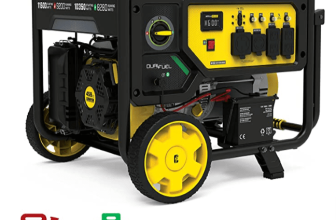
The best dual fuel inverter generator for most RV owners is the Champion 200988: 4,500 starting watts, electric start, 61 dBA, and propane-ready output for a 30A travel trailer. Premium buyers should get the Westinghouse iGen5000DF, while home-backup buyers who need 50A 240V output should look hard at the GENMAX GM9000iED; the full comparison below keeps the inverter category clean.
What counts as a dual fuel inverter generator
A real dual fuel inverter generator runs on gasoline or propane and produces inverter-clean power, usually listed by the maker as under-3% THD. That THD figure matters because it’s the line between clean power for sensitive electronics and the rougher output you get from many conventional portable generators.
This category gets messy because “dual fuel generator” and “dual fuel inverter generator” are not the same thing. A conventional dual-fuel unit can be a strong value for pumps, tools, and emergency circuits, but a conventional alternator is not inverter-clean just because the engine burns propane.
The inverter case is simple: cleaner power, lower noise, and usually less weight for the same practical RV or camping job. If you’re shopping only for the lowest cost per watt and don’t care about under-3% THD output, a conventional dual-fuel generator may still be the better buy.
Every pick here is a true dual-fuel inverter model verified against manufacturer specs and retailer listings in July 2026. That means gasoline and propane capability plus inverter-clean power, not just a propane carburetor on a conventional generator.
Propane vs gasoline: what changes
Gasoline gives these generators their maximum rated output. Propane gives you shelf life, cleaner-running storage, and a fuel that doesn’t gum up carburetors while it sits.
The trade-off is output. Propane has lower energy density, so dual-fuel generators generally derate by roughly 10% on propane compared with gasoline.
| Generator | Gasoline running watts | Propane running watts | Propane runtime reference |
|---|---|---|---|
| Champion 200988 | 3,500 | 3,150 | 21 hr at 25% on a 20-lb propane tank |
| Westinghouse iGen5000DF | 3,900 | 3,500 | 22 hr at 25% propane |
| GENMAX GM9000iED | 7,600 | 7,200 | Not listed in provided specs |
| Champion 200961 | 1,850 | 1,665 | Up to 34 hr at 25% on a 20-lb propane tank |
| Champion 200914 | 3,500 | 3,150 | 21 hr at 25% on a 20-lb propane tank |
That’s why the smartest setup for outages is usually both fuels, not one fuel forever. Keep gasoline for full output, and keep propane for storage and standby use.
A 20-lb grill tank is the common reference point for portable propane runtime claims. For a deeper propane-planning breakdown, see our guide to how much propane a generator uses.
The 5 best dual fuel inverter generators for 2026
Champion 200988 4500W dual fuel inverter: best overall for RVs
| Spec | Champion 200988 |
|---|---|
| Gas watts | 4,500 starting / 3,500 running |
| Propane watts | 4,500 starting / 3,150 running |
| Engine | 212cc |
| Noise | 61 dBA |
| Weight | 103 lb |
| Runtime | 14 hr at 25% gas / 21 hr at 25% on a 20-lb propane tank |
| Fuel tank | 2.25-gal |
| Outlets | RV-ready 30A outlet |
| Start | Electric start + Cold Start |
| Power quality | Under-3% THD |
The Champion 200988 is the default answer for a 30A travel trailer because it hits the sweet spot: 4,500 starting watts, 3,500 running watts on gas, and a built-in RV-ready 30A outlet. On propane, Champion’s published numbers show the expected derate to 3,150 running watts, while still keeping the same 4,500 starting-watt rating.
It’s not the lightest unit here at 103 lb, but the electric start and Cold Start setup make it friendlier than small pull-start-only models. If you’re sizing power for an RV air conditioner, converter, fridge, and basic outlets, start with this model and compare it against our broader travel trailer generator guide.

Champion Power Equipment 200988 4500-Watt Dual Fuel RV Ready Portable Inverter Generator, Electric Start
Check current price on Amazon →
Westinghouse iGen5000DF: best premium dual fuel inverter with remote start
| Spec | Westinghouse iGen5000DF |
|---|---|
| Gas watts | 5,000 peak / 3,900 running |
| Propane watts | 4,500 peak / 3,500 running |
| Engine | 224cc |
| Noise | 52 dBA |
| Weight | 104.7 lb |
| Runtime | 18 hr at 25% gas; 15 hr at 50% gas; 22 hr at 25% propane |
| Fuel tank | 3.4-gal steel tank |
| Outlets | TT-30R + two 20A 5-20R + two USB-A |
| Start | Key-fob remote start |
| Power quality | Under-3% THD |
The Westinghouse iGen5000DF is the premium pick if quiet operation and remote start are high on your list. Per Westinghouse’s published figures, it makes 5,000 peak watts and 3,900 running watts on gasoline, then steps down to 4,500 peak watts and 3,500 running watts on propane.
The 52 dBA rating is the quietest published figure in this lineup, and the key-fob remote start is the feature that makes it feel like a higher-end RV or cabin generator. The outlet panel is also strong for this size: TT-30R, two 20A 5-20R outlets, and two USB-A ports.
This is the refreshed successor to the popular iGen4500DF line, so it keeps the quiet enclosed-inverter idea but moves into the iGen5000DF spec set. At about $949 with CARB and EPA compliance plus a 3-yr warranty, it’s the polished choice rather than the bargain choice.
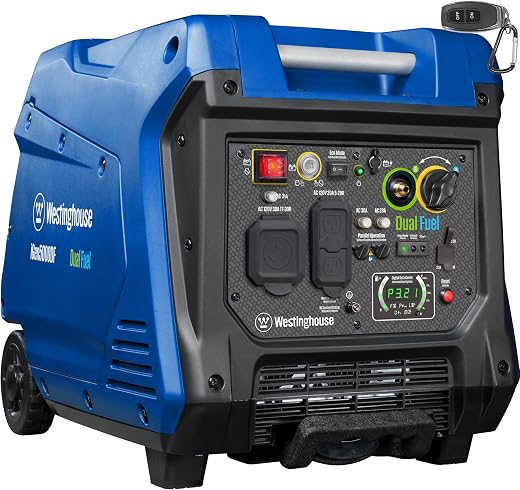
Westinghouse 4500 Peak Watt Super Quiet Dual Fuel Portable Inverter Generator, Remote Electric Start, Gas & Propane Powered, RV Ready 30A Outlet, Parallel Capable
Check current price on Amazon →
GENMAX GM9000iED: best big inverter for home backup
| Spec | GENMAX GM9000iED |
|---|---|
| Gas watts | 9,000 starting / 7,600 running |
| Propane watts | 8,550 starting / 7,200 running |
| Engine | 458cc |
| Noise | 62 dBA, per GENMAX’s published figure |
| Weight | Not listed in provided specs |
| Runtime | Not listed in provided specs |
| Outlets | 120/240V 50A L14-50R + 120/240V 30A L14-30R + four GFCI 120V 20A 5-20R + USB |
| Start | Remote start |
| Safety and display | CO Detect auto-shutoff + LCD data center |
| Parallel rating | Two units: 18,000 peak / 15,200 running |
The GENMAX GM9000iED is here because it does something rare: it gives you inverter-clean power with 120/240V 50A output. That makes it the right kind of portable inverter to consider for a transfer-switch home-backup setup, not just an RV cord and a few extension cords.
Use that 50A outlet only through a proper transfer switch or approved inlet setup. Backfeeding a house is dangerous, and a generator this size belongs behind the right hardware.
On gas, the GM9000iED is rated at 9,000 starting watts and 7,600 running watts. On propane, GENMAX lists 8,550 starting watts and 7,200 running watts, so it keeps most of its capacity while giving you the long-storage fuel option.
GENMAX’s published noise figure is 62 dBA, which is low for this much output on paper. It also brings CO Detect auto-shutoff, an LCD data center, remote start, and parallel capability for two units rated at 18,000 peak watts and 15,200 running watts.
Check current price on Amazon →
Champion 200961 2500W dual fuel ultralight: best ultralight camping pick
| Spec | Champion 200961 |
|---|---|
| Gas watts | 2,500 starting / 1,850 running |
| Propane watts | 1,665 running |
| Engine | 79cc |
| Noise | 53 dBA |
| Weight | 39 lb |
| Runtime | Up to 11.5 hr gas / up to 34 hr at 25% on a 20-lb propane tank |
| Fuel tank | 1.05-gal |
| Outlets | Two 5-20R + USB |
| Controls | Fuel selector dial + Cold Start |
The Champion 200961 is the one to buy when carrying weight matters more than running a big RV load. At 39 lb, it’s the ultralight pick for camping, tailgating, and small-device backup where you want quiet inverter power and propane flexibility.
Its gasoline rating is 2,500 starting watts and 1,850 running watts. On propane, Champion lists 1,665 running watts, so this is not a 30A trailer workhorse; it’s a compact power source for lights, charging, fans, and smaller camping loads.
The runtime story is strong if your load is modest. Champion lists up to 11.5 hr on gas and up to 34 hr at 25% on a 20-lb propane tank, which is exactly why small propane inverter generators make sense for camping storage.
The gas-only sibling is the Champion 200951, which we cover separately in our Champion 200951 review. Pick the 200961 when you want the same small-generator idea with propane added.
Check current price on Amazon →
Champion 200914 4250W open-frame inverter: best open-frame value
| Spec | Champion 200914 |
|---|---|
| Gas watts | 4,250 starting / 3,500 running |
| Propane watts | 4,250 starting / 3,150 running |
| Engine | 224cc |
| Noise | 64 dBA |
| Runtime | 22 hr at 25% gas / 21 hr at 25% on a 20-lb propane tank |
| Fuel tank | 4-gal |
| Outlets | TT-30R + two 5-20R + 12V DC with dual USB |
| Propane hose | 6-ft propane hose with regulator included |
| Power quality | Under-3% THD |
The Champion 200914 is the value play: same useful RV-class output as enclosed premium models, but in an open-frame inverter package. Champion rates it at 4,250 starting watts and 3,500 running watts on gas, then 4,250 starting watts and 3,150 running watts on propane.
The trade-off is noise. At 64 dBA, it’s louder than the enclosed models here, so it’s a better fit for budget RV power, jobsite-adjacent use, and spread-out camping than for tight campgrounds.
The outlet package is practical: TT-30R, two 5-20R outlets, and 12V DC with dual USB. Champion also includes a 6-ft propane hose with regulator, which matters because some dual-fuel listings leave that detail for the buyer to sort out.
The gas-only sibling is the Champion 201056, covered in our Champion 201056 review. Choose the 200914 if you want that open-frame inverter value with propane capability built in.
Check current price on Amazon →
Comparison table
| Model | Gas start/run | Propane run | Noise | Weight | RV/240V outlets | Start type |
|---|---|---|---|---|---|---|
| Champion 200988 | 4,500 / 3,500 | 3,150 | 61 dBA | 103 lb | RV-ready 30A outlet | Electric start + Cold Start |
| Westinghouse iGen5000DF | 5,000 / 3,900 | 3,500 | 52 dBA | 104.7 lb | TT-30R | Key-fob remote start |
| GENMAX GM9000iED | 9,000 / 7,600 | 7,200 | 62 dBA | Not listed in provided specs | 120/240V 50A L14-50R + 120/240V 30A L14-30R | Remote start |
| Champion 200961 | 2,500 / 1,850 | 1,665 | 53 dBA | 39 lb | None listed | Cold Start listed |
| Champion 200914 | 4,250 / 3,500 | 3,150 | 64 dBA | Not listed in provided specs | TT-30R | Not listed in provided specs |
Which one should you buy?
For a 30A travel trailer, buy the Champion 200988. It has the RV-ready 30A outlet, 4,500 starting watts, and 3,500 running watts on gasoline, with propane output still strong at 3,150 running watts.
For quiet premium RV or cabin power, buy the Westinghouse iGen5000DF. Its 52 dBA published rating is the quietest in this group, and the key-fob remote start is the feature you’ll appreciate when the weather turns ugly.
For home backup with 240V circuits, buy the GENMAX GM9000iED and wire it through a proper transfer switch. The 120/240V 50A outlet is the reason it stands apart from the smaller RV-focused inverters here.
For lightweight camping and tailgating, buy the Champion 200961. The 39-lb weight and 53 dBA rating make it the easiest pick to carry and live near, as long as you’re honest about its 1,850 running watts on gas and 1,665 running watts on propane.
For budget RV power, buy the Champion 200914. You get 3,500 running watts on gas, 3,150 running watts on propane, a TT-30R outlet, and a 6-ft propane hose with regulator included; you just accept the 64 dBA open-frame noise.
Running on propane: practical notes
Propane hookup is usually straightforward: connect the hose and regulator to a 20-lb tank, open the valve, select propane at the generator, and start it according to the maker’s procedure. The Champion 200914 specifically includes a 6-ft propane hose with regulator, which saves one common accessory purchase.
Cold weather can reduce propane vapor pressure, especially as tanks get low. Keep tanks fuller when you expect hard starting conditions, and don’t assume the last bit of propane in a grill tank will behave like a full tank on a cold morning.
Storage is where propane earns its keep. It stores indefinitely and doesn’t gum carburetors, so it’s the fuel you want sitting beside the generator between outages.
Gasoline still matters because it gives the maximum rated output on every model in this guide. If you store gasoline in the generator or fuel can, follow a proper shutdown and storage routine; our generator winterizing guide walks through the storage side.
Bottom line
Buy the Champion 200988 if you want the best all-around dual fuel inverter generator for an RV or emergency portable power. Buy the Westinghouse iGen5000DF if you want the quietest premium pick here with remote start, and buy the GENMAX GM9000iED if your home-backup plan needs 50A 240V output through a proper transfer switch.
Choose the Champion 200961 for the lightest camping setup, or the Champion 200914 if you want open-frame inverter value and can live with 64 dBA. Want natural gas too? Step up to our best tri-fuel generators guide instead.
Frequently asked questions
Are dual fuel inverter generators worth it?
Yes, if you want outage flexibility and clean inverter power. Gasoline gives the maximum rated output, while propane stores indefinitely and doesn’t gum carburetors. The trade-off is that propane usually derates output by roughly 10%.
How much power do you lose running propane?
Expect roughly 10% less running output on propane. For example, the Champion 200988 is rated at 3,500 running watts on gas and 3,150 running watts on propane, while the Westinghouse iGen5000DF is rated at 3,900 running watts on gas and 3,500 on propane.
How long will a dual fuel inverter run on a 20-lb propane tank?
Among the picks with published 20-lb propane figures, runtime ranges from 21 hr to 34 hr at 25% load. The Champion 200988 and Champion 200914 list 21 hr at 25%, the Westinghouse iGen5000DF lists 22 hr at 25%, and the Champion 200961 lists up to 34 hr at 25%.
What’s the difference between a dual fuel generator and a dual fuel inverter generator?
A dual fuel generator runs on gasoline or propane. A dual fuel inverter generator also produces inverter-clean power, usually listed as under-3% THD, which is better for sensitive electronics. Inverter models are also typically quieter and more portable than conventional dual-fuel units.
Can a dual fuel inverter power a house?
Yes, if it has the right output and is connected correctly. The GENMAX GM9000iED has 120/240V 50A output and is the home-backup pick here, but it should be used only through a proper transfer switch or approved inlet setup.
What’s the quietest dual fuel inverter generator?
From these picks, the Westinghouse iGen5000DF is the quietest with a published 52 dBA rating. The Champion 200961 is close behind at 53 dBA, but it’s a much smaller 2,500-watt class generator.
Do dual fuel generators run on natural gas?
No. In this category, dual fuel means gasoline and propane. If you want gasoline, propane, and natural gas, shop for a tri-fuel generator instead.