The DeWalt DXGN4500 is a Honda-powered 4,200-running-watt jobsite generator that can still make sense at a clear remaining-stock or used discount. DeWalt has moved on: its U.S. product page no longer serves, current spec databases no longer show it as a current model, and DeWalt’s active portable line is now the DXGNR series.
For tools, pumps, lights, and rough jobsite power, the DXGN4500 is still a tough machine built around the Honda GX270 engine. For transfer-switch home backup, I’d pass unless the price is very strong, because its 120/240V locking outlet is only 20 amps and most modern transfer-switch inlets are L14-30.

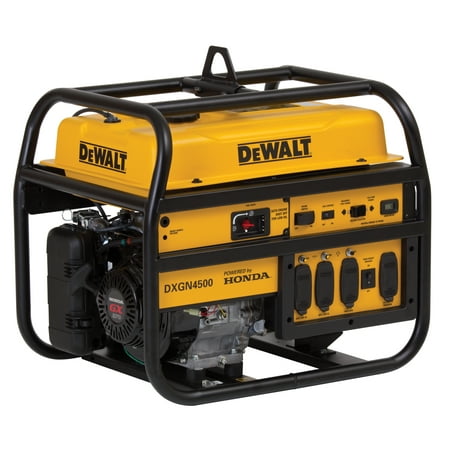
DeWALT DXGN4500 - 4 500-Watt Gas Powered Portable Generator 49 ST / CSA PD422MHI005
DeWalt DXGN4500 specs at a glance
The DXGN4500 sits in the older DeWalt contractor-generator family: steel frame, lifting hook, GFCI-protected 120V outlets, and a commercial Honda engine. It’s not an inverter and it’s not built for quiet campground use.
The key spec is the combination of 4,500 starting watts and 4,200 running watts, per DeWalt’s published sheet as preserved in dealer listings and spec databases checked in July 2026. That’s enough for many jobsite loads and basic emergency circuits, but the outlet panel matters just as much as the wattage number.
| Spec | Value |
|---|---|
| Starting watts | 4,500 watts |
| Running watts | 4,200 watts |
| Voltage | 120/240V |
| Engine | Honda GX270 commercial OHV, 270cc |
| Horsepower | 8.5 hp per DeWalt’s sheet |
| Starting system | Recoil start |
| Low-oil shutdown | Yes |
| Fuel tank | 7-gallon steel tank with fuel gauge |
| Runtime | Up to 15 hours at 50% load |
| Noise rating | 76 dBA |
| Dry weight | 160 lb |
| Frame | Steel frame with lifting hook |
| 120V outlets | Two 120V 20A GFCI duplexes, four 5-20R sockets total |
| 120V locking outlet | One 120V 30A L5-30R |
| 120/240V locking outlet | One 120/240V 20A L14-20R |
| Outlet covers | All outlets covered |
| Breakers | Hydraulic/magnetic circuit breakers |
| Idle control | Yes |
| Hour meter | Digital hour meter |
| Total harmonic distortion | Under 6% |
| Emissions | EPA and CARB compliant |
| Warranty when sold new | 3-year limited warranty |
| Typical new street class | Roughly $1,800 class when it sold new |
The outlet panel is very jobsite-friendly. The covered GFCI duplexes are what you want around tools, cords, damp slabs, and remodel work, and the L5-30R gives you a stronger 120V locking connection than a standard household-style plug.
The weak spot is the L14-20R. It gives you 120/240V capability, but it’s a 20-amp outlet, not the L14-30R many homeowners expect on a transfer-switch generator.
What 4,200 running watts can power
At 4,200 running watts, the DXGN4500 can cover a practical emergency load if you manage startup surge. A fridge listed at 700 running watts and 2,200 surge watts plus a 1/2 HP sump pump listed at 1,050 running watts and 2,150 surge watts puts the steady draw at 1,750 watts before you add a furnace fan, lights, and phone chargers.
| Load | Running watts | Surge watts |
|---|---|---|
| Fridge | 700 | 2,200 |
| 1/2 HP sump pump | 1,050 | 2,150 |
| Fridge plus sump pump running | 1,750 | 4,350 if both surge together |
That worksheet shows the real trick with a generator this size: running wattage usually isn’t the problem, startup timing is. If the fridge and sump pump both start at the same instant, the combined surge can crowd the generator, so keep loads staggered where you can.
On a jobsite, the DXGN4500 fits the old-school contractor role well. A circular saw in the 1,400- to 1,800-watt range plus compressor duty is exactly the kind of mixed load that made Honda GX-powered open-frame generators popular with crews.
The 120/240V outlet needs a blunt explanation. The L14-20R is a 20-amp receptacle, which means 4,800 watts of theoretical pass-through at 240V, but the generator itself is rated for 4,200 running watts. Most transfer-switch inlets are L14-30, so this is not the cleanest fit for a modern home-backup setup.
If you’re sorting out plug shapes, amp ratings, and locking connectors, our portable generator receptacle guide explains the common outlets without the catalog jargon. Never backfeed a house through a dryer outlet or any other improvised connection; use proper transfer equipment.
For RV use, the DXGN4500 is workable but not RV-ready. It does not have a TT-30R outlet, so the 30-amp RV workaround is an L5-30P-to-TT-30R adapter, and that is 120V only.

The Honda GX270 engine
The engine is the main reason the DXGN4500 still deserves a look. Per DeWalt’s published sheet, it uses a Honda GX270 commercial OHV engine with 270cc displacement and an 8.5 hp rating.
The GX series has a strong jobsite reputation because it’s built for long service, steady governed speed, and parts availability. In this class, the GX270’s cast-iron-sleeve durability and broad parts support matter more than flashy controls.
Starting is recoil-only. That keeps the system simple, but it also means there’s no push-button start and no battery to save you if the pull cord, carburetor, or fuel system has been neglected.
Low-oil shutdown is included, which is a good safeguard on a generator that may be used by several people on a crew. Still, shutdown protection is not a maintenance plan; check the oil before real work, especially on used machines with unknown service history.
For oil selection and service basics, use our generator oil guide before guessing at viscosity or grabbing whatever is on the shelf. The engine is the expensive part of this machine, and clean oil is cheap insurance.
The electrical side is less refined than a modern inverter. DeWalt’s preserved spec sheet lists total harmonic distortion under 6%, which is fine for most tools and basic loads, but this is not the sensitive-electronics choice.

Fuel, runtime, and noise
The DXGN4500 uses a 7-gallon steel fuel tank with a fuel gauge. DeWalt’s published runtime figure is up to 15 hours at 50% load.
That works out to about 0.47 gallons per hour: 7 gallons divided by 15 hours equals 0.47 gallons per hour. Real runtime changes with load, fuel quality, altitude, maintenance, and how often the generator sits near its rated output.
Idle control helps. When there’s no load, the engine can drop revs instead of sitting at full governed speed, which saves fuel and cuts some noise during gaps in tool use.
Do not mistake that for quiet-generator behavior. The DXGN4500 is rated at 76 dBA, which puts it firmly in jobsite-machine territory rather than campground-friendly territory.
That noise level is normal for older open-frame contractor generators, especially with a steel frame and a commercial engine. It’s tolerable around saws, pumps, and outdoor work, but it’s not what most RV parks or close neighbors want to hear for long stretches.
End of the line: what it means for buyers
The DXGN4500 is end-of-line. DeWalt’s U.S. product page no longer serves and redirects to the homepage, verified July 30, 2026, and current spec databases no longer list it among current DeWalt models.
That doesn’t mean every unit vanished. Remaining stock is still sold at some contractor-supply dealers, and used units will keep showing up because these generators were bought for work, not display.
New-old-stock pricing is the tricky part. The DXGN4500 lived in roughly the $1,800 street-price class when it sold new, but remaining-stock pricing varies, so check current listings instead of assuming old pricing still applies.
The warranty matters, too. DeWalt listed a 3-year limited warranty when sold new, but warranty coverage runs from original purchase, so a used unit may have little or no practical warranty left.
Parts outlook is split. Honda GX270 engine parts should be easier to source because the engine platform is common, but generator-end parts and DeWalt-specific panel pieces can be thinner on an end-of-line model.
On a used DXGN4500, start with the hour meter. A high-hour machine isn’t automatically bad if it was maintained, but a low-hour machine with stale fuel, varnish smell, and dirty oil can be worse than a well-used unit that was serviced on schedule.
Test the GFCI outlets with the built-in test buttons and a proper plug-in tester. Then check output under load, not just with the engine running and nothing connected.
Look at oil condition, fuel condition, frame damage, missing outlet covers, breaker behavior, and whether idle control responds correctly. If the seller won’t let you see it run a real load, price it like a repair project.
Current alternatives worth cross-shopping
DeWalt’s current successor class is the DXGNR4000, a 4,500-starting-watt and 4,000-running-watt model with CO Protect and idle control sold through Home Depot. If you want a current-line DeWalt instead of remaining DXGN4500 stock, that’s the natural place to start.
For home transfer-switch duty, the outlet issue is the bigger deal than brand loyalty. A DXGN6000-class generator with a real L14-30R is the better transfer-switch machine, and our DeWalt DXGN6000 review explains that step-up path.
The Champion 200988 is a better fit if you need cleaner, quieter mixed home and RV power. Champion’s published figures list 4,500 starting watts, 3,500 running watts on gas, 3,150 running watts on propane, and 61 dBA, and it’s an RV-ready open-frame inverter with dual fuel.
Check the Champion 200988 price on Amazon →
The Briggs & Stratton Q6500 is the step-up pick if you want more wattage and much lower noise than the old open-frame class. It’s a 6,500-starting-watt quiet inverter, which makes it a stronger home-backup choice for buyers who care about neighbor-friendly sound and cleaner power.
Check the Briggs & Stratton Q6500 price on Amazon →
If you’re shopping DeWalt because of the yellow-and-black lineup, also look at our DeWalt DXGNi2200 review. It’s a different category than the DXGN4500, but it shows where DeWalt’s inverter-style portable power fits.
Honda loyalists should compare the smaller jobsite inverter side, too. Our Honda EB2200i review covers a Honda-powered jobsite inverter with GFCI protection for buyers who want cleaner portable power over raw open-frame output.
Shoppers who realize they don’t need a 4,200-running-watt jobsite unit should step back and compare the middle class. Our best 3000-watt generators roundup is a better starting point for lighter RV, camping, and small-backup loads.
| Model | Best fit | Published power figures | Key advantage |
|---|---|---|---|
| DeWalt DXGN4500 | Remaining-stock or used jobsite buy | 4,500 starting / 4,200 running | Honda GX270 engine |
| DeWalt DXGNR4000 | Current-line DeWalt shopper | 4,500 starting / 4,000 running | CO Protect and idle control |
| Champion 200988 | Mixed home and RV duty | 4,500 starting / 3,500 gas running / 3,150 propane running | Open-frame inverter, dual fuel, RV-ready |
| Briggs & Stratton Q6500 | Quieter home backup step-up | 6,500 starting | Quiet inverter design |
Maintenance basics for owners
If you already own a DXGN4500, treat it like a commercial-engine generator, not a disposable appliance. The Honda GX270 is the asset, and it will reward basic upkeep.
Follow Honda’s oil schedule for the GX270 and check oil before use. Low-oil shutdown helps prevent disaster, but it can’t fix old oil, low oil that isn’t low enough to trip the sensor, or a machine run hard between service checks.
Fuel care is just as important. Old gasoline is one of the fastest ways to turn a good pull-start generator into a no-start headache, especially if the carburetor sits with untreated fuel in it.
If the generator is going to sit through the off-season, use our generator winterizing guide and put it away correctly. Stale-fuel prevention is cheaper than carb cleaning and easier than hunting parts during an outage.
Run the generator under load often enough to keep it ready. No-load exercise tells you the engine starts, but a real load tells you the generator end, breakers, receptacles, and governor are doing their jobs.
Test the GFCI outlets monthly. Those outlets are part of the reason this generator made sense on jobsites, and they should trip and reset correctly before you trust them around cords and wet work areas.
Keep the outlet covers intact. Covered receptacles are part of DeWalt’s spec for this model, and missing covers are a sign the unit has had a hard life or lazy maintenance.
Bottom line
Buy the DeWalt DXGN4500 only if the remaining-stock or used price reflects that it’s end-of-line. As a 4,200-running-watt Honda GX270 jobsite generator, it’s still a solid tool-power machine.
Skip it as your first choice for a transfer-switch home-backup setup unless you’re comfortable with the L14-20R limitation. For that job, a current generator with an L14-30R is the cleaner buy.
Frequently asked questions
Is the DeWalt DXGN4500 discontinued?
Yes. The DXGN4500 is end-of-line: DeWalt’s U.S. product page no longer serves and redirects to the homepage, verified July 30, 2026. Current spec databases no longer list it among current DeWalt models, and DeWalt’s current portable line is the DXGNR series.
Who makes the DeWalt DXGN4500’s engine?
The DXGN4500 uses a Honda GX270 commercial OHV engine. DeWalt’s published sheet lists it as a 270cc engine rated at 8.5 hp.
How long will the DeWalt DXGN4500 run on a tank?
DeWalt’s published runtime figure is up to 15 hours at 50% load. The tank is 7 gallons, which works out to about 0.47 gallons per hour at that rated load.
Can the DeWalt DXGN4500 power a house?
It can power basic loads through proper transfer equipment, such as a fridge, sump pump, furnace fan, lights, and phone chargers if you manage startup surge. The catch is the 120/240V outlet is a 20-amp L14-20R, while many transfer-switch inlets are L14-30, so a generator with an L14-30R is usually the better home-backup pick.
Is the DeWalt DXGN4500 RV-ready?
No. It does not have a TT-30R RV outlet. The workaround is an L5-30P-to-TT-30R adapter for 30-amp RV use, but that setup is 120V only.
Is the DeWalt DXGN4500 quiet?
No. DeWalt’s published figure is 76 dBA, which puts it in jobsite-generator territory. It’s not a campground-friendly inverter.
Is a used DeWalt DXGN4500 worth buying?
It can be, but only at the right price and after a real inspection. Check the hour meter, GFCI function, output under load, oil condition, fuel condition, outlet covers, and idle control before buying. Remember that the 3-year limited warranty runs from original purchase, so a used unit may not have useful warranty coverage left.