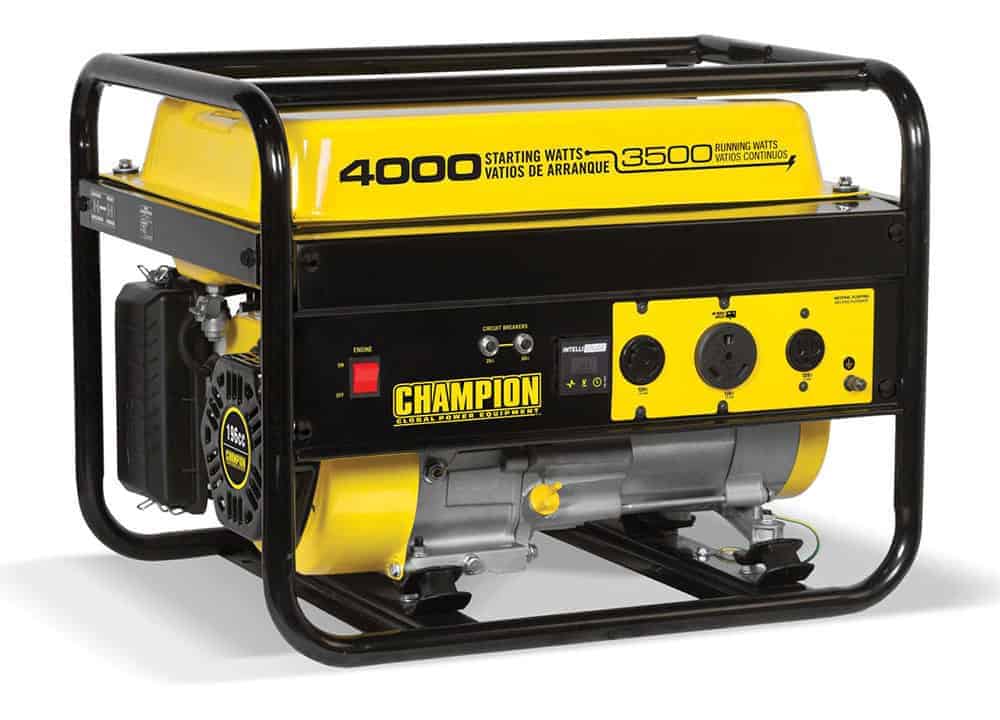
The Champion 46596 is discontinued, but it’s still a useful 4,000-starting-watt, 3,500-running-watt RV-ready generator if you already own one or find a clean used unit. My take: $200-300 territory feels fair for a low-hours, well-kept example, but anyone buying new should skip the hunt and get Champion’s current 201286 with CO Shield instead.
This was the sub-$500 open-frame Champion that showed up everywhere because it did the simple jobs right: run a 30-amp RV outlet, start a 13,500 BTU rooftop AC, and power basic home backup loads without fancy electronics. It is not an inverter, it has no CO-shutoff sensor, and most used units are long past any meaningful warranty support.

Champion 46596 specs at a glance
The 46596 was a conventional 120V portable generator built around a 196cc Champion OHV engine. The key draw was simple: 3,500 running watts, a real TT-30R RV outlet, and a fuel tank Champion dealer listings showed as good for up to 12 hours at 50% load.
| Spec | Champion 46596 |
|---|---|
| Starting watts | 4,000W |
| Running watts | 3,500W |
| Voltage | 120V |
| Engine | 196cc Champion OHV 4-stroke |
| Start type | Recoil start |
| Fuel tank | 3.8-gallon steel tank |
| Runtime | Up to 12 hours at 50% load |
| Noise rating | 68 dBA at 23 feet |
| Weight | 99.2 lb |
| Wheels | 6-inch never-flat wheels |
| Outlets | 120V 20A duplex 5-20R, 120V 30A L5-30R, 120V 30A RV TT-30R |
| Meter | Intelligauge-style volts, frequency, and run hours |
| Safety features | Low-oil shutoff, USDA-approved spark arrestor |
| Emissions | EPA-certified, 49-state, not CARB |
| Warranty when new | 3-year limited warranty |
Those numbers are from Champion dealer listings checked in July 2026, including Power Equipment Direct and Norwall. The important buying point is that the 46596 was never a quiet inverter generator; it was a standard AVR open-frame unit meant for RV AC loads, refrigerators, pumps, and tools.
Is the Champion 46596 discontinued?
Yes. Champion dealer listings confirmed the 46596 as discontinued in July 2026, so you should treat any “new” listing carefully unless it’s old stock, a refurb, or a marketplace seller using stale catalog data.
Discontinued does not mean useless. It means no normal new retail pipeline, limited dealer inventory, and no reason to expect a used purchase to carry meaningful warranty value even though the generator originally came with a 3-year limited warranty.
Parts are still the bright spot. The 46596 used a basic 196cc Champion OHV engine and common open-frame hardware, so normal wear parts and support are still handled through Champion’s support network.
The situation is similar to other older Champion models that still make sense used but don’t make sense as a new-generator target. We handled the same kind of discontinued-model decision in our Champion 100110 review.
What can it still run?
The Champion 46596 gives you 3,500 running watts and 4,000 starting watts. That’s enough for the classic entry-level RV job: starting and running a 13,500 BTU rooftop air conditioner while still leaving usable headroom for light loads.
Use the worksheet numbers this way. A 13,500 BTU RV rooftop AC needs about 2,800-3,000 watts to start and roughly 1,300-1,500 watts to run, so the 46596 fits that load without being right on the edge.
Once the AC is running, you still have room for the RV fridge and lights if you’re not stacking every heavy appliance at the same time. That’s why this generator became a common 30-amp RV choice: not because it was fancy, but because the math worked.
For home backup, think basic circuits and manual load management. A 700W fridge, sump pump, furnace blower, and power tools one at a time are realistic targets for a 3,500-running-watt generator.
What you shouldn’t do is treat it like a whole-house standby unit. If you want help matching RV loads to generator size, our 30-amp RV generator sizing guide walks through that decision without overselling wattage.
The RV-ready panel
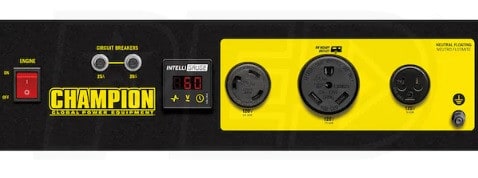
The best feature on the 46596 is the outlet panel. Champion gave it a 120V 30A RV TT-30R receptacle, so a standard 30-amp RV cord plugs in directly without a stack of adapters.
It also has a 120V 30A L5-30R twist-lock and a 120V 20A duplex 5-20R. That setup makes it flexible for campgrounds, jobsite use, and emergency home loads through the right transfer equipment.
The honest warning is power quality. The 46596 is not an inverter generator, does not have a quiet mode, and should not be described with low-THD inverter claims.
Standard AVR output is fine for an RV air conditioner, refrigerator, furnace blower, sump pump, and corded tools. For sensitive electronics, use a quality surge protector or UPS, especially with computers, networking gear, or anything you can’t afford to lose.
Noise is the other tradeoff. At 68 dBA from 23 feet per Champion dealer listings, it’s normal open-frame generator noise, not modern inverter-generator noise.
Buying a used 46596: checklist
A used Champion 46596 can be a solid buy, but only if the seller lets you inspect it cold and run it under load. A clean frame and easy start matter, but the real story is maintenance, stale fuel, and how it behaves with actual wattage on the outlets.
Start with the meter. The Intelligauge-style display tracks volts, frequency, and run hours, so check the hour reading and make sure the display works while the generator is running.
Look at the oil before the engine starts. Dark oil is not an automatic deal-killer on an older open-frame generator, but milky oil, glittery oil, or no oil on the dipstick is a walk-away sign.
Pull the recoil slowly with the switch off and feel for compression. You want a firm, even pull, not a rope that feels loose, gritty, or inconsistent.
Open the air filter housing if the seller allows it. A filthy or deteriorated air filter tells you the generator may have been run in dust or stored poorly.
Check the spark arrestor and muffler area. The 46596 included a USDA-approved spark arrestor, and a plugged or neglected screen can make an older generator run poorly.
Inspect the 6-inch never-flat wheels, axle area, feet, and open steel frame. Surface rust is common on older garage-kept equipment, but bent frame tubes, broken mounts, or fuel-tank rust are bigger problems.
Smell the fuel tank and carb area. Sour varnish odor points to stale gas, which often means carb cleaning before the generator will run right under load.
Most important: plug in a real load before paying. A generator that starts and idles can still stumble when asked to power an RV AC, tool, or heater load.
For price, I’d keep expectations grounded. Because the 46596 sold new for under $500 and is now discontinued, $200-300 feels fair to me for a clean, low-hours unit that starts easily, makes power, and runs smoothly under load.
46596 vs the current Champion 201286
Champion’s practical successor for shoppers who want this kind of generator new is the Champion 201286. It keeps the same 3,500 running watts class, stays RV Ready, and adds the big safety feature the old 46596 lacks: CO Shield carbon-monoxide auto-shutoff.
| Feature | Champion 46596 | Champion 201286 |
|---|---|---|
| Starting watts | 4,000W | 4,375W |
| Running watts | 3,500W | 3,500W |
| Runtime | Up to 12 hours at 50% load | Up to 12 hours on a full tank |
| Noise | 68 dBA at 23 feet | 68 dBA from 23 feet |
| CO Shield | No | Yes |
| RV Ready | Yes, TT-30R | Yes |
| Emissions availability | 49-state, not CARB when new | 49-state |
| Availability | Discontinued; used, refurb, or old listings only | Current new-model choice |
| Price class | Sold new for under $500 | Current retail replacement |
Check Champion 201286 listings on Amazon →
If you already own a working 46596, the 201286 is not a must-buy replacement just because it exists. If you’re shopping from scratch, the newer model is the better answer because CO Shield is a real safety upgrade and you get a current retail product instead of somebody else’s storage history.
If you want to compare newer RV choices beyond this direct successor, start with our guide to the best RV generators. The 46596 still explains why 3,500 running watts became popular, but newer buyers have better safety options now.
Pros and cons
Pros
The 46596’s biggest win is simple RV usefulness. With 4,000 starting watts, 3,500 running watts, and a TT-30R outlet, it fits the common 30-amp RV job without adapter gymnastics.
The runtime is also strong for this class. Champion dealer listings showed up to 12 hours at 50% load from the 3.8-gallon steel tank, which is enough for overnight-style light loading if you manage demand.
It’s also easy to understand and maintain. Recoil start, a 196cc OHV engine, low-oil shutoff, and basic open-frame construction mean fewer gadgets to diagnose on an older unit.
The Intelligauge-style meter helps used owners track run hours and watch volts and frequency. That matters more on a generator with years of unknown service behind it.
Cons
The first con is availability. The Champion 46596 is discontinued, so a buyer is dealing with used listings, refurbs, or old catalog pages rather than normal new inventory.
The second con is safety technology. The 46596 predates Champion’s CO Shield system, so it has no carbon-monoxide auto-shutoff sensor; run it outdoors only, far away from doors, windows, vents, garages, and RV openings.
It was also a 49-state generator when new and not CARB compliant. That matters most for California shoppers and anyone trying to confirm legal sale or use rules in stricter emissions areas.
Noise is another tradeoff. At 68 dBA from 23 feet, it’s acceptable for an open-frame generator but loud compared with inverter models built for quiet campground use.
The last practical drawback is no electric start. Recoil start is simple and reliable, but it’s not as convenient as turning a key or pushing a button.
Maintenance for an older unit
On an older 46596, assume maintenance history is incomplete unless you have receipts. The original break-in interval is likely long past, so focus on seasonal service and regular oil changes.
Champion’s general cadence for this style of generator is a 5-hour break-in oil change when new, then oil service around 50 hours or seasonally. If you just bought a used one, change the oil before you trust it for an RV trip or storm outage.
Use the correct oil for the temperature range and the engine manual tied to your unit. Our guide to what kind of oil a generator uses explains the common choices, including 10W-30 guidance for small Champion engines.
Clean or replace the air filter, check the spark plug, inspect the fuel line, and verify the low-oil shutoff isn’t being ignored by a seller who overfilled or underfilled the crankcase. A 196cc generator engine is not complicated, but small neglect adds up.
Fuel is the usual troublemaker. If the generator sat with old gasoline in the 3.8-gallon tank or carburetor, expect hard starting, surging, or no-start behavior until the fuel system is cleaned.
For a used-unit service baseline, follow our portable generator maintenance guide and treat the first service like you’re resetting the clock. That means fresh oil, clean air, clean fuel, and a real load run.
Storage matters just as much as repair. If the 46596 will sit between camping seasons or storm seasons, stabilize or drain the fuel properly and protect it from moisture.
Our generator winterizing guide covers the storage steps that prevent stale-fuel problems. That’s especially important on a discontinued model where you don’t want a simple carb issue to turn into a parts chase before the next outage.
Bottom line
The Champion 46596 was a good basic RV generator: 4,000 starting watts, 3,500 running watts, a real TT-30R outlet, and up to 12 hours at 50% load. It still makes sense if you already own one or can buy a clean used unit in the $200-300 range after seeing it run under load.
Don’t chase it as a new purchase. For a current version of the same idea, buy the Champion 201286 instead because it keeps the 3,500-running-watt RV-ready formula and adds CO Shield.
Frequently asked questions
Is the Champion 46596 discontinued?
Yes. Champion dealer listings confirmed the 46596 as discontinued in July 2026. The current successor for new buyers is the Champion 201286, which adds CO Shield carbon-monoxide auto-shutoff.
How many watts is the Champion 46596?
The Champion 46596 is rated at 4,000 starting watts and 3,500 running watts. It is a 120V open-frame generator with standard AVR output, not an inverter.
Will the Champion 46596 run a 30-amp RV with AC?
Yes, it can run a typical 13,500 BTU RV rooftop AC. That AC needs about 2,800-3,000 watts to start and roughly 1,300-1,500 watts to run, so the 46596 has real headroom for the fridge and lights if you manage loads.
How long does the Champion 46596 run on a tank?
Champion dealer listings show up to 12 hours at 50% load from the 3.8-gallon steel fuel tank. Runtime will drop when you run heavier loads like an RV air conditioner for long stretches.
Is the Champion 46596 CARB compliant?
No. The Champion 46596 was EPA-certified and sold as a 49-state generator, but it was not CARB compliant and was not sold new in California.
What oil does the Champion 46596 take?
Use the oil type specified in the manual for your unit and temperature range. For 196cc Champion engines, 10W-30 is typical per Champion guidance, and our generator oil guide explains when that makes sense.
What’s a fair used price for a Champion 46596?
Because the 46596 sold new for under $500 and is now discontinued, I’d treat the low hundreds as the right neighborhood. For a clean, low-hours unit that starts easily and runs under load, $200-300 feels fair as a market-opinion range.