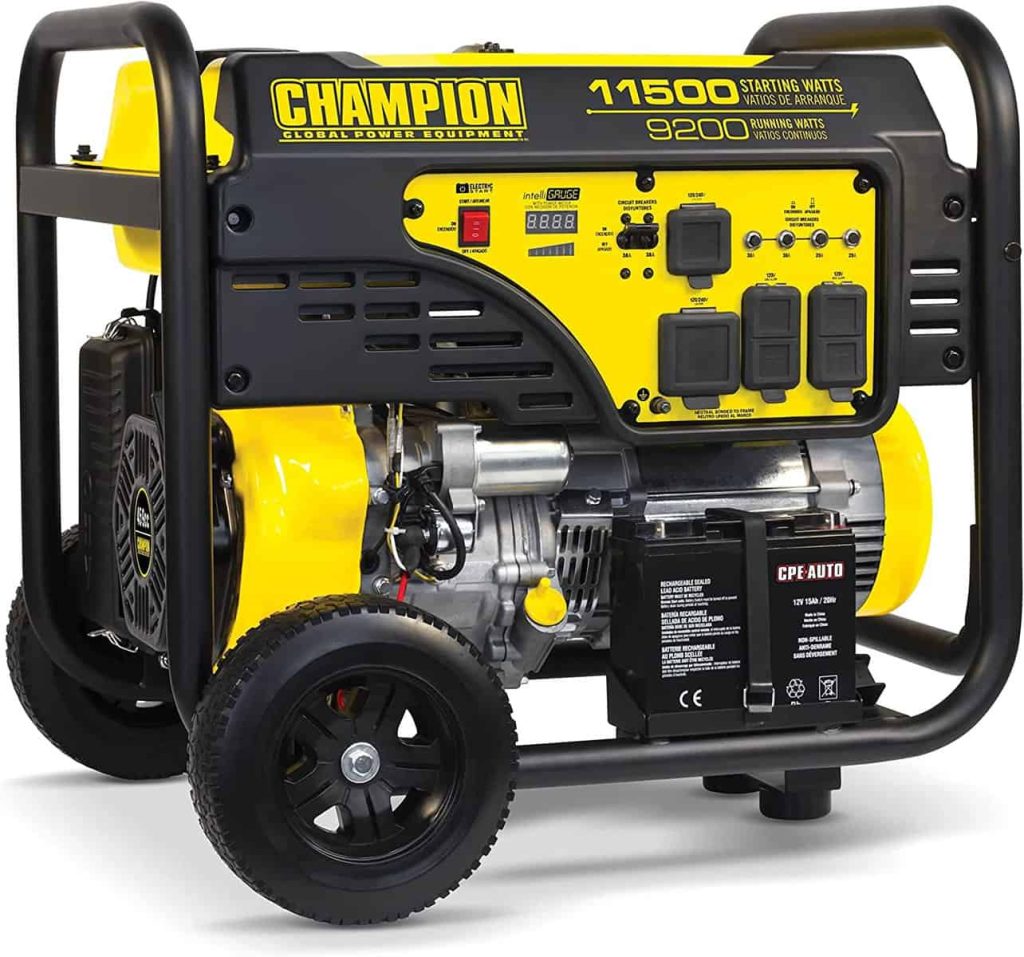
The Champion 100110 is a durable 11,500-starting-watt / 9,200-running-watt open-frame generator, but it’s discontinued. If you find one used or refurbished at a clear discount, it can still be a solid buy; for new purchases, the Champion 201110 is the better choice because it’s the same platform with CO Shield added.
This is a gasoline-only work generator for outages, job sites, and transfer-switch setups, not a quiet campground unit. Its best traits are the big outlet set, electric start, 7.7-gallon tank, and proven 459cc Champion engine; its biggest drawbacks are noise, no carbon-monoxide sensor, and used-market warranty caveats.


Check Champion 100110 availability on Amazon →
See the current Champion 201110 (successor with CO Shield) on Amazon →
Champion 100110 specs at a glance
The Champion 100110 sits in the high-output portable class with 120/240V power and enough capacity to run most essential home circuits through the right transfer equipment. Champion’s published specs show a conventional open-frame design: big engine, big tank, job-site outlets, and practical monitoring features.
| Spec | Value |
|---|---|
| Power output | 11,500 starting watts / 9,200 running watts |
| Voltage | 120/240V |
| Engine | 459cc Champion single-cylinder OHV engine, 3,600 rpm, low-oil shutdown |
| Fuel tank | 7.7-gallon steel gasoline tank |
| Runtime | Up to 10 hours at 50% load, per Champion’s published figure |
| Noise | 74 dBA at 23 feet |
| Outlets | One 120/240V 30A locking L14-30R, one 120/240V 50A 14-50R, four 120V 20A GFCI 5-20R household outlets |
| Starting system | Electric start with included battery, toggle-switch start, Cold Start Technology |
| Monitoring and protection | Intelligauge digital meter for volts, frequency, and run-hours; Volt Guard built-in surge protector |
| Compliance | EPA certified and CARB compliant for 50-state use |
| Mobility | 9.5-inch wheel kit, heavy open-frame build |
| Warranty | 3-year limited warranty plus lifetime free technical support; warranty applies to original purchase from authorized dealers |
The short version: the 100110 was built as a serious portable generator, not a lightweight inverter. It’s the kind of machine you roll out, connect safely, fuel heavily, and use to keep a house or worksite moving.
What can the Champion 100110 run?
At 9,200 running watts, the Champion 100110 can handle most household outage loads short of large central air conditioning. A realistic emergency load like a refrigerator, sump pump, furnace fan, lights, TV, and microwave still leaves over 5,000 watts of headroom using the standard wattage worksheet figures.
Here’s the worked math. A refrigerator uses 700 running watts with a 2,200-watt surge, and a 1/2 HP sump pump uses 1,050 running watts with a 2,150-watt surge. Add a furnace fan, lights, TV, and a 1,000-watt microwave, and this generator class still has room for normal cycling loads if you’re not trying to run everything in the house at once.
If you’re building a load plan, use the Electric Ninjas generator wattage calculator before you buy cables or a transfer switch. The running-watt number tells you what the generator can carry continuously, while surge watts cover motor startup from pumps, refrigerators, and fans.
The 120/240V 50A 14-50R is the big receptacle on this generator, useful for high-capacity connections where your inlet box and transfer equipment are built for that plug style. The 120/240V 30A L14-30R locking outlet is another transfer-switch-friendly option and is common on portable-generator inlet setups.
Do not read “50A outlet” as permission to overload the generator. The generator’s continuous ceiling is still 9,200 running watts, and your connected loads need to stay under that limit.
The four 120V 20A GFCI household outlets make the 100110 handy on a job site. They’re the right style for extension-cord loads like power tools, lights, chargers, and small appliances, with GFCI protection built into those receptacles.
For home backup, connect this generator through a proper transfer switch or interlock installed to code. Never plug a generator into a dryer outlet, and never backfeed a panel without approved transfer equipment. That kind of shortcut can energize utility lines and injure a lineworker.
Fuel use and runtime
The Champion 100110 has a 7.7-gallon gasoline tank, and Champion’s published runtime is up to 10 hours at 50% load. Since 50% of 9,200 running watts is 4,600 watts, that published figure works out to about 0.77 gallons per hour at a 4,600-watt load.
The division is simple: 7.7 gallons divided by 10 hours equals 0.77 gallons per hour. That’s a useful planning number for outage prep, because it tells you how fast stored fuel disappears when the generator is carrying a meaningful house load.
For cost planning, multiply your local pump price by 7.7 gallons for each full-tank run at that 50% load. In a long outage, you’re not just paying for the generator; you’re paying to keep enough fresh gasoline on hand, rotate it, and refill safely without spilling around a hot engine.
The big limitation is fuel type. The 100110 is gasoline only, with no propane option, so it doesn’t give you the long-storage convenience of a dual-fuel generator. If you’re estimating outage fuel needs, our guide to how much gasoline a generator uses will help you plan beyond the spec-sheet runtime.
Runtime also depends on load. Lighter loads stretch the tank, while heavy loads drain it faster than Champion’s 50% load figure. Treat the 10-hour number as a planning reference, not a guarantee for every appliance mix.
Noise, build, and everyday use
Champion rates the 100110 at 74 dBA at 23 feet. That’s about as loud as a shop vacuum, which puts it firmly in the outage and job-site category, not the quiet camping category.
This is a heavy open-frame generator with a 9.5-inch wheel kit, so it’s movable, but it’s not something you’ll casually lift in and out by yourself. The open-frame design is good for airflow and service access, but it also means more mechanical noise than an enclosed inverter generator.
The electric start is a major plus, especially on a 459cc engine. Champion includes the battery, and the toggle-switch start is simpler than yanking a recoil starter on a cold morning.
Cold Start Technology is another practical feature for winter outages. It doesn’t make gasoline storage easier, and it doesn’t replace battery maintenance, but it helps the engine start in cold weather compared with a plain manual-start setup.
The Intelligauge is more useful than it looks. It displays volts, frequency, and run-hours, so you can verify the generator is producing normal power and track service intervals without guessing.
Volt Guard is also built in as a surge protector. That doesn’t mean you should treat the 100110 like a clean-power inverter for every sensitive device, but it does add protection against voltage spikes during normal generator use.
Discontinued: what it means, and the Champion 201110
The Champion 100110 is discontinued, which is why new listings are usually dealer leftovers, refurbished units, or used-market finds. That doesn’t make the machine obsolete, but it changes the buying decision.
The main warranty issue is ownership. Champion’s 3-year limited warranty applies to the original purchase from authorized dealers, so used buyers should not assume the same coverage. Lifetime free technical support is a real benefit, but warranty coverage and parts availability should be checked before money changes hands.
The direct successor is the Champion 201110. It keeps the same 11,500 starting watts, 9,200 running watts, 459cc engine, 7.7-gallon tank, 10-hour runtime at 50% load, 74 dBA noise rating, electric start, Cold Start Technology, Intelligauge, and the same outlet set.
The big change is CO Shield. On the 201110, Champion adds a carbon-monoxide sensor that automatically shuts the engine off if unsafe CO accumulates around the unit.
| Feature | Champion 100110 | Champion 201110 |
|---|---|---|
| Watts | 11,500 starting / 9,200 running | 11,500 starting / 9,200 running |
| Engine | 459cc Champion single-cylinder OHV | 459cc Champion single-cylinder OHV |
| Tank and runtime | 7.7-gallon tank, up to 10 hours at 50% load | 7.7-gallon tank, up to 10 hours at 50% load |
| Noise | 74 dBA at 23 feet | 74 dBA at 23 feet |
| CO Shield | No | Yes |
| Availability | Discontinued; mostly used, refurbished, or leftover stock | In production and sold through major retailers |
There’s also the Champion 100485, a 9,200W model with an EFI engine plus CO Shield. EFI means easier cold starts and no carburetor gumming, which is appealing if stale fuel and winter starting are high on your worry list.
My buying advice is simple: buy a used 100110 only if it’s clearly cheaper than a new 201110 and the Intelligauge shows reasonable run-hours. If the price is close, take the newer 201110 for the CO Shield and cleaner warranty path.
Pros and cons
Pros
The outlet set is one of the 100110’s strongest points. Having both the 120/240V 50A 14-50R and the 120/240V 30A L14-30R gives you flexibility for transfer equipment, while the four 120V 20A GFCI outlets cover job-site and extension-cord loads.
Electric start with an included battery makes this generator easier to live with than a recoil-only unit in the same power class. Cold Start Technology helps when the weather turns bad, which is exactly when homeowners tend to need backup power.
The 7.7-gallon tank and Champion’s 10-hour runtime at 50% load are solid for outage use. You can run meaningful household loads without refueling every short stretch, as long as you plan your fuel supply.
The Intelligauge is a practical ownership feature. Seeing volts, frequency, and run-hours helps you spot abnormal output and stay on top of maintenance.
EPA certification and CARB compliance make the 100110 a 50-state generator. That matters if you’re buying used across state lines or trying to confirm whether a listing is legal for your area.
The 459cc Champion platform is the heart of both the 100110 and its direct successor, the 201110. That continuity is a good sign for owners comparing older and newer listings.
Cons
The biggest drawback is that the 100110 is discontinued. Used and refurbished units can still be worthwhile, but warranty coverage is not the same as buying new from an authorized dealer.
At 74 dBA at 23 feet, this generator is loud. It belongs outside, away from doors and windows, during outages or job-site work; it’s not a pleasant campground neighbor.
It’s gasoline only. You don’t get propane storage convenience, and you’ll need to manage stale fuel if the generator sits between storms.
The 100110 does not have CO Shield. The successor, the Champion 201110, fixes that by adding a carbon-monoxide sensor that can shut the engine off when unsafe CO accumulates around the unit.
The open-frame build is heavy. The 9.5-inch wheels help, but this still isn’t a compact inverter you toss around the garage.
Maintenance basics for owners
If you already own a Champion 100110, the manual should be your first source for maintenance intervals. The Intelligauge makes that easier because it tracks run-hours, which is the right way to schedule service instead of relying on memory.
Oil care matters on any air-cooled generator engine, especially one expected to run during outages. Use the oil type and change schedule in your Champion manual, and read our guide on what kind of oil a generator uses if you’re sorting out viscosity and seasonal use.
Fuel care is just as important. Gasoline left sitting can gum up the carburetor, so either run the generator dry for storage or use stabilizer and rotate your fuel supply.
The electric-start battery also needs attention. Keep it charged between uses, and check it before storm season so you’re not stuck using backup starting methods when the lights are already out.
For used buyers, maintenance records are worth real money. Check the run-hours on the Intelligauge, inspect the outlets, listen for rough running, and ask how the previous owner stored fuel between uses.
Bottom line
The Champion 100110 is still worth owning if you already have one, and it can be worth buying used if the price is clearly below a new Champion 201110. Its 9,200 running watts, 120/240V outlet set, 7.7-gallon tank, and electric start make it a strong outage generator.
If you’re buying new, get the Champion 201110 instead. It gives you the same core platform with CO Shield added, which is the smarter buy for most homeowners.
If your load plan shows that 9,200 running watts isn’t enough, compare larger options in our guide to the best 12000 watt generator picks before you commit to an older used unit.
Frequently asked questions
Is the Champion 100110 discontinued?
Yes. The Champion 100110 is discontinued, and its direct replacement in Champion’s lineup is the Champion 201110. The 201110 keeps the same 11,500 starting watts and 9,200 running watts, but adds CO Shield.
How many watts is a Champion 100110?
The Champion 100110 is rated for 11,500 starting watts and 9,200 running watts. It supplies 120/240V power, which makes it suitable for transfer-switch setups when installed correctly.
How long will a Champion 100110 run on a tank of gas?
Champion’s published runtime is up to 10 hours at 50% load on the 7.7-gallon gasoline tank. That works out to about 0.77 gallons per hour at a 4,600-watt load.
Will the Champion 100110 run a whole house?
It can run most essential household circuits through a proper transfer switch, including loads like a refrigerator, sump pump, furnace fan, lights, TV, and microwave. Large central air conditioning is usually the limit in this class, so add your running and surge watts before buying.
Is the Champion 100110 CARB compliant?
Yes. The Champion 100110 is EPA certified and CARB compliant for 50-state use.
What replaced the Champion 100110?
The Champion 201110 replaced it as the direct successor. It uses the same 11,500 starting watt / 9,200 running watt platform and adds CO Shield, a carbon-monoxide sensor that can shut the generator down if unsafe CO accumulates.
Is the Champion 100110 dual fuel?
No. The Champion 100110 runs on gasoline only and does not have a propane option. If you want propane capability, this specific model is not the right fit.