For a portable dual-fuel inverter, a 100 lb propane cylinder, about 23.6 gallons, is the storm-duty sweet spot: it runs a 4,500W-class inverter about 4.5 days at quarter load using Champion’s published burn rate. For a whole-house 22 kW standby generator, a 500-gallon propane tank, about 400 usable gallons, buys about 6.6 days at half load per Generac’s spec sheet.
The right tank size comes down to burn rate at your load, outage length, and refill access. Small bottles work for small inverters and short outages; big stationary tanks belong with standby generators, and the propane company handles siting and plumbing for those installs.
Propane tank sizes and what they actually hold
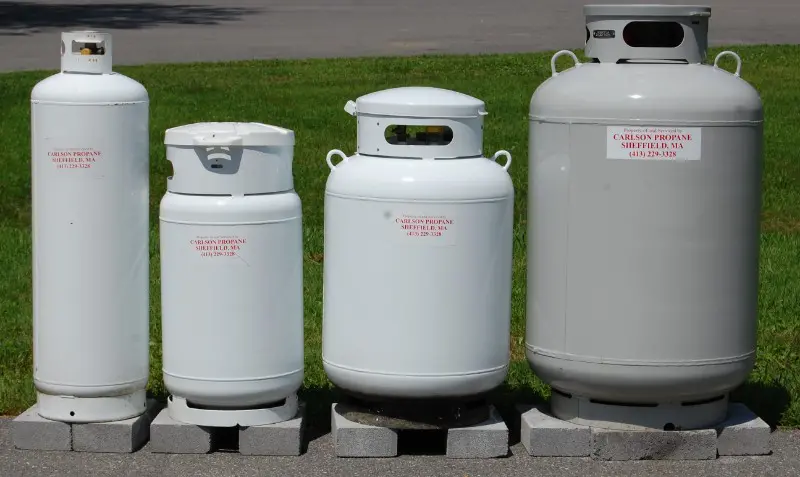
Portable propane cylinders are sold by weight, while stationary propane tanks are sold by water capacity in gallons. Propane weighs about 4.24 lb per gallon, so a 100 lb cylinder holds about 23.6 gallons of propane.
Stationary ASME tanks are different. They fill to about 80%, so a 500-gallon tank gives you about 400 usable gallons, not a full 500 gallons of propane.
| Tank | Nominal size | Usable gallons | Typical role |
|---|---|---|---|
| Grill bottle | 20 lb | About 4.7 gallons | Small inverter generators, short outages, easy swaps |
| Large portable cylinder | 30 lb | About 7 gallons | Longer portable runtime without moving to a stationary tank |
| Large portable cylinder | 40 lb | About 9.4 gallons | Portable dual-fuel units that accept larger cylinders |
| Storm-duty cylinder | 100 lb | About 23.6 gallons | Best portable choice for multi-day outage coverage |
| Entry stationary tank | 120-gallon | About 96 usable gallons | Small standby units or generator-dedicated storage |
| Mid-size stationary tank | 250-gallon | About 200 usable gallons | Common standby-generator tank for typical outages |
| Large stationary tank | 500-gallon | About 400 usable gallons | Storm-country whole-house standby storage |
That usable-gallon column is the number that matters for runtime. A 100 lb cylinder has roughly five times the propane of a 20 lb bottle, while a 500-gallon stationary tank has far more reserve because it’s built for delivered fuel and fixed equipment.
If you’re sizing from scratch, start with your generator’s propane consumption, then match the tank to the outage you’re trying to survive. Our propane consumption guide explains how load changes burn rate across common generator classes.
Runtime by tank size: the math
Runtime is tank gallons divided by gallons burned per hour. The catch is that burn rate changes with load, so the numbers below only compare tanks at the same published burn rate.
For example, Champion publishes 21 hours at 25% load on a 20 lb bottle for its 4,500W-class dual-fuel inverter. Since a 20 lb bottle holds about 4.7 gallons, that works out to about 0.22 gal/hr. A 100 lb cylinder has about 23.6 gallons, so 23.6 / 0.22 = about 107 hours, or about 4.5 days, at the same published burn rate.
The same math applies to the smaller inverter class. Champion publishes 34 hours at 25% load on a 20 lb bottle for a 2,500W-class dual-fuel inverter, or about 0.14 gal/hr. A 100 lb cylinder gives 23.6 / 0.14 = about 169 hours, or about 7 days, at that same published burn rate.
| Generator class | Published 20 lb bottle runtime | Approximate burn rate | 100 lb cylinder runtime at the same published burn rate |
|---|---|---|---|
| 2,500W-class dual-fuel inverter | 34 hours at 25% load, per Champion | About 0.14 gal/hr | 23.6 / 0.14 = about 169 hours, about 7 days |
| 4,500W-class dual-fuel inverter | 21 hours at 25% load, per Champion | About 0.22 gal/hr | 23.6 / 0.22 = about 107 hours, about 4.5 days |
| 14,500W-class tri-fuel open frame | Around 6 hours, per GeneratorBible | About 0.78 gal/hr class | 23.6 / 0.78 = about 30 hours |
This is why a 100 lb tank vs 20 lb generator setup is such a common decision point. With a small inverter, one grill bottle can be plenty for a night or a short utility outage. With a larger inverter or open-frame unit, the same bottle gets used up fast.
For 20 lb bottle planning, use the specific runtime figure for your generator class instead of guessing. We break that down separately in our 20 lb propane tank generator runtime guide.
Standby generators use a different scale. Generac’s spec sheet lists a 22 kW home standby at 2.53 gal/hr at half load and 3.90 gal/hr at full load. Using the half-load figure, the stationary-tank ladder looks like this:
| Stationary tank | Usable propane | 22 kW Generac runtime at half load |
|---|---|---|
| 120-gallon tank | About 96 usable gallons | 96 / 2.53 = about 38 hours, about 1.6 days |
| 250-gallon tank | About 200 usable gallons | 200 / 2.53 = about 79 hours, about 3.3 days |
| 500-gallon tank | About 400 usable gallons | 400 / 2.53 = about 158 hours, about 6.6 days |
Those standby numbers are not worst-case full-load numbers. If your house is pulling harder, runtime drops; if your loads are lighter, runtime stretches.
How far from the house and the generator does a tank go?
Propane placement rules are governed by code, and NFPA 58 is the baseline most propane companies work from. Treat the distances below as NFPA 58 as commonly applied; your propane company and local code are the authority, and they site stationary tanks.
| Tank type | Commonly applied clearance | What it means in practice |
|---|---|---|
| 100 lb cylinders | At least 3 feet from building openings and 5 feet from ignition sources | Keep cylinders outside, upright, and away from openings and anything that can ignite vapor |
| 125-500 gallon stationary ASME tanks | At least 10 feet from buildings and property lines | The propane company chooses the legal, serviceable location |
| 1,000-gallon-class stationary tanks | At least 25 feet | Large storage needs more room and stricter siting |
The generator-to-tank distance question is simple: a running generator is an ignition source. Keep cylinders clear of the generator using the ignition-source clearances above, and don’t run a portable close to the house just to make the propane hose convenient.
CPSC’s generator rule is that the generator itself runs outdoors 20+ feet from the house with exhaust pointed away. In real yards, that rule usually decides the layout first, then the propane tank gets placed so it also meets the cylinder or stationary-tank clearance. If you’re planning a portable setup, read our generator placement guide before buying hoses or deciding where the generator will sit.
Cylinders belong outside, upright, never indoors and never in basements. That applies even if the weather is bad and even if the cylinder is disconnected.
Bottles vs the 100 lb cylinder for portables
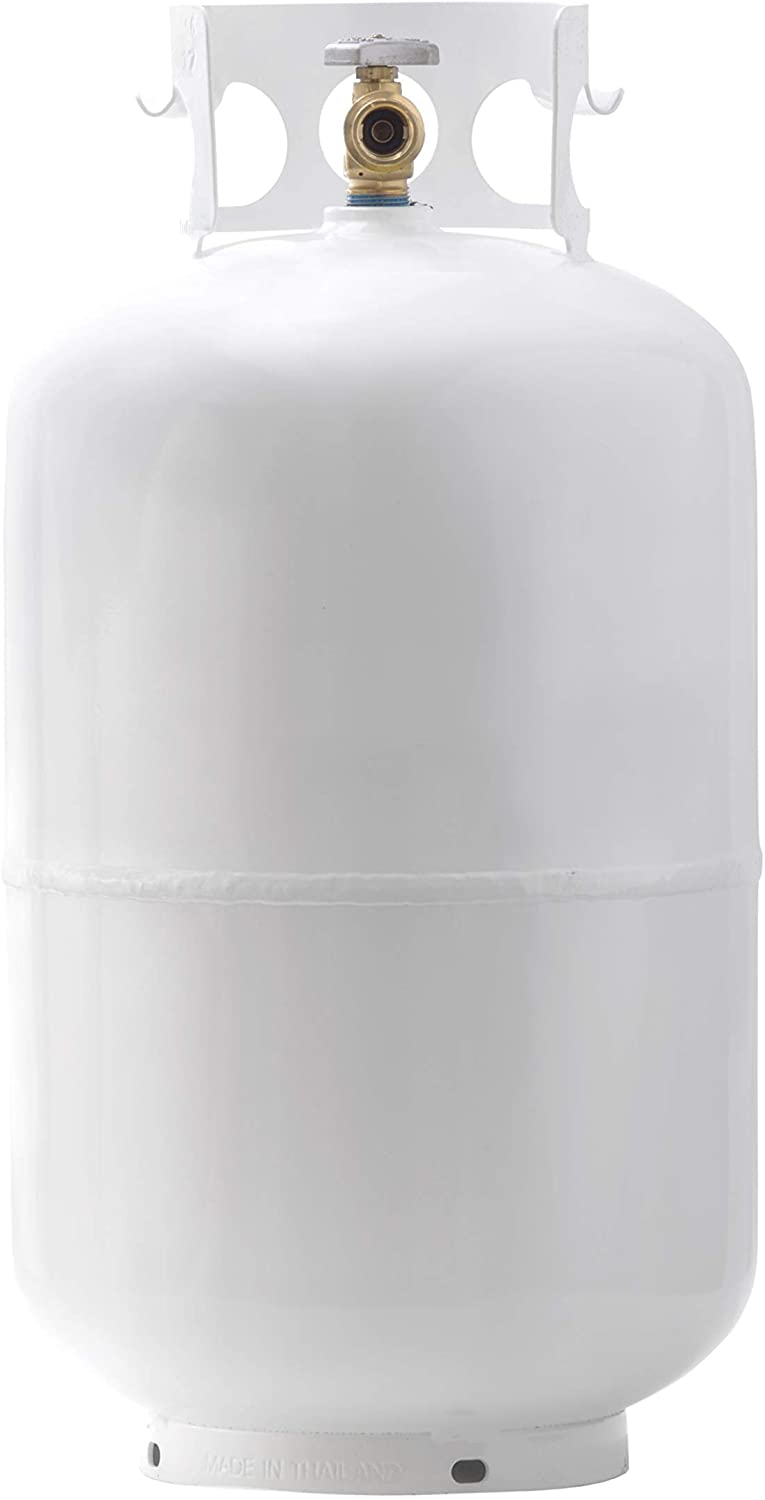
For a 2,000-2,500W-class inverter, 20 lb grill bottles make a lot of sense. They’re cheap, swappable, easy to store outside, and one bottle can run a 2,500W-class dual-fuel inverter 34 hours at 25% load per Champion’s published figure.
Two or three grill bottles often beat one large cylinder for flexibility. You can exchange one while another runs, move them without special planning, and keep separate fuel ready for cooking or backup use.
Shop 20 lb propane tanks on Amazon →
A 100 lb cylinder is the portable storm-duty sweet spot because it holds about 23.6 gallons, compared with about 4.7 gallons in a 20 lb bottle. That’s why it can run a 4,500W-class dual-fuel inverter about 4.5 days at quarter load using Champion’s published rate.
The tradeoff is handling and setup. A 100 lb cylinder is still a portable cylinder, but it’s no longer as casual as a grill bottle. You need a safe outside storage spot, upright placement, proper clearances, and the right connection arrangement for your generator.
Shop 100 lb propane cylinders on Amazon →
Big open-frame generators are where grill bottles start to look bad. GeneratorBible lists a 14,500W-class tri-fuel open frame at around 6 hours on a 20 lb bottle, and a small cylinder feeding a big machine can frost up and starve the engine because generators draw propane vapor.
Most dual-fuel portables ship with a hose and regulator that screws onto a standard 20-40 lb cylinder valve. A 100 lb cylinder and any stationary tank are a different connection class: fittings and regulator staging vary, larger setups need a properly sized regulator arrangement, and stationary-tank hookups are the propane company’s install, not a DIY hose job.
Shop generator propane hoses and regulators on Amazon →
If the question is “100 lb tank vs 20 lb generator bottle,” the practical answer is runtime versus flexibility. A few 20 lb bottles are better for casual use and easy exchanges; a 100 lb cylinder is better when you want the generator to run through a storm without constant bottle swaps.
Stationary tanks for standby generators (120 to 500 gallon)
For standby generators, don’t think in grill-bottle terms. A 22 kW whole-house standby generator can use 2.53 gal/hr at half load per Generac’s spec sheet, so even a 120-gallon tank is only about 1.6 days of half-load runtime after the 80% fill rule.
A 120-gallon tank is the entry stationary size. It can work for small standby units, short outages, or a generator-dedicated tank where refills are easy, but it’s thin reserve for a whole-house 22 kW unit during a long utility failure.
A 250-gallon tank gives about 200 usable gallons. On a 22 kW Generac at half load, that’s about 79 hours, or about 3.3 days, which covers many outages but can still feel short if roads are blocked or propane deliveries are backed up.
A 500-gallon tank gives about 400 usable gallons. At the same 22 kW half-load burn rate, that’s about 158 hours, or about 6.6 days, which is why it’s the storm-country whole-house answer. It’s also usually the point where delivery pricing gets better per gallon, though your supplier’s terms control that.
The propane company should site and plumb stationary tanks. They’ll account for tank clearances, delivery-truck access, regulator staging, local code, and the generator’s fuel demand.
If you’re asking “what size propane tank for Generac,” start with the actual model’s burn rate instead of assuming every standby uses the same fuel. Our Generac propane consumption chart gives per-model burn-rate planning, and our hurricane fuel storage guide helps you decide how much reserve to keep before a storm.
Keeping track of what’s left
Guessing propane level is a bad plan during an outage. Gauges and monitors beat shaking cylinders, tapping tanks, or waiting until the generator sputters.
For portables, check bottles before the weather window closes and refill or exchange early. For stationary tanks, don’t wait until the tank is low and every other standby owner in town is calling the same propane company.
Shop propane tank gauges on Amazon →
The bigger the generator, the less forgiving your fuel planning gets. A small inverter gives you time to react; a whole-house standby can burn through reserve quickly if the house load stays high.
Bottom line
Use 20 lb bottles for small inverters and short outages, step up to a 100 lb cylinder for portable storm duty, and plan on 250-500 gallons for a whole-house standby generator. Size the tank to your outage risk and refill access, not just to the generator nameplate.
If you’re still choosing the machine, our propane generator roundup can help you match the generator class to the fuel storage you’re willing to manage. Bigger tanks cost more once, but they save panic refills every storm.
Frequently asked questions
What size propane tank do I need for a generator?
For portables, use 20 lb bottles for 2,000-2,500W units and a 100 lb cylinder for multi-day storm duty on a 4,500W-class inverter. For standby generators, size to outage risk; a 22 kW Generac uses 2.53 gal/hr at half load, or about 61 gallons per day, so most whole-house installs land at 250-500 gallons.
How long will a 100 lb propane tank run a generator?
A 100 lb cylinder holds about 23.6 gallons. At the published burn rates, it runs a 2,500W-class inverter about 169 hours because 23.6 / 0.14 = about 169, a 4,500W-class inverter about 107 hours because 23.6 / 0.22 = about 107, and a 14,500W-class open frame about 30 hours because 23.6 / 0.78 = about 30.
What size propane tank does a 22kW Generac need?
Generac’s spec sheet lists a 22 kW standby at 2.53 gal/hr at half load. A 120-gallon tank lasts about 1.6 days, a 250-gallon tank about 3.3 days, and a 500-gallon tank about 6.6 days at that half-load rate. Most whole-house installs land at 250-500 gallons.
How far does a propane tank have to be from a generator?
A running generator is an ignition source. NFPA 58 as commonly applied keeps 100 lb cylinders at least 5 feet from ignition sources, and CPSC’s 20+ feet from the house generator rule usually sets the layout. The propane company sites stationary tanks.
How far from the house does a propane tank have to be?
NFPA 58 as commonly applied keeps 100 lb cylinders at least 3 feet from building openings. Stationary 125-500 gallon ASME tanks are commonly sited at least 10 feet from buildings and property lines, while 1,000-gallon-class tanks need at least 25 feet. Local code and your propane company govern the final placement.
Can I hook my generator to a 100 lb propane tank?
Usually yes for dual-fuel portables, but the 100 lb connection class differs from the included 20 lb hose. Verify the fitting and regulator arrangement matches your generator, and let the propane company handle anything tied to a stationary tank.
Is it better to have two 20 lb tanks or one 100 lb tank?
Two or three 20 lb bottles win on flexibility and easy exchange. One 100 lb cylinder wins on unattended runtime because it holds about 23.6 gallons versus about 4.7 gallons in one 20 lb bottle, or roughly five times the fuel.