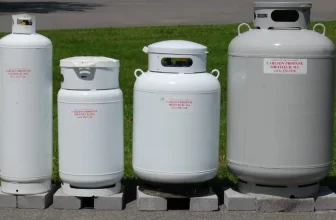
A portable propane generator burns roughly 2-3 lb of propane per hour at half load, while a whole-house standby generator burns roughly 2-2.5 gallons per hour at half load. A 22kW Generac uses 2.16 gal/hr at 50% load and 3.68 gal/hr at 100% load, per Generac’s published spec sheet.
Propane use scales with load, not just generator size: the same generator can sip fuel running a refrigerator and lights, then burn much harder when you add air conditioning, well pumps, heaters, or battery chargers.

The quick answer: propane use at a glance
If you’re sizing a propane generator for home backup, start with the load you actually plan to run. Manufacturer runtime numbers are usually tied to a specific load point, so a small inverter at a light load can run far longer on the same tank than a large open-frame generator pulling heavy loads.
| Generator class | Typical load | Propane burn | Tank runtime |
|---|---|---|---|
| 2,200W inverter | About 1,000 W | Roughly 1.2-1.6 lb/hr | About 12-16 hours from a 20-lb tank |
| Mid-size 4,500W dual-fuel | 25%-50% load | About 0.95-2.9 lb/hr, based on Champion and WEN published figures | About 7-21 hours from a 20-lb tank |
| Large 9,500W portable | About 4,500 W | About 5.6 lb/hr, or 1.3 gal/hr, based on DuroMax’s published figure | About 3.5 hours from a 20-lb tank |
| 22kW whole-house standby | 50% load | 2.16 gal/hr, per Generac’s spec sheet | About 185 hours, or 7-8 days, from a 500-gal tank filled to usable capacity |
The wide spread is normal. A 20-lb grill cylinder can last most of a day on a small inverter at light load, or only a few hours on a large portable at half load.
For home standby planning, stop thinking in grill tanks and start thinking in stationary tank capacity. A 22kW standby generator can empty small cylinders quickly, but a 500-gal residential tank gives you a realistic multi-day outage reserve at half load.
How to calculate propane use yourself
Propane can be counted by pounds, gallons, or BTUs. Per the U.S. Energy Information Administration, 1 gallon of propane contains 91,452 BTU, propane weighs 4.24 lb per gallon, and that works out to about 21,500 BTU per pound.
That’s why propane tanks can sound confusing. A standard 20-lb cylinder holds about 4.7 gallons of propane. A 100-lb cylinder holds about 23.6 gallons. Residential stationary tanks are commonly labeled 120, 250, or 500 gallons, but they’re filled to 80%, so a 500-gal tank holds about 400 usable gallons and a 250-gal tank holds about 200 usable gallons.
Here’s the practical way to calculate burn rate from a spec sheet:
- Find the tank size used in the manufacturer’s runtime claim.
- Convert that tank to gallons or pounds.
- Divide the fuel amount by the listed runtime.
- Match that number to your expected load.
Take the WEN DF475T as a clean example. WEN’s published figure says it runs about 7 hours at 50% load on a 20-lb tank, and a 20-lb tank holds about 4.7 gallons. So the math is 4.7 gallons ÷ 7 hours = 0.67 gal/hr, or about 2.9 lb/hr, at roughly a 1,750 W load.
Run the numbers across portable spec sheets and a pattern shows up. Portable generators usually burn roughly 1.2-1.6 lb of propane per kWh of electricity actually produced. Smaller engines are less efficient, and light loads waste more fuel on engine overhead.
Whole-house standby units are different. Bigger, purpose-built LP engines typically land around 0.7-0.9 lb per kWh. That’s why a home standby unit can be more efficient per kWh than a portable, even though it burns more total fuel per hour because it’s carrying a much larger load.
For quick planning, use this rule: a portable dual-fuel generator at half load burns about 2-3 lb/hr, and a whole-house standby generator at half load burns about 2-2.5 gal/hr. Then check the actual spec sheet for the model you’re buying or already own.
How much propane does a Generac generator use?
Generac’s Guardian standby generators publish LP fuel consumption in gallons per hour at different load levels. These are the numbers to use if you’re sizing a propane tank for a Generac home standby system.
| Generac Guardian size | LP use at 50% load | LP use at 100% load |
|---|---|---|
| 10 kW | 0.97 gal/hr | 1.48 gal/hr |
| 18 kW | 1.70 gal/hr | 3.02 gal/hr |
| 22 kW | 2.16 gal/hr | 3.68 gal/hr |
| 24 kW | 2.53 gal/hr | 3.90 gal/hr |
A 22kW Generac generator uses 2.16 gallons of propane per hour at half load and 3.68 gallons per hour at full load. Those figures vary slightly by model year, so check the spec sheet for your exact model before ordering a tank or planning outage runtime.
For tank sizing, the 22kW number is the one many homeowners care about. A 500-gal propane tank holds about 400 usable gallons, and 400 ÷ 2.16 = about 185 hours. That’s roughly 7-8 days of continuous runtime at half load.
A 250-gal tank holds about 200 usable gallons. With the same 22kW Generac at half load, that’s about half the runtime of the 500-gal tank: roughly 3.5-4 days. If your house load is higher, the tank drains faster; if you shed loads, it lasts longer.

How long will a generator run on a propane tank?
Tank duration comes down to fuel capacity divided by burn rate. A 20-lb cylinder is fine for small portable generators and short outages, but it’s too small for serious whole-house runtime planning.
| Propane tank size | Usable propane | Portable generator at half load | 22kW standby at half load |
|---|---|---|---|
| 20-lb cylinder | About 4.7 gal | About 3.5-7 hours for large to mid-size portables at half load; up to 12-16 hours on a smaller inverter at about 1,000 W | About 2 hours by fuel volume at 2.16 gal/hr |
| 100-lb cylinder | About 23.6 gal | About 33-35 hours for a mid-size portable at half load | About 11 hours by fuel volume at 2.16 gal/hr |
| 250-gal stationary tank | About 200 usable gal | Long reserve for portables; calculate from the generator’s hourly burn | About 3.5-4 days at 2.16 gal/hr |
| 500-gal stationary tank | About 400 usable gal | Long reserve for portables; calculate from the generator’s hourly burn | About 185 hours, or 7-8 days, at 2.16 gal/hr |
Here are the portable 20-lb examples from manufacturer-published figures:
- Champion 200988: Champion publishes 21 hours at 25% load on a standard 20-lb tank. That works out to about 0.95 lb/hr, or 0.22 gal/hr, at roughly a 790 W load.
- WEN DF475T: WEN publishes about 7 hours at 50% load on a 20-lb tank. That’s about 2.9 lb/hr, or 0.67 gal/hr, at roughly a 1,750 W load.
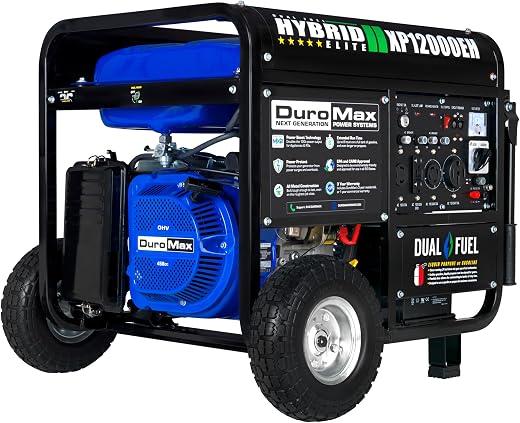
- DuroMax XP12000EH: DuroMax publishes about 7.2 hours at 50% load on a 40-lb tank. Cut that tank in half, and a 20-lb tank gives about 3.5 hours at roughly a 4,500 W load.
A 100-lb cylinder gives about 5x the fuel of a 20-lb cylinder. That’s why a mid-size portable at half load can run about 33-35 hours on a 100-lb tank, compared with about 7 hours on a 20-lb tank.
For a whole-house standby generator, the math changes because the engine is much larger and the load is usually higher. A 22kW Generac at half load is already burning 2.16 gal/hr, so stationary storage is the normal setup.
Propane vs gasoline: runtime and power
Gasoline carries more energy per gallon than propane. Gasoline is roughly 120,000+ BTU/gal, while propane is 91,452 BTU/gal. That means propane has roughly 27% less energy per gallon.
That lower energy density is why a generator usually runs for less time on a gallon of propane than on a gallon of gasoline. It’s also why most dual-fuel generators produce about 10% fewer watts on propane.
The Champion 200988 is a good example. It’s rated at 3,500 running watts on gasoline and 3,150 running watts on propane. That power drop matters if you’re already close to the generator’s limit.
Gasoline wins when you need the most wattage from a portable generator and you can get fresh fuel easily. Propane wins for emergency storage because it doesn’t go stale in months like gasoline can. If the tank and valve are sound, propane stores indefinitely.
Propane also burns cleaner. You get less carbon buildup, cleaner oil, and no carburetor gumming from stale gasoline. That’s a major reason propane is popular for standby generators that may sit for long stretches between outages.
Dual-fuel is the hedge: run propane for clean storage and easy standby use, then keep gasoline as a backup if propane supply gets tight. If you want even more fuel flexibility, our guide to the best tri-fuel generators covers units that can run on more than one backup fuel source.
If you’re comparing fuel plans, read our breakdown of how much gasoline a generator uses alongside the propane numbers here. The right choice depends on your load, storage setup, and how long you expect outages to last.
Choosing the right propane tank for your generator
A 20-lb cylinder is the easy option. It’s cheap, exchangeable, and familiar if you already use propane for grilling. For generators, though, expect anything from about 4-16 hours depending on the unit and load.
Small inverters and light loads make a 20-lb tank look good. A 2,200W inverter at about 1,000 W can run roughly 12-16 hours. A larger portable at half load can pull the same cylinder down in about 3.5 hours.
A 100-lb cylinder is a better fit for weekend outages, cabins, and portable generators you’ll run for long stretches. It holds about 23.6 gallons, which is roughly 5x a 20-lb cylinder. For a mid-size portable at half load, that puts you around 33-35 hours.
Stationary tanks are the right answer for automatic home standby. Residential tanks are commonly 120, 250, or 500 gallons, and the 80% fill rule matters. A 500-gal tank gives you about 400 usable gallons; a 250-gal tank gives about 200 usable gallons.
Cold weather can change the practical side of tank choice. Propane tanks lose pressure in extreme cold, so keep tanks above about -20°F and use larger tanks in winter when possible. Larger tanks have more surface area to vaporize propane, which helps when demand is high.
If you’re still choosing the generator itself, start with units built for the fuel you plan to store. Our best propane generators guide compares propane-ready options for home and portable backup power.

Top Propane & Dual-Fuel Generators (2026)
As an Amazon Associate we earn from qualifying purchases.


How to stretch a tank of propane
The fastest way to save propane is to reduce load. A generator doesn’t burn fuel based only on its nameplate size; it burns fuel based on the work you ask it to do. Heavy loads shorten runtime fast.
Run the refrigerator and freezer in cycles instead of leaving every load connected all day. Shed big loads you don’t need, especially air conditioning, electric heat, and high-draw tools. If your generator is connected through a transfer setup, build a simple load plan before the outage hits.
Right-size the generator before you buy. Too small and it struggles; too large and you waste fuel at light load. Use our generator wattage calculator to size your load before choosing a propane generator for home backup.
Maintenance also affects fuel use. Clean oil, clean filters, sound spark plugs, and a healthy regulator help the engine run the way the manufacturer intended. A neglected generator can burn more fuel while making less usable power.
Safety matters with every fuel. Never run a generator indoors, in a garage, or near windows. Propane generators still produce carbon monoxide, and CO can kill you even when the engine seems to be running clean.
Bottom line
Remember the planning numbers: a portable propane generator burns about 2-3 lb/hr at half load, while a whole-house standby burns about 2-2.5 gal/hr at half load. A 22kW Generac uses 2.16 gal/hr at 50% load and 3.68 gal/hr at full load.
For short portable use, a 20-lb or 100-lb cylinder can work. For whole-house backup, plan around a 250-gal or 500-gal stationary tank and size your loads before the next outage.
Frequently asked questions
How much propane does a generator use per hour?
A portable propane generator usually burns about 2-3 lb of propane per hour at half load. Whole-house standby generators burn about 2-2.5 gallons per hour at half load. Actual use depends on load, engine size, and the model’s spec sheet.
How much propane does a 22kW Generac generator use per hour?
A 22kW Generac Guardian uses 2.16 gallons per hour at 50% load and 3.68 gallons per hour at 100% load, per Generac’s published LP consumption figures. Check the spec sheet for your exact model year because figures can vary slightly.
How long will a generator run on a 20-lb propane tank?
A 20-lb propane tank holds about 4.7 gallons. A Champion 200988 runs 21 hours at 25% load, a WEN DF475T runs about 7 hours at 50% load, and a large DuroMax XP12000EH works out to about 3.5 hours at 50% load on a 20-lb tank.
How long will a 500-gallon propane tank run a whole-house generator?
A 500-gal propane tank holds about 400 usable gallons because tanks are filled to 80%. A 22kW Generac at 50% load burns 2.16 gal/hr, so that tank lasts about 185 hours, or roughly 7-8 days of continuous runtime.
Is it cheaper to run a generator on propane or gasoline?
Propane often costs less per gallon, but it carries about 27% less energy per gallon than gasoline. In real generator use, the cost difference is often roughly a wash. Propane’s bigger advantage is storage life because it doesn’t go stale like gasoline.
Does a generator produce less power on propane?
Yes, most dual-fuel generators produce about 10% fewer watts on propane. For example, the Champion 200988 is rated at 3,500 running watts on gasoline and 3,150 running watts on propane. That derate matters if your load is close to the generator’s limit.
Can I hook a generator to my house propane tank?
Yes, standby generators and many dual-fuel portables can run from a house propane tank with the correct regulator, hose, and fuel setup. For stationary tanks and whole-house standby systems, use a qualified installer so the fuel supply is sized and connected safely.