

For sensitive electronics, buy an inverter generator like the Honda EU2200i, which Honda rates at less than 3% THD, or a battery power station like the EcoFlow DELTA 3 Classic, which gives pure-sine AC with under-10ms UPS switchover. Conventional open-frame generators are for fridges, pumps, RV loads, and tools—not the first choice for desktops, CPAPs, TVs, or furnace control boards.
Why THD matters (and what the numbers mean)
THD means total harmonic distortion. In plain English, it’s how far the generator’s AC output strays from a clean sine wave like the power you get from the utility.
For sensitive electronics, the common safe line is under 3% THD. Under 6% THD is usually fine for tools and basic appliances, but that’s not the same standard you want for a desktop computer, audio gear, a CPAP, or a furnace control board.
Inverter generators earn their place here because they make power, convert it, and then electronically rebuild a cleaner AC waveform. If you want the plain-English mechanical explanation, our guide to what an inverter generator is walks through that difference without turning it into an electrical engineering class.
Battery power stations are even cleaner for desktop-class electronics because there’s no engine output to chase. They store power in a battery and feed your devices through a pure-sine inverter, which is why a unit with UPS-style pass-through can make more sense for a computer desk than any gas generator.
Open-frame conventional generators are a different animal. Many good ones do not publish a tight THD figure, and their output can swing more as load changes, especially when a motor kicks on or drops off. That does not mean every conventional generator instantly ruins electronics, but it does mean you’re accepting more risk.
The usual casualties are not always the expensive computer with a decent power supply. Switch-mode power supplies in many laptops, monitors, and desktop towers can ride through imperfect power better than people think. The bigger worry is the stuff with small control boards, cheaper wall adapters, certain audio equipment, and furnace electronics that do not like ugly voltage or frequency behavior.
That’s why this list separates clean-power picks from strong general-purpose generators. If a manufacturer publishes less than 3% THD, it belongs in the electronics conversation. If it’s a conventional open-frame unit without a published THD figure, it belongs in the appliance and backup-power conversation unless you add a UPS or battery buffer.
Best generators for electronics compared
The safe shortlist is mostly inverter generators, plus battery power stations for people who care more about clean desktop power than running an engine. For a broader generator-only view, see our guide to the best inverter generators.
Noise matters too if this is going near an RV, home office window, campsite, or neighbor’s fence. If the decibel ratings below don’t mean much yet, our guide to how loud a generator is puts those numbers in real-world context.
| Model | Type | Running watts | THD or output | Noise | Weight |
|---|---|---|---|---|---|
| Honda EU2200i | Inverter generator | 1,800W | Less than 3% THD per Honda | 48-57 dBA | 47.4 lb |
| WEN 56203i | Inverter generator | 1,700W | Under 1.2% THD per WEN | 51 dBA | 39 lb |
| WEN 56200i | Inverter generator | 1,600W | Under 1.2% THD per WEN | 51 dBA | — |
| Westinghouse iGen2200 | Inverter generator | 1,800W | Under 3% THD per Westinghouse | 52 dBA | 46.3 lb |
| EcoFlow DELTA 3 Classic | Battery power station | 1,800W AC | Pure sine wave | No engine | About 27 lb per EcoFlow |
| Goal Zero Yeti 3000X | Battery power station | 2,000W AC | Pure sine wave | No engine | 69.8 lb |
One note on the table: the DELTA 3 Classic and Yeti 3000X are not generators in the engine sense. They are included because for computers, TVs, CPAPs, routers, and desk gear, a pure-sine battery station is often the cleaner answer.
Honda EU2200i: best overall generator for electronics
The Honda EU2200i is the default gas-powered recommendation for sensitive electronics because Honda publishes less than 3% THD, and the size is practical for home, RV, and emergency use. It’s rated at 2,200 starting watts and 1,800 running watts, which is plenty for a home office, TV, router, CPAP, and chargers.
Per Honda’s published figures, the EU2200i weighs 47.4 lb, runs at 48-57 dBA, and uses a 0.95-gallon tank for 3.2-8.1 hours depending on load. It also has CO-MINDER CO shutoff and Bluetooth, which makes it feel current instead of bare-bones.
It’s not the cheapest way to get clean power. It is the one I’d point most homeowners toward if they want a small gas generator that can safely cover electronics and still pull utility duty around the house.
Check the Honda EU2200i price on Amazon →
WEN 56203i: best value clean-power inverter
The WEN 56203i is the value pick because WEN publishes under 1.2% THD, which is a tighter figure than Honda’s less-than-3% rating. It’s rated at 2,000 starting watts and 1,700 running watts, so it sits in the same small-inverter class for electronics, RV outlets, chargers, and light emergency loads.
WEN lists the 56203i at 39 lb and 51 dBA. The 1-gallon tank is rated for 7 hours at 50% load or 10.8 hours at 25% load, and the carb-draining fuel shutoff is a real maintenance advantage if the generator sits between outages.
This is the one to look hard at if you want clean inverter power and don’t want to pay Honda money. For more models in this size range, our best 2000-watt generators guide is the next stop.
Check the WEN 56203i price on Amazon →
WEN 56200i: budget pick, but no longer the smart WEN buy
The WEN 56200i was this page’s old top pick, and the clean-power part still holds up. WEN publishes under 1.2% THD, and the generator is rated at 2,000 starting watts and 1,600 running watts with a 51 dBA noise figure.
The problem is not the waveform. The problem is that the newer WEN 56203i is the same money better spent, and the 56200i lacks a CO sensor.
If you already own a 56200i, it’s still a legitimate inverter generator for electronics. If you’re buying now, I’d move to the 56203i instead because the newer model gives you the cleaner ownership case without giving up WEN’s tight THD rating.

WEN 56200i 2000-Watt Gas Powered Portable Inverter Generator, CARB Compliant,Black & Orange
Check the WEN 56200i price on Amazon →
Westinghouse iGen2200: aging but still-listed inverter option
The Westinghouse iGen2200 used to sit here as the RV pick, and on paper it still fits the electronics-safe category. Westinghouse publishes under 3% THD, with 2,200 starting watts and 1,800 running watts.
Its published noise figure is 52 dBA, and the 1.14-gallon tank is rated for up to 12 hours at 25% load. That makes it a useful size for a small RV setup, TV, router, laptop station, or CPAP backup.
The catch is availability. Several dealers mark the iGen2200 discontinued or hard to find while Westinghouse still lists it, so I’d treat it as an aging, still-listed model rather than the first generator to chase down.

Westinghouse Outdoor Power Equipment 2200 Peak Watt Super Quiet & Lightweight Portable Inverter Generator, Gas Powered, Parallel Capable, Long Run Time
Check remaining Westinghouse iGen2200 stock on Amazon →
EcoFlow DELTA 3 Classic: best answer for desktop electronics
The EcoFlow DELTA 3 Classic is not a gas generator, and that’s exactly why it may be the best pick for computers, monitors, Wi-Fi gear, TVs, and CPAPs. It has a 1,024Wh LiFePO4 battery, 1,800W AC output, and 3,600W surge capability per EcoFlow’s listing.
The key electronics feature is the under-10ms UPS switchover. That means you can run a desktop through it like a UPS, with the battery stepping in fast when wall power drops.
EcoFlow lists it at about 27 lb, and the roughly 1-hour fast AC recharge makes it easier to cycle during a storm if utility power comes and goes. If you’re shopping this category broadly, see our guide to the best portable power stations.
Check the EcoFlow DELTA 3 Classic price on Amazon →
Goal Zero Yeti 3000X: big battery capacity, older generation
The Goal Zero Yeti 3000X was this page’s old battery pick, and it still has one obvious strength: capacity. Goal Zero rates it at 3,032Wh with 2,000W AC output and 3,500W surge capability.
That is a lot of watt-hours for electronics, especially if you’re running a desk, TV, router, modem, chargers, and medical gear through a long outage. It also weighs 69.8 lb, so this is more of a park-it-and-use-it power station than something you casually carry around.
The honest catch is battery generation. The Yeti 3000X uses older NMC battery chemistry, while Goal Zero’s newer Yeti PRO 4000 is the LiFePO4 successor generation. At the right old-model price, the 3000X can still make sense because it brings a lot of stored energy.
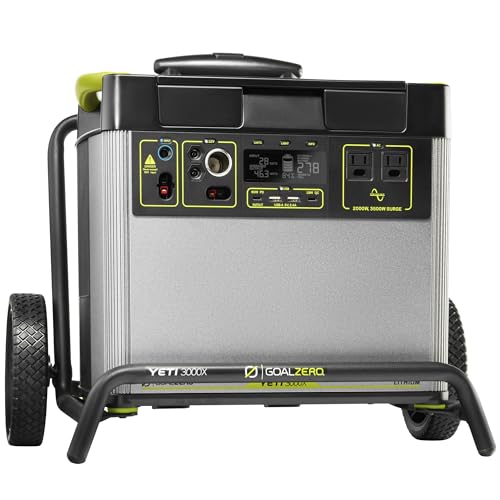
Goal Zero Yeti 3000X Portable Power Station, 2982Wh Portable Lithium Battery Emergency Power Station, 2000W Portable AC Inverter, Outdoor Portable Generator, Portable Solar Generator for Solar Panels
Check the Goal Zero Yeti 3000X price on Amazon →
The old picks that don’t belong in this list (and what they’re actually good for)
The Champion 76533 was this page’s old “best dual fuel” pick, but it should not be ranked as one of the best generators for electronics. Champion rates it at 4,750 starting watts and 3,800 running watts on gas, plus 4,275 starting watts and 3,420 running watts on propane, and it has TT-30R and L5-30R outlets.
That makes it a fine RV and appliance generator. The issue is that it is not an inverter, and Champion does not publish a THD figure for it. Use it for RV loads, a fridge, and general backup work, but keep computers off it or put them behind a line-interactive UPS.

Champion Power Equipment 76533 4750/3800-Watt Dual Fuel RV Ready Portable Generator with Electric Start
Check the Champion 76533 price on Amazon →
The Generac GP6500 COsense is the same story, just with more home-backup muscle. Generac rates the current model at 8,125 starting watts and 6,500 running watts, and it includes COsense CO shutoff.
That’s useful for a fridge, well pump, furnace blower, and other practical outage loads. But as a conventional open-frame generator, it’s not the clean-power pick for sensitive electronics straight from the outlet. Put the desk gear on a UPS or a battery station, and let the Generac do the heavy lifting.

Check the Generac GP6500 COsense price on Amazon →
A line-interactive UPS between a generator and computer helps smooth transfer blips and gives you clean shutdown time. A battery power station running as a pass-through UPS does the same job with hours of buffer instead of minutes.
This is also where general buying features matter. CO shutoff, outlet mix, fuel shutoff, portability, and runtime all matter once you move beyond a desk setup, and our guide to portable generator features covers what to look for before you buy.
Sizing: what your electronics actually draw
Most electronics use less power than people expect. The reason a 2,000W inverter generator is popular is not that a laptop needs anything close to that; it’s that the same generator can run a desk setup and still have room for something like a fridge.
| Device | Typical draw | What it means for generator sizing |
|---|---|---|
| Laptop | 30-90W | Easy load for any inverter or power station here |
| Desktop and monitor | 150-400W | Best on an inverter, UPS, or battery station |
| TV | 100-300W | Easy load, but still wants clean power |
| CPAP | 30-60W | Any inverter here can run one all night |
| Wi-Fi gear | 10-30W | Small load, good fit for a power station |
| Phone chargers | 10-30W | Small load, usually not the sizing driver |
A CPAP is a perfect example. At 30-60W, any inverter generator in this guide has far more output than the machine needs, so your real question becomes noise, placement, fuel, and whether you want an engine running overnight.
A furnace is different. The blower is one load, but the control board is the part people worry about with “dirty power.” If you’re powering a furnace from a portable generator, inverter output or a battery buffer is the safer way to protect the electronics side of the system.
A desktop plus monitor in the 150-400W range is also a better match for a UPS or the EcoFlow DELTA 3 Classic than for a big open-frame generator by itself. The power draw is small, but the value of a clean shutdown and stable waveform is high.
For whole-outage planning, don’t size the generator only around your computer. Add the fridge, router, lights, sump pump, furnace, or RV loads you actually plan to run, then check the math with our generator wattage calculator.
Bottom line
If you want the safest gas-powered pick for electronics, buy the Honda EU2200i or the WEN 56203i. Both are inverter generators with published clean-power THD figures, and both are sized right for home-office gear, TVs, CPAPs, chargers, and light backup loads.
If your main concern is a desktop computer, router, TV, or CPAP, the EcoFlow DELTA 3 Classic is the cleaner answer because it gives pure-sine AC and under-10ms UPS switchover with no engine. Keep conventional open-frame generators like the Champion 76533 and Generac GP6500 COsense for appliances and backup muscle, not direct computer power.
Frequently asked questions
Can a generator damage electronics?
Yes, a generator can damage electronics if the power is unstable or has high total harmonic distortion. It is not guaranteed to fry your gear, but furnace boards, cheap adapters, audio equipment, and some control electronics are the common risk points. For sensitive electronics, use an inverter generator under 3% THD or a pure-sine battery power station.
What THD is safe for electronics?
Under 3% THD is the accepted safe line for sensitive electronics. Under 6% THD is generally fine for tools and basic appliances, but that is not the same standard for computers, TVs, CPAPs, or furnace control boards. Honda publishes less than 3% THD for the EU2200i, and WEN publishes under 1.2% THD for the 56203i and 56200i.
Can I run a computer on a portable generator?
Yes, if it is an inverter generator with clean published power, or if the computer is protected by a UPS or battery station. A desktop plus monitor typically draws 150-400W, so wattage is not the hard part. The hard part is giving it a clean waveform and time to shut down safely.
Do I need a pure sine wave generator for a TV?
A TV typically draws 100-300W, so almost any small generator has enough wattage. For power quality, an inverter generator or pure-sine battery station is the better choice. Conventional open-frame generators are better reserved for appliances and tools unless you add a UPS or battery buffer.
Is a power station better than a generator for electronics?
For desktop-class electronics, yes, a power station is often better. The EcoFlow DELTA 3 Classic has pure-sine AC output and under-10ms UPS switchover, so it can run a desktop through an outage like a UPS. A gas inverter generator is better when you need longer runtime from fuel and can safely run an engine outside.
Can a generator run a furnace safely?
Yes, but the furnace control board is the part to protect. A conventional open-frame generator may run the blower, but it is not the cleanest choice for the electronics in the furnace. Use inverter output or a battery buffer if you want the safer setup.
Will a UPS protect my computer on generator power?
A line-interactive UPS can help smooth transfer blips and gives your computer time to shut down cleanly. It is a smart buffer between a generator and desktop gear. A battery power station used as a pass-through UPS does the same job with hours of buffer instead of minutes.


