

The best CARB-compliant generator for most people is the Honda EU2200i: 2,200 starting watts, 1,800 running watts, 48-57 dBA, 47.4 lb, and under 3% THD. The other winners are the Champion 200988 for dual fuel, WEN 56203i for budget, DuroMax XP12000EH for home backup, and Westinghouse iGen4500 for RV use.
CARB-compliant means the generator meets California Air Resources Board emissions rules for portable generators. Every generator on this list is CARB-compliant and 50-state legal as of July 2026, so it can be sold in California and used anywhere in the United States.
Best CARB-compliant generators compared
| Model | Type | Starting/Running watts | Noise | Weight | Fuel | Best for |
|---|---|---|---|---|---|---|
| Honda EU2200i | Inverter | 2,200 / 1,800 watts | 48-57 dBA | 47.4 lb | Gasoline | Best overall |
| Champion 200988 | Dual-fuel inverter | 4,500 / 3,500 watts on gasoline; 4,500 / 3,150 watts on propane | 61 dBA | 103 lb with wheels | Gasoline or propane | Best dual fuel |
| WEN 56203i | Inverter | 2,000 / 1,700 watts | 51 dB at quarter load | 39 lb | Gasoline | Best budget |
| DuroMax XP12000EH | Open frame | 12,000 / 9,500 watts on gasoline; 9,025 running watts on propane | Open-frame and loud compared with inverters | Over 200 lb | Gasoline or LP | Best for home backup |
| Westinghouse iGen4500 | Inverter | 4,500 / 3,700 watts | 52 dBA | 98 lb | Gasoline | Best for RV |
Product boxes below show live Amazon pricing. As an Amazon Associate, Electric Ninjas earns from qualifying purchases.
The quick split is simple: pick Honda for the cleanest small-generator choice, Champion if you want propane, WEN if price matters most, DuroMax if you need serious home-backup output, and Westinghouse if you want a built-in RV outlet. The big tradeoff is size versus comfort. Smaller inverters are quieter and easier to move, while the DuroMax gives you far more wattage but is not a campground-style machine.
What CARB compliance actually means in 2026
CARB stands for California Air Resources Board, and portable generators fall under its Small Off-Road Engine rules. CARB’s SORE program sets emissions requirements for small engines, including portable gas generators sold in California.
The December 2021 rulemaking made model-year 2024 emission standards for portable generators 40-90% more stringent. Model-year 2028 is currently set as the zero-emission requirement for new portable generators sold in California, subject to a CARB technology-readiness review. Gas generators you already own stay legal to use.
CARB compliance is about what can be sold in California, not how the generator works in your yard. A CARB-compliant generator has the same job as any other portable generator: it produces power from the fuel it’s built to use. It simply meets tighter evaporative and exhaust emission limits.
- Look for “CARB compliant” on the manufacturer spec sheet or retailer listing.
- Look for “50-state” in the title or compliance section if you need California-legal status.
- Avoid listings marked “49-state” if you’re buying for California, because those units are not California-legal for new sale or shipment.
California buyers need CARB compliance because non-CARB portable generators can’t legally be sold or shipped there. If you live outside California, you can buy either type, but CARB-compliant models are the safer default because they’re legal across all states and usually hold resale value better.
Best overall: Honda EU2200i
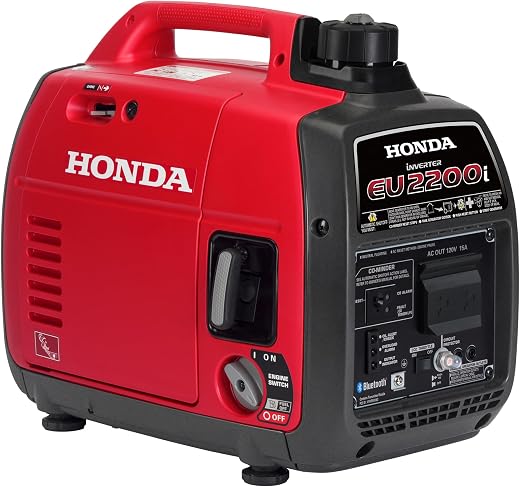
Honda 664240 EU2200i 2200 Watt Portable Inverter Generator with Co-Minder
Check current price on Amazon →
The Honda EU2200i is the best CARB-compliant generator here because it gets the balance right: 2,200 starting watts, 1,800 running watts, 47.4 lb, 48-57 dBA, and under 3% THD, per Honda’s published specs. It’s a clean-power inverter that makes sense for outages, tailgating, jobsite punch-list work, and light RV use where quiet operation matters.
In practice, 1,800 running watts is for essentials, not whole-house backup. Think refrigerator, modem and router, lights, fan, chargers, small electronics, and carefully managed small appliances. The EU2200i’s low total harmonic distortion is the reason it’s a safer fit for sensitive electronics than a standard open-frame generator.
The 0.95-gal tank runs up to 8.1 hours at quarter load, and Honda’s figure is about 3.2 hours at full rated load. Current models include Honda’s CO-MINDER carbon-monoxide shutoff, which is a real safety advantage, but it doesn’t make indoor operation safe. Run it outdoors, away from openings, and treat carbon monoxide like the killer it is.
Pros
- 2,200 starting watts and 1,800 running watts in a 47.4 lb package
- Very quiet for a gas generator at 48-57 dBA
- Under 3% THD, so it’s suitable for sensitive electronics
- Runs up to 8.1 hours at quarter load from a 0.95-gal tank
- Current models include Honda’s CO-MINDER carbon-monoxide shutoff
Cons
- Premium price for 1,800 running watts
- Gasoline only
- No electric start, and a 30A RV hookup needs a parallel kit or adapter
Best dual fuel: Champion 200988 4500-Watt Dual Fuel Inverter

Champion Power Equipment 200988 4500-Watt Dual Fuel RV Ready Portable Inverter Generator, Electric Start
Check current price on Amazon →
The Champion 200988 is the best CARB-compliant dual-fuel pick because it gives you inverter-grade power, an RV-ready outlet, electric start, and the flexibility to run gasoline or propane. Champion’s published figures are 4,500 starting watts and 3,500 running watts on gasoline, or 4,500 starting watts and 3,150 running watts on propane.
That propane option matters during an outage. A standard 20-lb propane tank gives up to 21 hours at 25% load, per Champion’s figure, so you can keep modest essentials running without pouring gasoline in the dark. Propane stores cleanly, doesn’t gum up the carburetor like old gasoline, and is easier to rotate if you already keep tanks for a grill or RV.
This is still a 103 lb machine with wheels, so it’s not a suitcase inverter. At 61 dBA, it’s louder than the smaller inverters on this list, but it also brings more usable wattage and RV-ready 30-amp convenience. The under 3% THD rating makes it a cleaner choice for electronics than a conventional open-frame generator.
Pros
- Runs on gasoline or propane
- 4,500 starting watts and 3,500 running watts on gasoline
- Up to 21 hours at 25% load on a standard 20-lb propane tank
- Electric start with battery plus Cold Start Technology
- RV-ready 30-amp outlet and under 3% THD
Cons
- 103 lb is heavy for one person
- 61 dBA is louder than the smaller inverters here
- Propane output drops about 10%
Best budget: WEN 56203i 2000-Watt Inverter

WEN 56203i Super Quiet 2000-Watt Portable Inverter Generator w/Fuel Shut Off, CARB Compliant, Ultra Lightweight, Black/Orange
Check current price on Amazon →
The WEN 56203i is the budget winner because it’s usually the cheapest name-brand CARB inverter while still bringing clean power and a useful feature set. WEN lists 2,000 surge watts, 1,700 rated watts, a 79cc engine, 39 lb weight, and 51 dB at quarter load.
This is a small-load generator, and that’s the right way to use it. It can handle basic outage essentials, battery chargers, lights, small electronics, and campsite loads that don’t need a 30-amp RV outlet. It won’t run an RV air conditioner, so RV owners should step up to the Westinghouse or Champion if that’s the goal.
The standout feature is the fuel shutoff. It lets the engine burn remaining carburetor fuel before shutdown, which helps prevent gumming during storage. WEN also lists eco-mode, a 1-gal tank with over 7 hours of half-load runtime, THD under 0.3% at no load and 1.2% at full load, plus two 120V outlets, 12V DC, and two USB ports.
Pros
- Usually the cheapest name-brand CARB inverter
- 39 lb, making it the lightest generator on this list
- 51 dB at quarter load
- Fuel shutoff helps prevent carburetor gumming during storage
- Very low THD: under 0.3% at no load and 1.2% at full load
Cons
- 1,700 running watts won’t run an RV air conditioner
- Plastic housing feels budget-grade
- No RV TT-30 outlet
Best for home backup: DuroMax XP12000EH Dual Fuel
Check current price on Amazon →
The DuroMax XP12000EH is the right CARB-compliant choice here if your priority is home-backup wattage instead of campground manners. It’s rated at 12,000 starting watts and 9,500 running watts on gasoline, with 9,025 running watts on propane, per DuroMax’s published specs.
This is the unit for bigger outage plans: hard-starting loads, 120V/240V needs, and running more of the house through the right electrical setup. The MX2 120V/240V switch gives it the flexibility that smaller inverter generators don’t have. If you’re connecting any portable generator to home circuits, use the proper transfer equipment and a qualified electrician.
The tradeoff is noise, weight, and power quality. The XP12000EH is an open-frame generator, not an inverter, and DuroMax lists it as over 200 lb with a heavy-duty frame and wheel kit. Because it’s not an inverter, total harmonic distortion is higher than the inverter picks here, so sensitive electronics should go through a UPS or surge protection.
Pros
- 12,000 starting watts and 9,500 running watts on gasoline
- 9,025 running watts on propane
- Dual fuel operation with gas or LP
- Keyed electric start
- MX2 120V/240V switch for broader home-backup use
Cons
- Open-frame and loud compared with inverters, so it’s not a campground unit
- Over 200 lb, making it a two-person job
- Not an inverter, so sensitive electronics need a UPS or surge protection
Best for RV: Westinghouse iGen4500

Westinghouse Outdoor Power Equipment 4500 Peak Watt Super Quiet Portable Inverter Generator, Remote Electric Start with Auto Choke, Wheel & Handle Kit, RV Ready, Gas Powered, Parallel Capable
Check current price on Amazon →
The Westinghouse iGen4500 is the best CARB-compliant RV generator on this list because it puts 4,500 peak watts and 3,700 running watts into an inverter package with a built-in TT-30R 30-amp RV outlet. Westinghouse also lists 52 dBA noise, THD of 3% or less, a 3.4-gal tank, and up to 18 hours at 25% load.
For RV owners, the outlet layout matters as much as the wattage. A built-in TT-30R means you don’t have to build the generator around adapters just to plug in a standard 30-amp RV cord. The remote electric start with key fob is also handy when the generator is outside and you don’t want to walk out for every start.
At 98 lb, this isn’t a light grab-and-go generator, but the telescoping handle helps. The LED data center is useful for checking operating status without guessing. The weak spot is rough ground: the rear wheels are small, so it’s better on packed surfaces than rutted campsites.
Pros
- 4,500 peak watts and 3,700 running watts
- Built-in TT-30R 30-amp RV outlet
- 52 dBA noise rating
- Up to 18 hours at 25% load from a 3.4-gal tank
- Remote electric start with key fob
Cons
- 98 lb
- Gasoline only, though a dual-fuel iGen4500DF exists
- Rear wheels are small for rough ground
How to choose a CARB-compliant generator
Sizing your wattage
Start with running watts, then check starting watts for anything with a motor or compressor. A generator can handle a brief surge above its running rating, but it can’t carry that surge forever. That’s why the Honda’s 2,200 starting watts and 1,800 running watts are a very different class from the Westinghouse’s 4,500 peak watts and 3,700 running watts.
For home backup, write down only the loads you truly need during an outage. Refrigerator, internet gear, lights, fan, furnace controls, medical gear, and a few outlets can be a very different plan than trying to power the whole house. Use our generator wattage calculator before you buy, because oversizing wastes fuel and undersizing trips breakers.
RV buyers should pay special attention to the outlet and the running-watt number, not just the peak number in the product title. A small 1,700 running-watt inverter like the WEN is great for simple campsite loads, but WEN’s own limitation is clear: it won’t run an RV air conditioner. The Westinghouse and Champion are better fits if RV convenience is the main goal.
Inverter vs open frame
Inverter generators are the better pick for most portable use because they’re quieter, cleaner, and easier to live with. The Honda EU2200i, Champion 200988, WEN 56203i, and Westinghouse iGen4500 all publish low-THD output suitable for electronics. That matters for phones, laptops, TVs, battery chargers, routers, and modern appliance controls.
Open-frame generators trade comfort for output. The DuroMax XP12000EH gives you far more wattage than the inverter picks here, along with 120V/240V capability, but it’s loud compared with inverters and weighs over 200 lb. It’s the better home-backup tool, not the better neighbor-friendly camping tool.
If you’re leaning toward clean, quiet portable power, compare these picks with our broader guide to the best inverter generators. If you need heavy home-backup wattage, accept that noise and weight come with the territory.
Fuel type
Gasoline gives you the highest output on the dual-fuel Champion and DuroMax models. Champion rates the 200988 at 3,500 running watts on gasoline and 3,150 running watts on propane, so propane output drops about 10%. DuroMax rates the XP12000EH at 9,500 running watts on gasoline and 9,025 running watts on propane.
Propane’s advantage is storage and availability. A standard 20-lb propane tank can run the Champion up to 21 hours at 25% load, and a 40-lb propane tank can run the DuroMax about 7.2 hours at 50% load. For a deeper fuel-planning breakdown, use our guide to propane consumption.
Gasoline-only inverters still make sense if you want lower weight, lower noise, or a simpler setup. The Honda, WEN, and Westinghouse are all gasoline-only models in this list. Just store fuel safely, rotate it, and don’t leave old gas sitting in a carburetor if the generator has a better shutdown option like WEN’s fuel shutoff.
Noise limits
Noise is where the spec sheet tells a lot of the story. The Honda EU2200i is rated at 48-57 dBA, the WEN 56203i at 51 dB at quarter load, and the Westinghouse iGen4500 at 52 dBA. Those are the best fits here for quiet neighborhoods, campsites, and RV parks.
Many campgrounds use 60 dBA as a practical rule of thumb, though every campground sets its own rules. The Champion 200988 is rated at 61 dBA, so it’s still inverter-quiet compared with open-frame home-backup units, but it’s not as quiet as the smaller Honda or WEN. The DuroMax XP12000EH is the wrong tool for campground use because it’s open-frame and loud compared with inverters.
Load affects sound, too. A generator working hard will be louder than the same generator loafing along in eco-mode. If noise matters, buy enough running watts that the generator isn’t constantly pinned near its rated output.
Bottom line
Buy the Honda EU2200i if you want the best overall CARB-compliant generator: it’s quiet, light, clean enough for electronics, and 50-state legal. Buy the WEN 56203i if you want the cheapest name-brand CARB inverter for smaller loads. Buy the DuroMax XP12000EH if home-backup wattage matters more than noise and portability. If you want more mid-size options, compare this list with our guide to the best 3000-watt generators.
Frequently asked questions
What does CARB compliant mean for a generator?
CARB compliant means the generator meets California Air Resources Board emissions rules for portable generators. It meets tighter evaporative and exhaust emission limits under California’s Small Off-Road Engine rules.
Do I need a CARB-compliant generator outside California?
Outside California, you can buy either CARB-compliant or non-CARB models if your state allows them. A CARB-compliant generator is still the safer default because it is 50-state legal and can hold resale value across all states.
Can I use a non-CARB generator in California?
Gas generators you already own stay legal to use in California. The restriction is on buying or shipping new non-CARB generators into California; listings marked 49-state are not California-legal for new sale there.
Are CARB-compliant generators less powerful?
No. CARB compliance does not make a generator less powerful by itself. A CARB-compliant generator works like any other generator with the same published wattage; it just meets tighter emissions limits.
Is the Honda EU2200i CARB compliant?
Yes. The Honda EU2200i is CARB-compliant, sold in California, and 50-state legal as of July 2026. It is rated at 2,200 starting watts and 1,800 running watts.
Are gas generators banned in California?
No. Gas generators you already own stay legal to use. The model-year 2028 zero-emission requirement is currently set for new portable generators sold in California, subject to a CARB technology-readiness review.
What is the quietest CARB-compliant generator?
From this list, the WEN 56203i is rated at 51 dB at quarter load, and the Honda EU2200i is rated at 48-57 dBA. Both are conversation-level choices compared with larger open-frame generators.


