For a small 2,500W inverter running essentials about 12 hours a day, store roughly 4 gallons of gas or two full 20 lb propane bottles for 3 days; a 9,500W whole-home-lite generator needs about 20 gallons of gas or five 20 lb bottles for the same 3 days. A mid-size 4,500W inverter lands between them at about 6 gallons of gas or two 20 lb propane bottles for 3 days.
Three days is the floor, not the finish line. Seven days is the comfortable target if you have the storage space, safe containers, and a generator plan that doesn’t burn fuel you don’t need to burn. This page shows the per-day math so you can scale it to your generator before landfall.
How many days of fuel you actually need
NOAA says the climatological peak of the Atlantic hurricane season is September 10, with most activity happening between mid-August and mid-October. That’s the stretch when fuel planning matters most, because the gas station may be out of fuel or out of power right when you need it. NOAA’s explainer on the peak of hurricane season is a good reminder that September planning is not early planning.
Federal emergency-preparedness guidance is built around being self-sufficient for at least 72 hours. For generator fuel, that means 3 days is the minimum number to plan around, not a generous reserve.
Hurricane outages can run longer than the basic preparedness window, and fuel trucks do not always return as soon as the sky clears. That’s why a 7-day fuel plan is the better comfort target for a generator you actually depend on for refrigeration, medical gear, fans, communications, or a window AC.
The right number is not the same for every house. A small inverter sipping fuel for a fridge, lights, and chargers is a different animal than a big open-frame dual-fuel unit carrying heavy loads. The burn rate depends on the generator, so start there.
Your generator’s real burn rate
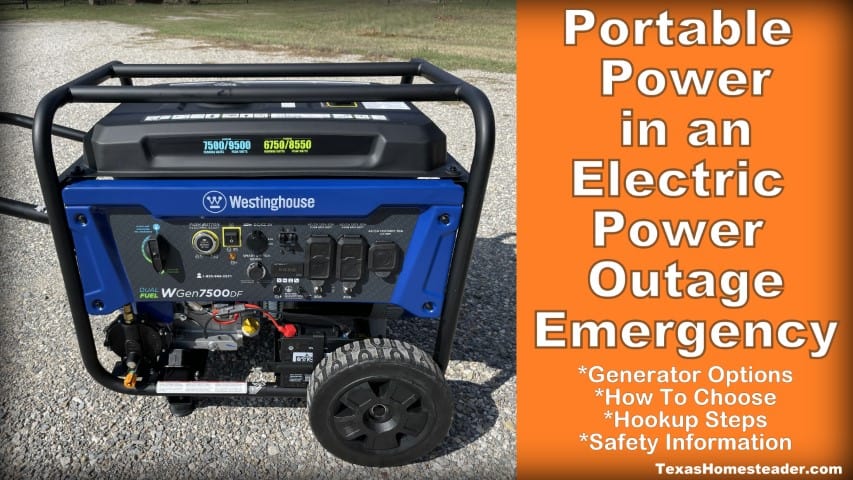
Manufacturer runtime ratings are the cleanest starting point because they tie tank size, load, and runtime together. The table below uses published figures from Champion and Westinghouse, then converts those ratings into gallons per hour and gallons per day using the same 12-hour daily run schedule.
| Model | Running watts (gas) | Published runtime & load | Works out to (gal/hr) | Gal per day (12 hr/day) |
|---|---|---|---|---|
| Champion 201122 | 1,850 running W | 11.5 hours at 25% load on 1.1 gal, per Champion | 1.1 ÷ 11.5 ≈ 0.096 | 0.096 × 12 ≈ 1.2 |
| Champion 200988 | 3,500 running W | 14 hours at 25% load on 2.3 gal, per Champion | 2.3 ÷ 14 ≈ 0.16 | 0.16 × 12 ≈ 1.9 |
| Westinghouse WGen9500DF | 9,500 running W | Up to 12 hours at 25% load on 6.6 gal, per Westinghouse | 6.6 ÷ 12 ≈ 0.55 | 0.55 × 12 ≈ 6.6 |
These figures assume continuous running at the stated load. Most storm households do not need to run a portable generator all night. A realistic planning schedule is about 12 hours a day: daytime plus evening, then off overnight if the house and loads allow it.
If you plan to run continuously, double the daily fuel number. That turns the small inverter from about 1.2 gallons per day into about twice that, and it turns the large 9,500W unit from about 6.6 gallons per day into a much bigger storage problem.
Load discipline matters as much as generator size. Use the generator wattage calculator to decide what you actually need to power, then use our gasoline consumption guide if you want more per-hour examples for different generator sizes.
The 3-day and 7-day gasoline math
Once you know gallons per day, the hurricane math is simple. Multiply by 3 days for the minimum plan and by 7 days for the better reserve. Then round up to real gas cans, because nobody stores exactly 5.8 gallons cleanly.
| Model | 3-day gallons | 5-gal cans | 7-day gallons | Cans |
|---|---|---|---|---|
| Champion 201122 | ≈ 3.5 gal | One can | ≈ 8.1 gal | Two cans |
| Champion 200988 | ≈ 5.8 gal | Two cans | ≈ 13.5 gal | Three cans |
| Westinghouse WGen9500DF | ≈ 19.8 gal | Four cans | ≈ 46.2 gal | Gasoline-only planning breaks down |
For a small inverter, the 3-day answer is easy: one full 5-gallon can is enough room to cover the roughly 3.5-gallon need. For a mid-size inverter, two cans covers the roughly 5.8-gallon need with practical headroom. For a 9,500W unit, four cans gets you through the 3-day gasoline plan, assuming the published 25% load figure matches how you run the unit.
The 7-day number is where large gasoline plans get ugly. The Westinghouse example works out to about 46.2 gallons for 7 days at 12 hours per day. That is well beyond what most homeowners can store safely or legally around the house.
NFPA 30 allows no more than 25 gallons of gasoline inside a dwelling, in approved containers. It also limits gasoline in an attached garage to no more than 10 gallons, prohibits gasoline storage in basements, and treats empty containers as full. Local codes are often stricter, so check your fire department before you build a fuel stash.
That storage limit is the honest argument against a gasoline-only plan for a large generator. If your math says you need more than the safe storage amount, the fix is not more red cans in bad places. The fix is propane for reserve, a smaller load, shorter run windows, or a generator strategy built around essentials instead of everything in the panel.
Shop 5-gallon gas cans on Amazon →
Keeping stored gasoline fresh until landfall
Gasoline is convenient, but it does not sit forever. Untreated pump gas can start degrading in as little as 30 days, according to Gold Eagle, the maker of STA-BIL. That matters during hurricane season because a can filled early may not be fresh by the next named storm.
STA-BIL’s published claim is that treated fuel stays fresh up to 24 months when dosed at 1 oz per 2.5 gallons. If you store gasoline for storm season, treat it when you fill the can, not after it has already been sitting.
Check STA-BIL Storage stabilizer prices on Amazon →
Date every can with a marker as soon as you fill it. Every few months, run the stored gas through a vehicle and refill the can with fresh treated fuel. That habit keeps your hurricane fuel from turning into varnish while still leaving you ready when a storm track shifts your way.
Do not count on buying stabilizer, cans, or fuel the day before landfall. The time to fill, treat, label, and stage your cans is before the cone points at your county.
The propane side: bottles beat cans for storage
Propane’s big storage advantage is simple: it does not degrade in the tank. There is no stabilizer dose, no stale-fuel smell, and no rotation schedule like gasoline. If the cylinder is in good shape and properly filled, the fuel is ready when you need it.
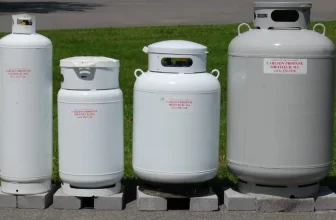
A properly filled 20 lb propane cylinder holds about 4.7 gallons because propane weighs about 4.24 lb per gallon. Exchange-rack bottles are often filled to 15 lb, which is about 3.5 gallons, and the sleeve says so. That difference matters when you are counting days of runtime.
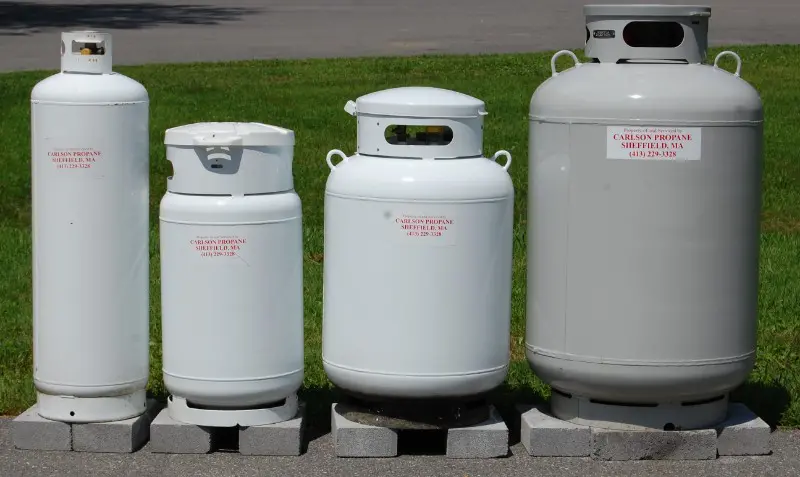
On the Champion 201122, Champion publishes 34 hours at 25% load on a 20 lb tank. Using 4.7 gallons per true fill, that works out to 4.7 ÷ 34 ≈ 0.14 gal/hr, or about 0.14 × 12 ≈ 1.7 gal/day. A full 20 lb bottle lasts about 4.7 ÷ 1.7 ≈ 2.8 days on that schedule, so the 3-day plan is two full bottles.
On the Champion 200988, Champion publishes 21 hours at 25% load on a 20 lb tank. That works out to 4.7 ÷ 21 ≈ 0.22 gal/hr, or about 0.22 × 12 ≈ 2.6 gal/day. A full 20 lb bottle lasts about 4.7 ÷ 2.6 ≈ 1.8 days, so the 3-day plan is also two bottles.
On the Westinghouse WGen9500DF, Westinghouse publishes up to 7 hours at 50% load on a 20 lb tank and about 0.67 gal/hr propane consumption at that load. At 12 hours per day, that is about 0.67 × 12 ≈ 8 gal/day. For 3 days, you need roughly 24 gallons, which is about five full 20 lb bottles or one 100 lb cylinder.
The 100 lb cylinder is why propane makes sense for bigger generators. A 100 lb cylinder holds about 23.6 gallons, and 23.6 ÷ 8 ≈ 3 days for the Westinghouse example at the stated propane load. That is far cleaner than trying to safely store a week of gasoline for a large unit.
Propane does carry less energy per gallon than gasoline. Per EIA energy figures, gasoline contains 120,214 Btu/gal while propane contains 91,452 Btu/gal, about 24% less. That is why dual-fuel generators are usually rated lower on propane.
Use our 20 lb propane tank runtime guide if you want bottle-by-bottle planning, and our propane consumption per hour guide if you want to compare propane burn rates by generator size.
Shop 20 lb propane tanks on Amazon →
A worked storm plan for three setups
Essentials-only inverter household
This is the small-inverter plan: fridge, lights, chargers, fans, and careful load management. For a Champion 201122-class generator running about 12 hours per day at the published 25% load figure, stage roughly 4 gallons of gasoline for 3 days or about 8.1 gallons for 7 days.
In real storage terms, that means one 5-gallon gas can for the 3-day floor or two cans for the 7-day target. If you prefer propane, stage two full 20 lb bottles for 3 days. The reasoning is straight from the tables: this class burns about 1.2 gallons of gasoline per day or about 1.7 gallons of propane per day on the planning schedule.
Mid-size inverter with fridge and window AC
This setup fits a Champion 200988-class inverter: more output than the small unit, but still manageable if you avoid running every load at once. For 3 days, stage about 5.8 gallons of gasoline, which rounds to two 5-gallon cans. For 7 days, stage about 13.5 gallons, which rounds to three cans.
On propane, plan on two full 20 lb bottles for 3 days. This generator class uses about 1.9 gallons of gasoline per day or about 2.6 gallons of propane per day at the published 25% load planning point. The gas plan is still practical, and propane makes a good no-rotation reserve.
Whole-home-lite 9,500W setup
This is the big portable plan: a Westinghouse WGen9500DF-class generator carrying heavier loads. For 3 days at 12 hours per day, the gasoline number is about 19.8 gallons, so stage four 5-gallon cans if gasoline is your short-term fuel.
The 7-day gasoline number is about 46.2 gallons, and that is where the plan runs into NFPA 30 storage reality. For propane, the 3-day number is roughly 24 gallons, which means five full 20 lb bottles or one 100 lb cylinder. The better strategy for this size is propane for the deeper reserve, gasoline for easy short-term top-ups, and tighter control over what the generator is actually powering.
Store only what you can store safely
A detached shed beats an attached garage for gasoline storage. Never store gasoline in a basement or living space, and do not treat the garage as a fuel room. Use approved containers, keep caps tight, and keep the cans where heat, sparks, and children are not part of the equation.
Keep gas cans clean and dedicated to gasoline. Dirt and water in a can become dirt and water in the generator carburetor or fuel system. If a can is swollen, cracked, missing a cap, or hard to seal, retire it before storm season gets serious.
For propane, check the cylinder valve, collar, and general condition before you count it as part of your plan. Store bottles upright, keep valves closed, and do not assume an exchange-rack bottle equals a true full 20 lb fill. If the sleeve says 15 lb, use the lower fuel amount in your math.
Put fuel rotation on the same calendar as the rest of your storm prep. Gasoline gets dated, treated, used in a vehicle every few months, and refilled. Propane gets inspected and topped off, but it does not need stabilizer or rotation.
Before a storm is named, walk through our hurricane generator checklist and make sure cords, oil, transfer equipment, carbon monoxide alarms, and fuel are ready. If you are still choosing a machine, start with our hurricane generator guide so you do not buy more generator than you can feed.
Bottom line
For a small 2,500W inverter running essentials about 12 hours a day, plan on roughly 4 gallons of gasoline or two full 20 lb propane bottles for 3 days. For a 9,500W whole-home-lite unit, plan on about 20 gallons of gasoline or five 20 lb bottles for the same 3 days.
Seven days is the better comfort target, but gasoline-only storage gets hard fast with big generators. The most practical storm plan is propane for the deep reserve, gasoline for the fast top-up, and a disciplined load plan that keeps the generator from drinking fuel you did not need to burn.
Frequently asked questions
How much gas should I store for a 3-day hurricane outage?
At 12 hours per day, store about 3.5 gallons for a small Champion 201122-class inverter at 25% load, about 5.8 gallons for a Champion 200988-class inverter at 25% load, or about 19.8 gallons for a Westinghouse WGen9500DF-class generator at 25% load. In real cans, that rounds to one, two, or four 5-gallon cans.
How much fuel do I need to run a generator for a week?
At 12 hours per day, the gasoline math is about 8.1 gallons for the small inverter, about 13.5 gallons for the mid-size inverter, and about 46.2 gallons for the 9,500W unit. The big-unit answer usually needs propane or stricter load discipline because NFPA 30 storage limits make a large gasoline-only reserve impractical.
How many 20 lb propane tanks should I have for a hurricane?
For 3 days at 12 hours per day, two full 20 lb bottles covers the small inverter and two bottles also covers the mid-size inverter based on the published 25% load figures. A 9,500W unit at the published propane load needs about five 20 lb bottles or one 100 lb cylinder for the same 3 days.
Can I legally store 20 gallons of gas in my garage?
NFPA 30 limits gasoline in an attached garage to no more than 10 gallons, even though the in-dwelling cap is 25 gallons in approved containers. Gasoline is not allowed in basements, and empty containers count as full. Local codes can be stricter, so check your fire department.
How long does stored gasoline stay good?
Untreated pump gas can start degrading in as little as 30 days. STA-BIL’s published claim is that treated fuel stays fresh up to 24 months when dosed at 1 oz per 2.5 gallons. Date every can and rotate stored gas through a vehicle every few months.
Is it better to store propane or gasoline for a hurricane?
Propane is better for long storage because it does not degrade in the tank and does not need stabilizer. Gasoline is easier to top up quickly and carries about 24% more energy per gallon per EIA figures. Most solid hurricane plans use both: propane for reserve and gasoline for quick refills.