
A 20 lb propane tank will run a generator anywhere from about 3 hours to 34 hours, depending on generator size and load. A 2,500W inverter sipping at quarter load gets Champion’s published 34 hours from a 20 lb tank, while a 13,000W open-frame unit at half load drains the same bottle in about 3 hours.
A properly filled 20 lb cylinder holds about 4.7 gallons of propane. Exchange bottles are often labeled 15 lb instead, which is about 3.5 gallons, so they cut the runtimes below to about 0.75 of the full-cylinder number.
This page gives you manufacturer-published runtime figures with the load stated, then shows the math for a 100 lb cylinder and a 500-gallon stationary tank. If you’re provisioning before a storm, don’t just count bottles; match the tank size to the generator’s fuel draw.
What’s actually inside a 20 lb propane tank
A standard 20 lb propane cylinder holds about 4.7 gallons when it’s properly filled, because propane weighs about 4.24 lb per gallon. Propane contains 91,452 Btu per gallon, according to the EIA conversion factor, compared with 120,214 Btu per gallon for gasoline.

That energy gap matters. Propane has about 24% less energy per gallon than gasoline, which is why every dual-fuel generator has a lower wattage rating on propane than it does on gas.
The catch is the exchange rack outside the store. The big exchange brands commonly short-fill cylinders, and the sleeve label typically says 15 lb, not 20 lb. A 15 lb fill is about 3.5 gallons, so any runtime based on a full 20 lb cylinder gets cut by roughly a quarter.
Propane’s storage advantage is real, though. It does not degrade in the tank and does not need stabilizer, while gasoline is a months-scale fuel. The steel cylinder is the part with a clock on it: common exchange-style cylinders need DOT requalification 12 years after manufacture.
Published 20 lb tank runtimes by generator size
Here are real published figures for common dual-fuel generators, using the load level stated by the manufacturer or published source. The last column turns the 20 lb tank into gallons per hour so you can scale the math to a larger tank.
| Model | Class | Running watts on propane | Published runtime on 20 lb | Load level | Works out to (gal/hr) |
|---|---|---|---|---|---|
| Champion 201122 | 2,500W ultralight inverter | 1,665 W | Up to 34 hours | 25% load | 4.7 gal ÷ 34 hr ≈ 0.14 gal/hr |
| Champion 200988 | 4,500W inverter | 3,150 W | Up to 21 hours | 25% load | 4.7 gal ÷ 21 hr ≈ 0.22 gal/hr |
| Westinghouse WGen9500DF | 12,500W dual-fuel portable | 8,500 W | Up to 7 hours | 50% load | About 0.67 gal/hr; 4.7 gal ÷ 0.67 gal/hr ≈ 7.0 hr |
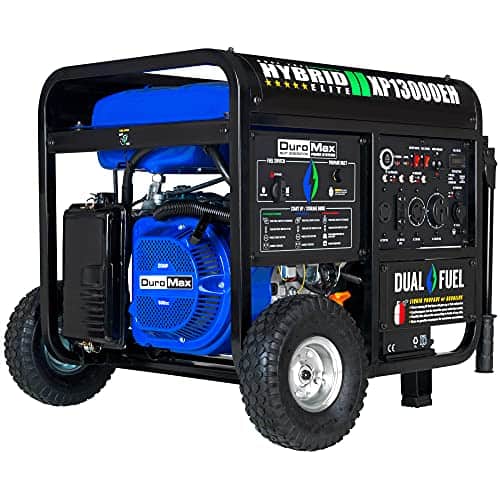
| DuroMax XP13000EH | 13,000W dual-fuel portable | 9,975 W | About 3 hours | 50% load | 4.7 gal ÷ 3 hr ≈ 1.6 gal/hr |
Load level is half the story. A 34-hour number at 25% load and a 7-hour number at 50% load are not measuring the same work, and neither tells you what happens if you run the generator near its propane running-watt limit.
That is why a 20 lb bottle feels huge on a small inverter and tiny on a storm-size open-frame generator. For more model shopping context, see our guide to the best propane generators.
The Champion 200988 is the middle ground in this set. Champion publishes up to 21 hours at 25% load on a 20 lb tank, and the math works out to about 0.22 gallons per hour. Its 3,150 W propane running rating is enough for RV loads and light home backup, but it still rewards you for keeping the load modest.
Check the Champion 200988 price on Amazon →
The Westinghouse WGen9500DF is the storm-generator example. Westinghouse publishes up to 7 hours at 50% load on a 20 lb tank and also lists about 0.67 gallons per hour at that load. That puts it in “hours, not days” territory unless you move up to larger propane storage.
Check the Westinghouse WGen9500DF price on Amazon →
The DuroMax XP13000EH shows why big dual-fuel units are hard on small bottles. GeneratorBible’s published figure is about 3 hours at 50% load on a 20 lb tank, and DuroMax recommends at least a 40 lb tank on this class of generator for steadier fuel delivery.
Check the DuroMax XP13000EH price on Amazon →
Small inverters are the natural partners for grill-style cylinders. If that’s the route you want for RV use, refrigerators, electronics, and quiet backup, compare our dual-fuel inverter picks before buying more generator than your propane setup can comfortably feed.
The math for any generator
The simple formula is: tank gallons divided by published hours equals gallons per hour. Then you use that gallons-per-hour number to estimate another tank size at the same load.
Start with a runtime figure that states the load. If the maker says a 20 lb tank runs 21 hours at 25% load, divide 4.7 gallons by 21 hours. That gives about 0.22 gallons per hour at that load.
Now rescale the tank. A 100 lb cylinder holds about 23.6 gallons, so the same generator at the same load gets about 23.6 gallons divided by 0.22 gallons per hour. That is the same as multiplying the 20 lb runtime by about 5, because 23.6 ÷ 4.7 ≈ 5.
The Westinghouse WGen9500DF cross-check is cleaner because Westinghouse publishes the consumption rate. At 50% load, Westinghouse lists about 0.67 gallons per hour. Multiply 0.67 gallons per hour by 7 hours and you get about 4.7 gallons, so the published consumption and published 20 lb runtime agree.
If you already know the generator’s propane burn rate, use that directly. If you only have a tank runtime, turn it into gallons per hour first. For a broader per-hour reference, keep our propane consumption per hour guide open next to this page.
Do not mix load levels. A rate calculated at 25% load should not be used to predict a hard 50% load unless you’re only trying to build a rough fuel cushion. Real fuel use rises when the generator works harder.
How long will a 100 lb propane tank run a generator?
A 100 lb propane cylinder holds about 23.6 gallons. Since a full 20 lb tank holds about 4.7 gallons, a 100 lb cylinder is about 5 times the fuel, so you can multiply any 20 lb runtime by about 5 at the same load.
Using Champion’s published 201122 number, 34 hours at 25% load becomes about 170 hours on a 100 lb cylinder. That is roughly a week of continuous light-load inverter running, before accounting for maintenance stops and changing electrical loads.
Using the Westinghouse WGen9500DF number, 7 hours at 50% load becomes about 35 hours on a 100 lb cylinder. That’s a much better match for a larger storm generator than a 20 lb bottle, but it is still not unlimited fuel.
The trade-off is handling. A 100 lb cylinder is far heavier than a grill bottle and usually stays put once placed. That can be fine beside a generator pad or shed, but it is less convenient for RV travel or quick bottle swaps in bad weather.
If you are building a storm fuel plan, count the load you actually need to carry and the refills you can realistically get. Our guide on how much fuel to store for a hurricane walks through that broader planning problem.
How long will a 500-gallon tank run a generator?
A 500-gallon stationary propane tank is not filled to 500 usable gallons. It is filled to 80% for safety, which gives about 400 usable gallons.
Using the Westinghouse WGen9500DF half-load figure, 400 usable gallons divided by 0.67 gallons per hour equals about 597 hours. That is about 24-25 days of continuous half-load running for a 9,500W-class portable generator, based on Westinghouse’s published propane consumption figure.
That number is fuel math, not a permission slip to run a portable generator nonstop for that long. Multi-day operation means oil changes, shutdowns, inspections, and rest periods. If your plan is to power major loads through long outages, use our hurricane generator guide to think through the generator side, not just the tank side.
This is also where standby-generator territory begins. A large stationary propane tank can support serious backup power, but installation, clearances, refilling, and service access matter. If you have natural gas available and want to avoid the tank-limit problem, compare tri-fuel generators before committing to propane-only storage.
Why big generators starve small tanks
Runtime is not the only issue with a 20 lb bottle. A propane cylinder has to vaporize liquid propane fast enough to feed the engine, and that vaporization rate drops as the tank empties and as temperature falls.
That is why a big generator can run fine on a full bottle and stumble later, even though there is still propane inside. The engine is asking for vapor faster than the small, cold, partly empty cylinder can supply it.
DuroMax’s guidance on its 13,000W class makes the point clearly: it recommends at least a 40 lb tank for steady fuel delivery. The DuroMax XP13000EH may connect to a 20 lb tank, but GeneratorBible’s published runtime is only about 3 hours at 50% load, and the small tank can be the weak link.
For small inverters under about 2,500W, a 20 lb cylinder is a natural match. For open-frame storm units, especially the kind people buy to run refrigerators, pumps, window air conditioners, and kitchen loads, 40 lb to 100 lb cylinders make more sense.
Stretching every hour of propane
The best way to stretch propane is to cut load. Run the lowest wattage that does the job, and use eco or economy throttle modes where the generator has them.
Stagger big appliances instead of starting everything at once. A refrigerator, pump, microwave, and air conditioner do not all need to hit the generator at the same time if you manage the house manually.
Before buying fuel, list the loads you actually plan to run and check them with our generator wattage calculator. Oversizing the generator can burn more propane than you expected, while undersizing it can force overloads and constant load juggling.
Keep a second full bottle ready if you are using 20 lb cylinders. Swap bottles with the valve closed, keep the spare closed until needed, and treat exchange bottles as 15 lb fills unless the label says otherwise.
Propane also rewards advance planning. Because it does not go bad in the tank, you can store it without the stabilizer routine that gasoline needs. The cylinder itself still needs to be in date, so check the manufacture date before you count it as storm fuel.
Bottom line
A 20 lb propane tank is an overnight-to-multi-day fuel source for small inverters, but it is only hours of runtime for large storm generators. The real range is about 3 hours to 34 hours based on the published examples above.
Buy tank capacity to match the generator, not the other way around. For a small inverter, a 20 lb bottle makes sense; for open-frame storm power, step up to 40 lb, 100 lb, or a stationary tank sized around your actual load.
Frequently asked questions
How long will a 20 lb propane tank run a generator?
A 20 lb propane tank runs a generator about 3 to 34 hours, depending on generator size and load. Champion publishes up to 34 hours at 25% load for the 2,500W Champion 201122, while GeneratorBible lists about 3 hours at 50% load for the 13,000W DuroMax XP13000EH.
How many gallons of propane are in a 20 lb tank?
A properly filled 20 lb propane tank holds about 4.7 gallons, using propane’s weight of about 4.24 lb per gallon. Many exchange bottles are filled to 15 lb instead, which is about 3.5 gallons and cuts runtime to about 0.75 of a full 20 lb cylinder.
How long will a 100 lb propane tank run a generator?
A 100 lb propane tank holds about 23.6 gallons, or about 5 times a full 20 lb cylinder. Multiply the 20 lb runtime by about 5 at the same load; Champion’s 201122 example goes from 34 hours at 25% load to about 170 hours.
How long will 500 gallons of propane run a whole-house-size portable generator?
A 500-gallon stationary tank has about 400 usable gallons at an 80% fill. Using Westinghouse’s 0.67 gal/hr figure for the WGen9500DF at half load, that works out to about 597 hours, or about 24-25 days, but long runs need oil changes and shutdowns.
Can I run a 10,000+ watt generator on a 20 lb tank?
It may connect, but a 20 lb tank is a poor match for that class of generator. The DuroMax XP13000EH is listed at about 3 hours at 50% load on a 20 lb tank, and DuroMax recommends at least a 40 lb tank for steady fuel delivery.
Does propane go bad in storage?
No. Propane does not degrade in the tank and does not need stabilizer, unlike gasoline, which is a months-scale fuel. The cylinder still needs DOT requalification; common exchange-style cylinders are requalified 12 years after manufacture.


