
The best tri-fuel generator for most home backup buyers is the DuroMax XP13000HXT because it still delivers 9,000 running watts on natural gas, with 10,500 running watts on gasoline and 10,000 on propane. Tri-fuel matters because a natural-gas hookup gives you effectively unlimited runtime during an outage, as long as the gas utility keeps flowing.
Most generator spec sheets lead with the gasoline number, but that’s not the number to size against if you plan to run from your home’s gas line. Every tri-fuel generator makes less power on propane than gasoline, and less again on natural gas, so the natural-gas running wattage is the planning number for home standby use.
Best tri-fuel generators compared
| Model | Watts on gasoline (peak/running) | Watts on propane | Watts on natural gas | Noise | Start |
|---|---|---|---|---|---|
| DuroMax XP13000HXT | 13,000 / 10,500 | 12,500 / 10,000 | 11,250 / 9,000 | Loud open-frame class | Push-button electric start |
| Champion 100416 | 10,000 / 8,000 | Not published; lower than gasoline | Not published; lower than propane | Open-frame noise | Electric start |
| Westinghouse WGen9500TFc | 12,500 / 9,500 | 11,200 / 8,500 | 9,500 / 7,500 | 74 dBA | Remote electric start with fob |
| Firman T07571 | 9,400 / 7,500 | 8,450 / 6,750 | 6,900 / 5,500 | 74 dB at 25% load | Electric start |
| Winco HPS12000HE | 12,000 / 10,800 | About 9,720 continuous | 8,640 continuous | About 78 dBA at 7 meters | Electric start |
Note how each fuel steps output down — size against the fuel you’ll actually run.
How tri-fuel generators work and why natural gas changes everything
A tri-fuel generator runs on gasoline, propane, or natural gas. That gives you three fuel paths during a storm: pour gasoline if stations are open, connect propane if you have tanks, or run from a natural-gas quick-connect if your house has service.
The natural-gas hookup is the killer feature. With gasoline, you’re limited by cans, stale fuel, and gas-station lines. With propane, you’re limited by tank inventory. With natural gas, runtime is effectively unlimited because the generator is tied into your home’s gas line.
The tradeoff is output. Natural gas has lower energy density than gasoline, and propane sits in between, so every tri-fuel generator derates as you move from gasoline to propane to natural gas. The DuroMax XP13000HXT drops from 10,500 running watts on gasoline to 9,000 on natural gas, while the Firman T07571 drops from 7,500 running watts on gasoline to 5,500 on natural gas.
That derate is not a flaw. It’s the physics of the fuel. The mistake is buying based on the gasoline number, then discovering the generator is smaller than expected once it’s connected to the house gas line.
Natural-gas hookups also need to be done correctly. You need adequate gas-line pressure and a proper quick-connect sized for the generator. Have a plumber or gas tech do the tie-in instead of treating it like a grill hose project.
Fuel storage is the other big difference. Propane stores indefinitely, gasoline goes stale in months, and natural gas never needs storing at all. If propane is part of your outage plan, use our propane generator fuel-use guide to think through tank size and burn-rate math before the storm hits.
Best overall: DuroMax XP13000HXT
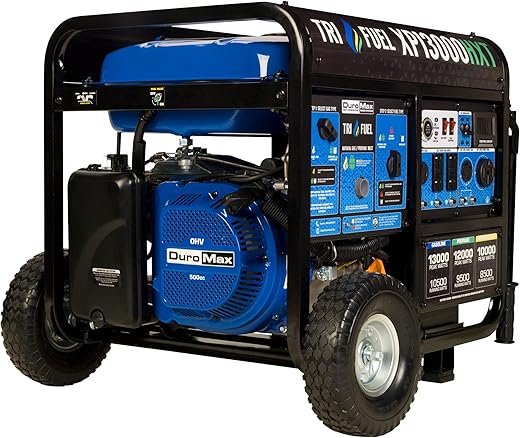
DuroMax XP13000HXT 13,000-Watt 500cc Tri Fuel Gas Propane Natural Gas Portable Generator with CO Alert, Black/Blue
Check current price on Amazon →
The DuroMax XP13000HXT is the strongest all-around tri-fuel pick because its natural-gas number stays high: 11,250 peak watts and 9,000 running watts on NG, per DuroMax’s published specs. On gasoline it’s rated at 13,000 peak watts and 10,500 running watts, and on propane it’s rated at 12,500 peak watts and 10,000 running watts.
That matters for a real house. If you sketch an essentials load with a 700-watt refrigerator, a 1,050-watt sump pump, and a roughly 700-watt furnace blower, the DuroMax still leaves a useful cushion on natural gas. It’s the kind of output that makes sense for a transfer-switch setup instead of a couple of loose extension cords.
The hardware fits that role. The XP13000HXT has a 500cc OHV engine, push-button electric start, front-panel fuel selection, CO Alert shutoff, and a 50-amp transfer-switch-ready outlet. Runtime is listed at 8.5 hours at rated load on gasoline and 6.5 hours at rated load on propane, and the unit is EPA and CARB certified for all-state sale.
This is still a big open-frame machine, not a quiet inverter. It’s wheeled, but moves are a two-person job, and the open-frame sound level is part of the package. If you’re shopping this power class broadly, see our guide to more big-generator options.
Pros
- Best balance of high gasoline, propane, and natural-gas output.
- 9,000 running watts on natural gas is a strong home-backup number.
- 50-amp transfer-switch-ready outlet supports serious panel connection plans.
- CO Alert shutoff and front-panel fuel selection are useful safety and convenience features.
- EPA and CARB certified for all-state sale.
Cons
- Big and heavy, even with wheels.
- Loud open-frame class.
- Premium price compared with smaller tri-fuel units.
Best home-backup value: Champion 100416

Champion Power Equipment 100416 10,000/8,000-Watt TRI Fuel Portable Natural Gas Generator, NG/LPG Hose Kits and CO Shield
Check current price on Amazon →
The Champion 100416 is the value route if you want whole-panel essentials coverage on a natural-gas line without stepping into premium commercial pricing. Champion publishes 10,000 starting watts and 8,000 running watts on gasoline for this model, with output stepping down on propane and again on natural gas like every tri-fuel portable.
The catch is that Champion publishes fewer fuel-by-fuel figures here than the rivals in this list. That makes it harder to plan from the spec sheet alone if natural gas is your main fuel. For buyers who want exact NG wattage before purchase, the DuroMax, Westinghouse, Firman, and Winco listings are more transparent.
For the right home, the Champion still makes sense. Its 459cc Champion engine, electric start, and CO Shield auto-shutoff cover the basics that matter during outage work. If your load plan is essentials-first — refrigerator, sump pump, furnace blower, lights, and some outlets — it can be a practical buy, but don’t assume the 8,000-watt gasoline running number is what you’ll get on natural gas.
Pros
- Strong value pick for a true tri-fuel home-backup setup.
- 10,000 starting watts and 8,000 running watts on gasoline.
- Electric start keeps operation simple.
- CO Shield auto-shutoff adds an important safety layer.
Cons
- Fewer published fuel-by-fuel output figures than several rivals.
- Natural-gas planning number is not as clear from the published specs.
- Open-frame noise.
Best mid-size: Westinghouse WGen9500TFc
See Westinghouse WGen9500TFc listings on Amazon →
The Westinghouse WGen9500TFc is the best mid-size tri-fuel generator here because it gives clear numbers on all three fuels and still lands at 7,500 running watts on natural gas. Westinghouse lists 12,500 peak watts and 9,500 running watts on gasoline, 11,200 peak watts and 8,500 running watts on propane, and 9,500 peak watts and 7,500 running watts on natural gas.
That 7,500-watt natural-gas running rating is enough for a serious essentials plan. A 700-watt refrigerator, 1,050-watt sump pump, and roughly 700-watt furnace blower together leave room for lights, device charging, and selected outlets, assuming you manage startup loads. It’s not the model to pretend every large load in the house can run at once, but it’s a strong fit for outage discipline.
The WGen9500TFc also has one convenience feature that stands out: it can switch fuels without shutting down. It uses a 457cc engine, remote electric start with a fob, a CO sensor, and an L14-30R transfer-switch-ready outlet. Westinghouse lists a 6.6-gallon tank with up to 12 hours at 25% load, and about 7 hours on a 20-lb propane tank.
The main knock is noise. Westinghouse publishes 74 dBA, which is normal open-frame territory but not neighbor-friendly in a dense subdivision. Also, the gasoline runtime figure is a light-load number at 25% load, so expect less runtime as the load rises.
Pros
- Clear published output on gasoline, propane, and natural gas.
- 7,500 running watts on natural gas is solid for home essentials.
- Switches fuels without shutting down.
- Remote electric start with fob.
- L14-30R transfer-switch-ready outlet.
Cons
- 74 dBA is loud enough to notice.
- Gasoline runtime claim is based on 25% load.
- Expect less runtime at heavier household loads.
Best budget tri-fuel: Firman T07571
See Firman T07571 tri-fuel listings on Amazon →
The Firman T07571 is the budget pick because it’s regularly the cheapest true tri-fuel generator from a major brand. Firman lists 9,400 starting watts and 7,500 running watts on gasoline, 8,450 starting watts and 6,750 running watts on propane, and 6,900 starting watts and 5,500 running watts on natural gas.
That last number is the honest planning number. At 5,500 running watts on natural gas, this is an essentials machine, not a big-load machine. A worksheet with a 700-watt refrigerator, 1,050-watt sump pump, and roughly 700-watt furnace blower still leaves working room, but you’ll need to manage extras carefully.
The T07571 uses a 439cc engine, electric start, an 8-gallon tank, and a 12-hour run time. Firman publishes 74 dB at 25% load and backs the unit with a 3-year warranty. It’s sold at Lowe’s, and Firman also sells factory-refurbished T07571F units directly.
This is the pick for a homeowner who wants the security of natural gas without paying for the biggest output class. It’s also a good reminder that “tri-fuel” doesn’t automatically mean whole-house power. The generator can only deliver what its lowest-fuel rating allows.
Pros
- Strong budget path into true tri-fuel backup power.
- Published output numbers for gasoline, propane, and natural gas.
- Electric start.
- 8-gallon gasoline tank with a 12-hour run time.
- 3-year warranty.
Cons
- 5,500 running watts on natural gas is the real planning limit.
- Enough for essentials, not large simultaneous loads.
- Basic fit and finish compared with pricier models.
Premium commercial: Winco HPS12000HE
Ebay

The Winco HPS12000HE is the premium commercial pick, built around a Honda GX630 688cc commercial engine and a brushless alternator. Winco publishes 12,000 surge watts and 10,800 continuous watts on gasoline, about 9,720 continuous watts on propane, and 8,640 continuous watts on natural gas.
That 8,640-watt natural-gas output puts it close to the DuroMax for NG-backed home essentials, but the Winco’s appeal is different. This is a heavier-duty, dealer-channel machine for buyers who value the Honda commercial engine and brushless alternator more than the lowest price.
Fuel data is also more complete than most portable listings. Winco publishes a 15-gallon tank with about 9 hours at full load and 14.5 hours at half load. Published fuel burn is 1.67 gallons per hour of gasoline at full load, 2.2 gallons per hour of propane, and 200 cubic feet per hour of natural gas.
The tradeoffs are serious. The HPS12000HE weighs 425 lb and is rated about 78 dBA at 7 meters. It’s also a 49-state unit, not CARB compliant, so it can’t be sold in California.
Pros
- Honda GX630 688cc commercial engine.
- Brushless alternator.
- Strong continuous output on all three fuels.
- Detailed published fuel-burn data.
- About 9 hours at full load on the 15-gallon gasoline tank.
Cons
- Dealer-channel pricing is expensive.
- 425 lb is a major handling issue.
- About 78 dBA at 7 meters.
- 49-state only and not CARB compliant.
No natural gas line? Get a dual fuel instead
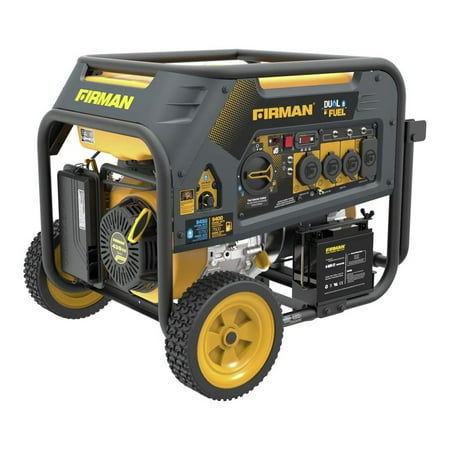
FIRMAN H07552 9400 / 7500 Watts Hybrid Dual Fuel Generator
 Walmart Affiliate Program
If your home has no natural-gas service, you probably don’t need a tri-fuel generator. A dual-fuel model gives you gasoline and propane, which covers the two fuels you can actually store on site.
The Firman H07552 is the clean alternative to the tri-fuel Firman above. It runs 9,400 starting watts and 7,500 running watts on gasoline, and 8,450 starting watts and 6,750 running watts on propane. It uses a 439cc engine, electric start, an 8-gallon tank for 12 hours, and is rated 74 dB.
Think of it as the same basic platform as the T07571 minus the natural-gas plumbing. It’s California-emissions certified and ships with the LP hose, which makes more sense than paying for NG capability you can’t use.
Tri-fuel conversion kits
Tri-fuel conversion kits can turn some gasoline-only generators into gasoline, propane, and natural-gas machines. Specialists such as Hutch Mountain and similar kit makers support popular gas-only units, including Honda inverter models.
These kits can work well, but the fit has to be exact. Make sure the kit is engineered for your specific generator model, not just the engine family or a similar-looking unit. You should also assume the conversion can affect the engine warranty unless the manufacturer says otherwise in writing.
A conversion kit makes the most sense when you already own a high-quality generator and want fuel flexibility. If you’re buying from scratch for home backup, a factory tri-fuel model is usually the cleaner path because the fuel system, labeling, and support are built around all three fuels from the start.
How to choose
Size against your worst-case fuel: natural gas
If natural gas is your outage plan, ignore the gasoline headline number and size against the NG running watts. The DuroMax XP13000HXT is 10,500 running watts on gasoline but 9,000 on natural gas. The Firman T07571 is 7,500 running watts on gasoline but 5,500 on natural gas.
Use a real load list before buying. Start with the must-runs: refrigerator at 700 watts, sump pump at 1,050 watts, furnace blower at roughly 700 watts, plus lights, chargers, and key outlets. Then add startup-heavy loads one at a time instead of assuming everything can start together.
For a cleaner load plan, use our generator wattage calculator and run the math against the natural-gas rating. That’s the number you’ll live with during a long outage.
Transfer switch or extension cords
A tri-fuel generator only becomes a serious home-backup setup when it’s connected safely. The DuroMax XP13000HXT includes a 50-amp transfer-switch-ready outlet, which fits its higher-output role. The Westinghouse WGen9500TFc includes an L14-30R transfer-switch-ready outlet, which fits a managed essentials panel.
Extension cords are fine for a refrigerator, a few lights, and a simple temporary setup. For furnace circuits, well-planned panel loads, and cleaner operation during multi-day outages, use a properly installed transfer switch or interlock setup. Don’t backfeed a panel through a dryer outlet or any other shortcut.
CARB note if you’re in California
California buyers need to check emissions status before getting attached to a model. The DuroMax XP13000HXT is EPA and CARB certified for all-state sale. The Winco HPS12000HE is a 49-state unit and is not CARB compliant, so it can’t be sold in California.
If you’re shopping in California or any state that follows similar rules, start with verified CARB-compliant models. Our CARB-compliant generator guide is the right next stop before you buy.
Noise expectations
These are open-frame outage machines, not camping units. Published figures here include 74 dBA for the Westinghouse, 74 dB at 25% load for the Firman, and about 78 dBA at 7 meters for the Winco. DuroMax and Champion are also open-frame machines, so don’t shop them expecting quiet inverter behavior.
Plan the generator location before the outage. Keep it outside, away from doors and windows, and far enough from living areas that the sound won’t drive everyone crazy. CO shutoffs are helpful, but they don’t replace safe placement.
Bottom line
Buy the DuroMax XP13000HXT if you want the best tri-fuel generator for home backup, because its 9,000 running watts on natural gas give you real room for an essentials panel. Pick the Champion 100416 if value matters most and you’re comfortable with fewer published fuel-by-fuel figures.
Choose the Firman T07571 if you want the cheapest major-brand path into true tri-fuel, but size it against its 5,500-watt natural-gas running rating. If you have a natural-gas line, have a pro install the quick-connect and buy for the NG number, not the gasoline number.
Frequently asked questions
What is a tri-fuel generator?
A tri-fuel generator runs on gasoline, propane, or natural gas. You can switch fuel based on what’s available during an outage. The big advantage is natural gas, because a home gas line gives you effectively unlimited runtime.
Are tri-fuel generators worth it?
Yes, if you have or can add a natural-gas hookup. That setup avoids gasoline storage, propane tank limits, and gas-station runs during an outage. If your home has no natural-gas service, a dual-fuel generator usually makes more sense.
Does a tri-fuel generator lose power on natural gas?
Yes. The DuroMax XP13000HXT drops from 10,500 running watts on gasoline to 9,000 on natural gas, and the Firman T07571 drops from 7,500 to 5,500. Size the generator against the natural-gas rating if that’s the fuel you plan to use.
Can I hook a tri-fuel generator to my house’s natural gas line?
Yes, but it needs a proper quick-connect and adequate gas-line pressure. Have a plumber or gas tech do the tie-in. Don’t assume a grill connection is sized correctly for a portable generator.
Does Honda make a tri-fuel generator?
Honda does not sell factory tri-fuel portable generators in the mainstream market. Conversion kits exist for popular Honda models, including inverter generators. Check exact model fit and understand that a kit can affect the engine warranty.
Does anyone make a tri-fuel inverter generator?
Tri-fuel inverter generators exist, but they are rare in 2026 compared with open-frame tri-fuel models. Champion has sold tri-fuel inverter models, but the mainstream market is still mostly open-frame home-backup machines.
How long can a tri-fuel generator run on natural gas?
It can run as long as natural gas keeps flowing and the generator is maintained. Natural gas doesn’t require tanks or fuel cans, so runtime is effectively unlimited. During long outages, follow the oil-change schedule and shut down safely for service.


