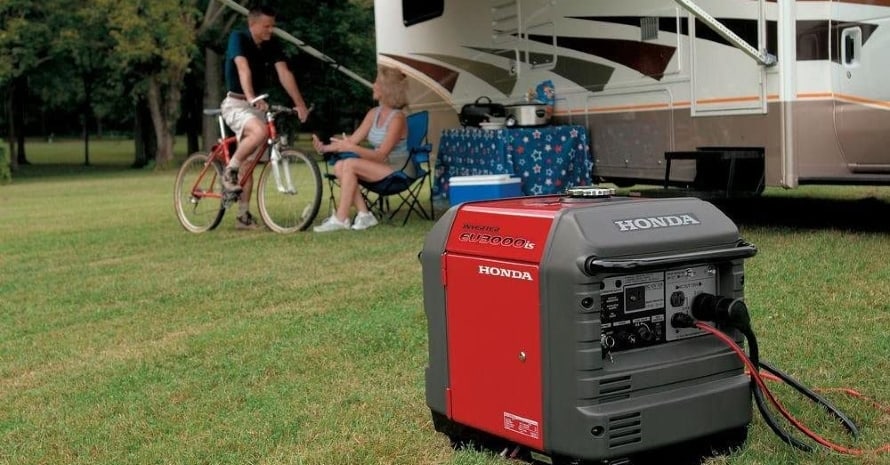
The best 3000 watt generator for most buyers is the Honda EU3200i because it gives you 3,200 max watts, 2,600 rated watts, low noise, and a 59.1 lb carry weight in a serious inverter package. Just know the truth up front: “3,000 watts” on the box is almost always starting watts, while the number that actually runs your stuff is usually 2,500-2,800 watts in this class.
That running-watt gap is why this list is tighter than the old padded roundups. We compared manufacturer spec sheets and kept the lineup to machines that make sense for homeowners, RV owners, and outage prep without pretending every “3,000-watt” unit can act like a whole-house generator.
Best 3,000-watt generators compared
| Model | Starting/running watts | Noise | Weight | Start | Notable |
|---|---|---|---|---|---|
| Honda EU3200i | 3,200 max / 2,600 rated | 58 dB(A) at rated load; 54 dB(A) at 1/4 load | 59.1 lb | Not listed in provided specs | CO-MINDER, Honda GX130 130cc OHC engine, lightest serious 3,000-class pick |
| Generac GP3300i | 3,300 starting / 2,500 running | About 58 dBA | 59.5 lb | Recoil | THD under 3%, COsense, 1.06-gal tank, 49-state and 50-state versions |
| Yamaha EF3000iSEB | 3,000 max / 2,800 rated; 3,500 starting with Boost Technology | 53-60 dBA | Heavy; published figure not provided here | Not listed in provided specs | Discontinued, limited stock; up to 19 hours at 1/4 load; CO sensor; 50-state legal |
| WEN 56380i | 3,800 surge / 3,400 rated | 57 dB at quarter load | Heavier than true 3,000 class; published figure not provided here | Electric | TT-30R RV outlet, 2.2-gal tank, over 8.5 hours at half load, THD under 1.2% |
| Westinghouse iGen4500 | 4,500 peak / 3,700 running | 52 dBA | 98 lb | Remote electric start with fob | TT-30R RV outlet, 3.4-gal tank, up to 18 hours at 25% load, EPA + CARB |
| Champion 200988 | 4,500 starting / 3,500 running on gasoline; 3,150 running on propane | 61 dBA | 103 lb | Electric with Cold Start | Dual fuel, RV-ready 30A, 21 hours at 25% load on a 20-lb propane tank, EPA + CARB |
Starting watts vs running watts (read this first)
A 3000 watt generator is not usually a 3,000-watt continuous generator. In this bracket, the useful number is running watts, and the common range is 2,500-2,800 watts.
Starting watts are the short burst a generator can deliver when a motor kicks on. Running watts are what it can carry after that. Refrigerators, fans, pumps, and RV air conditioners all care about both numbers because motors pull harder for a moment at startup.
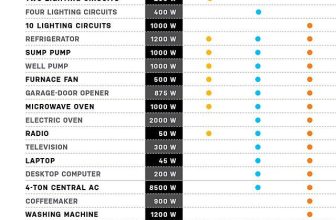
Here’s the practical homeowner math using standard wattage worksheet figures: refrigerator at 700 running watts with a 2,200-watt surge, LED lights around 40 watts, a 55-inch TV around 100 watts, laptop and phone charging around 90 watts, and a box fan around 100 watts. The steady running load is about 1,030 watts, so a 2,600-rated-watt inverter still has useful headroom once the refrigerator is running.
The catch is compressor startup. That refrigerator surge is brief, but you still don’t want to stack multiple motor starts at once. If you’re using a 3,000-class inverter during an outage, start the refrigerator first, then add lights, charging, TV, and a fan after the compressor settles.
A 13,500 BTU RV air conditioner is where this class gets tight. A clean 2,600-2,800 running watts can often handle the air conditioner only if other loads are off, but the comfortable answer is usually the 3,400-3,700 running-watt step-up class.
Inverter models dominate here for good reasons. The units in this guide offer electronics-friendly power with under 3% THD or better where published, quieter operation in the 53-59 dBA range for the true 3,000-class picks, and eco throttles that reduce fuel burn when your load is light. If you want to build your own appliance list, use our generator wattage calculator before you buy.
Best overall: Honda EU3200i
See Honda EU3200i listings on Amazon →
The Honda EU3200i is the best 3000 watt generator here because it hits the right balance of real output, carry weight, noise, and long-haul trust. Per Honda’s published specs, it makes 3,200 max watts and 2,600 rated watts from a Honda GX130 130cc OHC engine.
The big win is portability. At 59.1 lb, the EU3200i is less than half the weight of the old EU3000iS it replaced in Honda’s lineup, while still sitting in the same useful power class for refrigerators, electronics, fans, lights, and small RV loads.
Noise is also strong for this category. Honda lists 58 dB(A) at rated load and 54 dB(A) at 1/4 load, which puts it near the quiet end of serious 3,000-class machines. CO-MINDER carbon-monoxide shutoff is built in, which matters if the generator gets used during outages by people who may be tired, cold, or setting up in bad weather.
The limitation is the same one that defines this whole class: 2,600 rated watts demands load discipline. It’s not the unit for running a big RV air conditioner while also acting like shore power, and it does not have a built-in 30A RV outlet. For a deeper model-specific breakdown, read our full Honda EU3200i review.
Pros
- 3,200 max watts and 2,600 rated watts in a light inverter package.
- 59.1 lb weight makes it the lightest serious 3,000-class unit in this lineup.
- 54 dB(A) at 1/4 load and 58 dB(A) at rated load, per Honda’s spec sheet.
- CO-MINDER carbon-monoxide shutoff.
- Honda reliability is the main reason to pay the premium.
Cons
- Premium price compared with value-focused brands.
- 2,600 rated watts still requires careful load management.
- No built-in 30A RV outlet.
Best value: Generac GP3300i

Generac GP3300i 7154 3,300-Watt Gas-Powered Portable Inverter Generator - CARB Compliant - Advanced PowerRush Technology - RV Essentials - Quiet and Compact Solution - Duplex Outlets - USB Ports
Check current price on Amazon →
The Generac GP3300i is the value play because it gives you name-brand inverter power without jumping into premium pricing. Generac lists 3,300 starting watts and 2,500 running watts from a 149cc engine, with THD under 3% for sensitive electronics.
At 59.5 lb, it lands right beside the Honda on carry weight, and its published noise figure is about 58 dBA. It also includes low-oil shutdown and COsense carbon-monoxide protection, both of which are worth having on a generator that may see emergency use.
The tradeoff is runtime. The GP3300i has a 1.06-gal tank, with Generac’s published runtime at 4.5 hours at 50% load and 7 hours at 25% load. That’s fine for tailgating, tools, short outage windows, or RV battery charging, but it means more refueling during a long blackout.
California buyers need to pay attention before ordering. Generac sells both 49-state and 50-state versions, so confirm the 50-state model number if you need California compliance.
Pros
- 3,300 starting watts and 2,500 running watts.
- 59.5 lb carry weight is excellent for this power class.
- About 58 dBA and THD under 3%, per Generac’s published figures.
- COsense protection and low-oil shutdown.
- Routinely one of the cheapest name-brand 3,000-class inverters.
Cons
- 1.06-gal tank is small.
- 4.5 hours at 50% load means short runtime compared with larger-tank options.
- Pull-start only.
- 2,500 running watts is the low end of this bracket.
Longest runtime: Yamaha EF3000iSEB

YAMAHA EF3000iS, 2800 running Watts/3000 Starting Watts, Gas Powered Portable Inverter
Check remaining Yamaha stock on Amazon →
The Yamaha EF3000iSEB is the runtime king of the true 3,000-watt class, but there’s a major catch: Yamaha has ended production. It is still sold from remaining retailer stock, so treat it as a buy-while-you-can machine and think hard about long-term parts support.
On specs, it’s still impressive. Yamaha lists 3,000 max watts and 2,800 rated watts, plus Boost Technology that borrows battery power for up to 10 seconds to deliver 3,500 starting watts for hard compressor starts. That extra surge help is exactly why this model earned a loyal RV following.
Noise runs 53-60 dBA, and Yamaha lists up to 19 hours at 1/4 load. It also has a CO sensor and is 50-state legal. If you find a clean one at a fair price and understand the discontinued status, it remains one of the strongest real 3,000-watt inverter generators ever built.
The downsides are simple. It’s heavy, premium-priced, and now an orphaned model. For most new buyers, the Honda is the safer long-term pick, while the Yamaha is for people who specifically value that 2,800 rated-watt output and long runtime.
Pros
- 3,000 max watts and 2,800 rated watts.
- Boost Technology provides 3,500 starting watts for up to 10 seconds.
- Up to 19 hours at 1/4 load, per Yamaha’s published figure.
- 53-60 dBA noise range.
- CO sensor and 50-state legal status.
Cons
- Discontinued, with limited retailer stock.
- Long-term parts support is a real concern.
- Heavy compared with modern portable inverters.
- Premium price for a discontinued model.
Most watts per dollar: WEN 56380i

WEN 56380i Super Quiet 3800-Watt RV-Ready Portable Inverter Generator with Fuel Shut-Off and Electric Start
Check current price on Amazon →
The WEN 56380i is the smart step-up if you keep looking at 3,000-watt generators and wishing they had more room. WEN lists 3,800 surge watts and 3,400 rated watts from a 212cc engine, which is a meaningful jump over the 2,500-2,800 running-watt true 3,000 class.
This is also where RV owners start getting the features they usually want. The WEN has a built-in TT-30R RV outlet, electric start, fuel shutoff, a digital load display, and a 2.2-gal tank rated for over 8.5 hours at half load. WEN also lists THD under 1.2%, which is cleaner than the under 3% benchmark used by many inverter generators.
Noise is listed at 57 dB at quarter load, which keeps it in the quiet-inverter conversation. The warranty is 2 years. For buyers who want more breathing room than the Honda or Generac without jumping into the biggest RV inverters, this is the value step-up.
The compromise is build feel and weight. WEN’s fit and finish are budget-grade, and this model is heavier than the true 3,000-watt class. If you can live with that, the running-watt bump is hard to ignore.
Pros
- 3,800 surge watts and 3,400 rated watts.
- Built-in TT-30R RV outlet.
- Electric start and fuel shutoff.
- 2.2-gal tank with over 8.5 hours at half load.
- THD under 1.2% and a digital load display.
Cons
- Heavier than true 3,000-class inverters.
- Budget-grade fit and finish.
- Not as compact as the Honda or Generac.
Quiet RV step-up: Westinghouse iGen4500
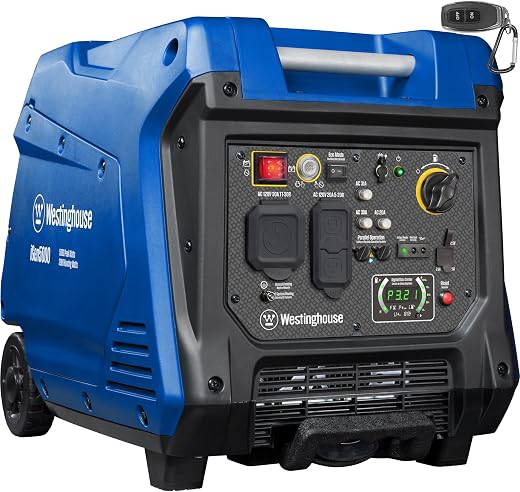
Westinghouse Outdoor Power Equipment 4500 Peak Watt Super Quiet Portable Inverter Generator, Remote Electric Start with Auto Choke, Wheel & Handle Kit, RV Ready, Gas Powered, Parallel Capable
Check current price on Amazon →
The Westinghouse iGen4500 is the pick if an RV air conditioner is in your future and you want more margin than a 3,000-class inverter provides. Westinghouse lists 4,500 peak watts and 3,700 running watts from a 224cc engine, which puts it comfortably above the tight 2,600-2,800 running-watt range.
It’s also built around RV convenience. You get a built-in TT-30R outlet, remote electric start with fob, a telescoping handle, and a 3.4-gal tank rated for up to 18 hours at 25% load. THD is listed at 3% or less, and the unit is EPA + CARB compliant.
The standout number is noise: 52 dBA. That is quieter than every true 3,000-class pick in this lineup on the published figures, even though the iGen4500 is a larger machine.
The penalty is weight. At 98 lb, this is no longer a casual one-hand carry generator, and it runs on gasoline only. If you’re sizing around a 30A RV setup, use our 30-amp RV generator guide before deciding whether this is enough margin for your trailer or motorhome.
Pros
- 4,500 peak watts and 3,700 running watts.
- 52 dBA published noise rating.
- Built-in TT-30R RV outlet.
- Remote electric start with fob.
- 3.4-gal tank with up to 18 hours at 25% load.
Cons
- 98 lb weight is a real handling issue.
- Gasoline only.
- Larger than buyers may want for simple outage essentials.
Dual-fuel step-up: Champion 200988

Champion Power Equipment 200988 4500-Watt Dual Fuel RV Ready Portable Inverter Generator, Electric Start
Check current price on Amazon →
The Champion 200988 is the dual-fuel answer for outage country. On gasoline, Champion lists 4,500 starting watts and 3,500 running watts. On propane, it lists 3,150 running watts, which still beats most true 3,000-class inverters on continuous output.
The propane option is the reason to buy it. Gasoline can go stale and may be hard to find during a widespread outage, while propane stores cleanly and gives you another fuel path. Champion lists 21 hours at 25% load on a 20-lb propane tank, which is useful for overnight refrigerator duty, battery charging, lights, and small comfort loads.
It’s RV-ready with a 30A outlet, electric start with Cold Start, under 3% THD, parallel capability, EPA + CARB compliance, and a 3-year warranty. That’s a strong spec set if you want one generator for both camping and emergency backup.
The downsides are weight and noise. At 103 lb and 61 dBA, it’s heavier and louder than the true 3,000-class models. For propane planning, especially if you’re comparing tank sizes and load levels, see our guide to how much propane a generator uses.
Pros
- 4,500 starting watts and 3,500 running watts on gasoline.
- 3,150 running watts on propane.
- 21 hours at 25% load on a 20-lb propane tank.
- Electric start with Cold Start.
- RV-ready 30A outlet, under 3% THD, parallel capability, and 3-year warranty.
Cons
- 103 lb weight.
- 61 dBA is louder than the true 3,000-class inverters here.
- Propane output is lower than gasoline output.
Budget wildcard: Harbor Freight’s Predator 3500
Harbor Freight’s Predator 3500 has been a longtime budget favorite in the 3,500-watt-class inverter category, but treat online listings carefully. It is sold through Harbor Freight stores, and online marketplace listings are often resellers with markups, so price-check your local store before paying extra.
Ebay

How to choose in the 3,000-watt class
Check the running watts, not the box number
The best 3000 watt generator for you is the one whose running watts match your actual loads. The Honda EU3200i is rated at 2,600 watts, the Generac GP3300i at 2,500 watts, and the Yamaha EF3000iSEB at 2,800 watts. Those are the numbers that matter after the startup surge is over.
If your plan is refrigerator, lights, TV, charging, and a fan, this class makes sense. If your plan includes a 13,500 BTU RV air conditioner, a well pump, or several motor loads, don’t shop by the “3,000” label alone.
Runtime equals tank size and load
Runtime claims only make sense when you compare the load level. The Generac GP3300i has a 1.06-gal tank and is rated for 4.5 hours at 50% load or 7 hours at 25% load. That’s very different from the Yamaha EF3000iSEB’s published figure of up to 19 hours at 1/4 load.
That doesn’t automatically make one better. A smaller tank can be fine for short jobs and easier handling, while a longer-running unit is better for overnight outages or quiet campground power. Just compare the same load level before you decide.
Noise matters more than people think
The spread in this lineup runs from 52 dBA to 61 dBA on published figures. The Westinghouse iGen4500 is listed at 52 dBA, the Yamaha at 53-60 dBA, the Honda at 54 dB(A) at 1/4 load and 58 dB(A) at rated load, and the Champion at 61 dBA.
Campgrounds often cap noise around 60 dBA, and neighbors notice generator noise fast during an outage. A quieter inverter also tends to be easier to live with because eco mode can throttle down when your load is light.
Know when to step up to 3,400-4,500 watts
Step up if you want to run an RV air conditioner with fewer compromises, if you need a built-in TT-30R outlet, or if your load list keeps creeping upward. The WEN 56380i gives you 3,400 rated watts, the Champion gives you 3,500 running watts on gasoline, and the Westinghouse gives you 3,700 running watts.
That extra margin is not about bragging rights. It keeps you from constantly turning one thing off to start another, and it gives motor loads more breathing room.
When 3,000 watts isn’t enough
A 3000 watt generator is great for essentials, electronics, lights, a refrigerator, charging, fans, and careful RV use. It is not the right answer for central AC, whole-home backup, or running every RV appliance like you’re plugged into full shore power.
If your needs land between a small inverter and a larger single generator, pairing machines can be a clean path. Two smaller inverters may be easier to move and store than one heavy unit, and our parallel generators guide explains how that setup works.
Bottom line
Buy the Honda EU3200i if you want the best true 3,000-class inverter and can live with 2,600 rated watts. Buy the Generac GP3300i if price matters most and you’re okay with 2,500 running watts and shorter runtime.
If RV air conditioning is part of the plan, skip the tight fit and move up. The WEN 56380i, Westinghouse iGen4500, and Champion 200988 give you more running watts, RV-ready outlets, and better margin for real campground loads.
Frequently asked questions
What will a 3,000-watt generator run?
A typical 3,000-watt generator in this class runs about 2,500-2,800 watts continuously. It can handle an essentials kit like a refrigerator at 700 running watts, LED lights around 40 watts, a 55-inch TV around 100 watts, laptop and phone charging around 90 watts, and a box fan around 100 watts, with room left under a 2,600-watt rated output.
Will a 3,000-watt generator run a house?
It can run household essentials through extension cords or a small transfer setup, but it is not whole-home power. Think refrigerator, lights, TV, charging, and a fan, not central AC or every appliance at once.
Will a 3,000-watt generator run an RV air conditioner?
A 13,500 BTU RV air conditioner usually gets tight on a 2,600-2,800 running-watt generator, especially if other loads are on. The more comfortable answer is a step-up inverter with 3,400-3,700 running watts, like the WEN 56380i or Westinghouse iGen4500.
What’s the quietest 3,000-watt generator?
In the true 3,000-watt class, the Yamaha EF3000iSEB and Honda EU3200i lead on published noise figures. Yamaha lists 53-60 dBA, while Honda lists 54 dB(A) at 1/4 load and 58 dB(A) at rated load. In the step-up class, the Westinghouse iGen4500 is listed at 52 dBA.
Is the Honda EU3000iS discontinued?
Yes. Honda replaced the old EU3000iS in its lineup with the EU3200i, which weighs 59.1 lb and is less than half the weight of the old model.
How long will a 3,000-watt generator run on a tank?
It varies a lot by tank size and load. The Generac GP3300i runs about 4.5 hours at 50% load on its 1.06-gal tank, while the Yamaha EF3000iSEB is rated up to 19 hours at 1/4 load. Always compare runtime at the same load level.
Is an inverter generator worth it in the 3,000-watt class?
Yes, for most homeowners and RV owners. Inverter models in this bracket offer cleaner power for electronics, commonly under 3% THD where published, plus lower noise and eco throttling for lighter loads.