
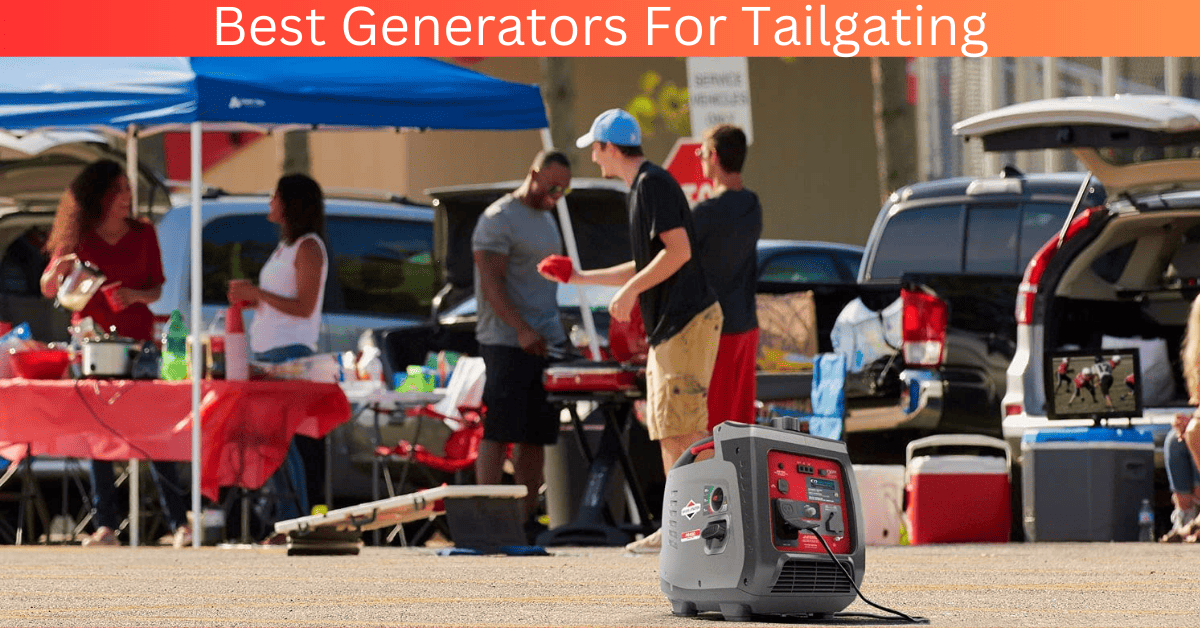
For most tailgates, the Honda EU2200i is still the one to beat: 1,800 running watts, 48-57 dBA, clean power under 3% THD, and a 47.4 lb carry weight per Honda’s published specs. The Champion 200951 is the value play at 1,850 running watts and 39 lb, while griddle crews should step up to the Champion 200988 and its 3,500 running watts.
Kickoff is weeks away in late August and early September, and the good inverter generators tend to get harder to find every August. If you’re powering a TV, speakers, blender, slow cooker, griddle, and phones from a stadium lot for 4-8 hours, buy for the biggest load you’ll actually run: that’s usually the electric griddle.

How many watts a tailgate really needs
A basic tailgate doesn’t need a jobsite generator. A TV usually draws 100-300W, speakers or a small PA take 50-300W, phone chargers need 10-100W, LED lights use 10-50W, and an electric cooler sits around 60-100W.
The problem load is food. A blender can surge from 300-1,000W, a slow cooker uses 200-300W, and an electric griddle is about 1,500W. One griddle claims most of a 2,000W inverter by itself.
That’s why a 1,700-1,850 running-watt inverter is right for TV, music, blender bursts, and chargers. Add a griddle or two slow cookers, and you’re shopping the 3,000-4,500W class instead. For a deeper sizing walk-through, start with our guide to selecting a camping generator; the same load math works in a parking lot.
| Tailgate setup | Running watts target | Best pick |
|---|---|---|
| TV corner: TV, speakers, phones, LED lights | 1,700W inverter class | WEN 56203i |
| Full spread: TV, music, blender, chargers, cooler | 1,800-1,850 running watts | Honda EU2200i or Champion 200951 |
| Griddle crew: griddle plus TV, music, chargers, food gear | 3,000-4,500W class | Champion 200988 |
Best tailgating generators compared
For tailgating, the best generator is usually an inverter. It’s quieter, cleaner for TVs, and easier to live with next to a truck or canopy. Our broader best inverter generators guide covers the category, but the models below are the ones that make the most sense for stadium lots in 2026.
| Model | Start/run watts | Weight | Noise | Runtime figure | Fuel |
|---|---|---|---|---|---|
| Honda EU2200i | 2,200/1,800W | 47.4 lb | 48-57 dBA | — | Gas |
| Champion 200951 | 2,500/1,850W | 39 lb | 53 dBA at 23 ft | 11.5 hr at 25% load | Gas |
| WEN 56203i | 2,000/1,700W | 39 lb | 51 dBA | — | Gas |
| Champion 200961 | 2,500/1,850W gas; 1,665W running propane | 39 lb | — | Up to 34 hr at 25% on a 20-lb tank | Gas/propane |
| Champion 200988 | 4,500/3,500W gas; 3,150W running propane | — | 61 dBA | — | Gas/propane |
| Goal Zero Yeti 1000 Core | 1,200W AC; 2,400W surge | About 32 lb | Silent | 983Wh capacity | Battery |
| DuroStar DS4000S | 4,000/3,300W | 92 lb | 69 dBA | About 8 hr at 50% on 4 gallons, per GeneratorBible | Gas |
Honda EU2200i: Best overall tailgating generator
The Honda EU2200i is the safest recommendation for most serious tailgaters because it hits the hard balance: enough power, low noise, clean output, and manageable weight. Honda lists it at 2,200 starting watts, 1,800 running watts, 47.4 lb, 48-57 dBA, and under 3% THD.
That 1,800 running-watt rating is right in the sweet spot for a TV, speakers, phone chargers, lights, cooler, and quick blender use. It is not the right answer if your whole party revolves around an electric griddle, because a griddle at about 1,500W leaves very little room for everything else.
The EU2200i also gets the small details right for a crowded lot. Honda’s CO-MINDER shutoff adds protection if exhaust builds up, and Bluetooth gives you remote status without standing over the unit. Clean power under 3% THD is the figure you want to see if you’re plugging in a TV.
One honest update from the old version of this page: the Honda EU2200iTAG tailgating edition is discontinued. The standard EU2200i now carries the CO shutoff and Bluetooth features that made the TAG special, so that’s the model to buy.
If you already own one EU2200i and need more capacity for a bigger spread, parallel operation can make sense, but don’t buy two small units before pricing one larger inverter. Our parallel generators guide explains where that setup helps and where it gets clunky.
Check the Honda EU2200i price on Amazon →
Champion 200951: Best value tailgating generator
The Champion 200951 is the practical value pick for a parking-lot setup. Champion publishes 2,500 starting watts, 1,850 running watts, 39 lb, 53 dBA at 23 ft, and 11.5 hr at 25% load.
That runtime figure is the big win. At a light tailgate load, 11.5 hr at 25% gives you enough published capacity for an afternoon setup and the night game without planning your whole day around refueling.
The 39 lb weight also matters more than people think. You may only lift the generator twice, but those two lifts are from the garage to the truck and from the truck bed to asphalt, often with coolers, chairs, and a tent already in the way.
For most 2026 tailgates, the Champion 200951 covers the normal electrical pile: TV, music, chargers, cooler, LED lights, and blender bursts. It still isn’t a griddle-first machine. A 1,500W griddle eats too much of a 1,850W running-watt budget.
If this model is on your shortlist, read our full Champion 200951 review before buying. It’s the closest thing here to the no-drama budget answer for people who want inverter manners without Honda money.
Check the Champion 200951 price on Amazon →
WEN 56203i: Best budget quiet generator for tailgating
The WEN 56203i is the budget quiet pick for smaller lots and simpler menus. WEN publishes 2,000 starting watts, 1,700 running watts, 39 lb, 51 dBA, and under 1.2% THD.
That under-1.2% THD figure is excellent on paper for sensitive electronics. If your tailgate is built around a TV, speaker, phone chargers, LED lights, and an electric cooler, this is enough generator without dragging a loud open-frame unit into a social space.
The 1,700 running-watt ceiling is where you need discipline. Blender surges are fine if you aren’t stacking other heavy loads at the same time, but a griddle at about 1,500W leaves almost no headroom. This is a TV-and-snacks generator, not a cook-for-the-row generator.
At 39 lb, it ties the Champion 200951 on listed weight and stays easy to handle. The 51 dBA published noise figure also keeps it in the range where people can talk around the tailgate without shouting, assuming you point the exhaust away and give it space.
The older WEN 56200i is still sold in some places with 2,000 starting watts and 1,600 running watts. It was a reasonable old budget pick, but the 56203i has superseded it here because the newer model gives you 1,700 running watts.

WEN 56200i 2000-Watt Gas Powered Portable Inverter Generator, CARB Compliant,Black & Orange
Check the WEN 56200i price on Amazon →
Check the WEN 56203i price on Amazon →
Champion 200961: Best dual-fuel generator for tailgating season
The Champion 200961 is the season-long pick because it runs on gas or propane. Champion lists 2,500 starting watts and 1,850 running watts on gas, plus 1,665 running watts on propane, at a 39 lb carry weight.
The propane number is the reason to care. Champion publishes up to 34 hr at 25% load on a 20-lb tank, which is more than enough for normal tailgate use across a long day. It also lets you swap the same style of grill tank many fans already bring.
Propane is cleaner to store between home games because you don’t have old gas sitting in the carburetor. If you tailgate hard one weekend and the generator sits until the next home game, that stale-gas problem is exactly what dual fuel helps avoid.
The tradeoff is power. On propane, the 200961 is rated at 1,665 running watts, so you need to be a little more careful than you would on gas. TV, speakers, chargers, lights, and an electric cooler fit the job; a 1,500W griddle is still too close to the ceiling.
For people who already cook on propane in the lot, this is the neatest fuel plan. Keep the cylinder upright, transport it safely, and you can run the generator without carrying a gas can next to the food bins.
Check the Champion 200961 price on Amazon →
Champion 200988: Best generator for a group tailgate with a griddle
The Champion 200988 is the right move when the tailgate is really an outdoor kitchen. Champion lists 4,500 starting watts and 3,500 running watts on gas, plus 3,150 running watts on propane, with a 61 dBA open-frame inverter design.
The 3,500 running-watt gas rating changes the whole plan. A griddle at about 1,500W no longer consumes the entire generator, so you can run food gear and still keep the TV, speakers, chargers, lights, and cooler alive.
This is the generator for the group that feeds a crowd. If you’re running one griddle, a slow cooker, and the entertainment setup, the 3,000-4,500W class is where you should be shopping. Smaller 1,700-1,850W inverters are better for quiet TV corners, not full-spread cooking.
The cost of that power is sound. Champion’s 61 dBA figure is still far better lot behavior than a loud conventional open-frame generator, but it won’t disappear into the background like a smaller suitcase inverter. Put it downwind, away from the canopy, and away from the conversation circle.
The dual-fuel side is useful here too. Gas gives the highest listed running wattage at 3,500W, while propane gives 3,150 running watts and easier fuel storage. Pick the fuel based on the menu and how close you are to the generator’s limit.

Champion Power Equipment 200988 4500-Watt Dual Fuel RV Ready Portable Inverter Generator, Electric Start
Check the Champion 200988 price on Amazon →
Goal Zero Yeti 1000 Core: Best silent no-fumes tailgating option
The Goal Zero Yeti 1000 Core is not a generator in the gas-engine sense, but it solves a real tailgating problem: no noise and no exhaust next to the food. Goal Zero lists a 983Wh battery, 1,200W AC output, 2,400W surge, and about 32 lb.
For a TV, music, phone charging, and a few small accessories, it’s a clean and polite parking-lot power source. You can set it near the table without engine noise, fumes, pull starts, or fuel spills.
The honest limit is energy storage. One 983Wh charge is a fraction of a tank of gas in practical tailgate terms. If you plug in a griddle at about 1,500W, it exceeds the 1,200W AC rating and would flatten the battery fast even if the load were lower.
This is the best option for lots that frown on generator noise or for fans who only need electronics. It’s also strong as a companion to a gas inverter: let the battery run the TV and chargers near the seats while the generator stays farther away handling heavier work.
If your party expects hot food from electric appliances, don’t pretend a battery station is the same as a 3,500 running-watt inverter generator. Use it for clean, quiet convenience, not high-watt cooking.

Goal Zero Yeti 1000 Core + Boulder 200 Briefcase Solar Generator for Camping, Tailgating, and Emergency Solar Power
Check the Goal Zero Yeti 1000 Core price on Amazon →
DuroStar DS4000S: Best cheap open-frame power if noise is not your problem
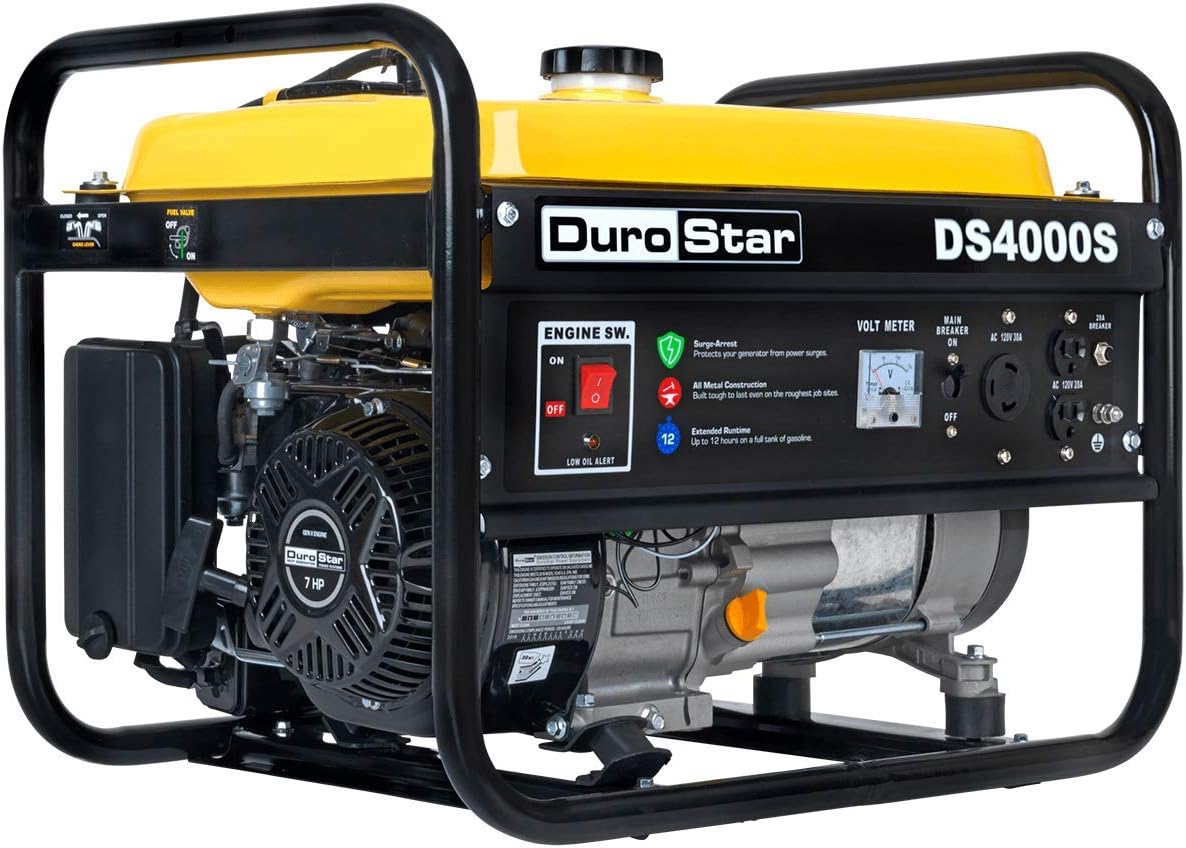
The DuroStar DS4000S is the blunt-force budget power pick. DuroStar lists 4,000 starting watts, 3,300 running watts, 69 dBA, and 92 lb, while GeneratorBible lists about 8 hr at 50% load on 4 gallons.
The upside is simple: lots of watts. A 3,300 running-watt generator gives you room for a griddle, TV, speakers, chargers, lights, and other tailgate gear in a way a 2,000W-class suitcase inverter cannot.
The downside is also simple: 69 dBA is loud next to a conversation. In a stadium lot, that can turn you into the problem neighbor fast, especially if nearby groups are trying to watch pregame coverage or talk under a canopy.
The 92 lb weight is another real penalty. This is not a casual one-hand carry from the truck bed to the asphalt. Bring help, plan where it sits, and don’t expect it to feel like a 39 lb inverter.
Buy the DS4000S only if your lot setup can tolerate the noise and weight. If you care about conversation, TV audio, or good neighbor behavior, a quieter inverter is the better tailgate tool.
Check the DuroStar DS4000S price on Amazon →
Lot etiquette and safety
Check your venue’s tailgate policy before you pack a generator. Many stadium lots restrict generator use, noise, placement, or fuel handling, and those rules change by venue. Don’t assume your setup is allowed because it worked somewhere else.
Noise is the fastest way to make enemies. A Honda EU2200i at 48-57 dBA or a WEN 56203i at 51 dBA is a different neighbor experience than a DuroStar DS4000S at 69 dBA. If you want context for those ratings, read our guide on how loud a generator is before buying.
Run the generator downwind and away from the food table, chairs, and canopy. Exhaust near an enclosed or semi-enclosed canopy is a carbon monoxide risk even outdoors, especially when tents, vehicles, and wind patterns trap fumes. Treat 20-ft-style spacing as the mindset near tents and canopies, even in a parking lot.
Route cords like people are walking with plates and coolers, because they are. Keep cords out of the main path, tape them down where needed, and don’t put connections where spilled drinks or rain can sit on them.
Fuel needs the same common sense. Carry gas in sealed cans, keep propane cylinders upright, and don’t refuel a hot generator beside the food table. If you’re using propane for the grill and generator, label what’s connected so nobody drags a live hose through the walking lane.
Season prep in 20 minutes
Do one home test before the first game. Set up the generator, plug in the actual TV, speaker, chargers, lights, cooler, blender, and cooking gear you plan to bring, then see what trips or bogs before you’re parked between two trucks.
Check the oil before that test run and again before game day. Small generators are simple machines, but low oil can shut down the party before kickoff. Keep spare oil in the tailgate bin so you’re not hunting for it in a stadium lot.
Make a fuel plan now. If you’re running gas, use stabilized fuel and don’t let old gas sit through the season. If you’re running propane, make sure the cylinder is filled, upright, and packed where it won’t roll.
Pack the boring accessories because they save the day: outdoor-rated cords, a power strip, duct tape for cord routing, spare oil, and whatever adapter your setup needs. Our generator accessories checklist is worth scanning before the first home game.
Keep the generator plan simple on game day. Put it in the same spot every time, point exhaust away from people, run cords the same route, and shut it down before packing fuel or cords back into the vehicle.
Bottom line
Buy the Honda EU2200i if you want the best all-around tailgating generator for TV, music, chargers, lights, cooler use, and blender bursts. Buy the Champion 200951 if you want similar tailgate capacity with a 39 lb carry weight and an 11.5 hr published runtime at 25% load.
If the menu includes an electric griddle, skip the 2,000W-class guessing game and get the Champion 200988 with 3,500 running watts on gas. If your lot bans noise or you only need electronics, the Goal Zero Yeti 1000 Core is the clean, silent option as long as you respect its 983Wh battery limit.
Frequently asked questions
What size generator do I need for tailgating?
For TV, music, chargers, lights, cooler use, and blender bursts, a 1,700-1,850 running-watt inverter is the right class. If you’re adding an electric griddle at about 1,500W or two slow cookers at 200-300W each, move up to the 3,000-4,500W class.
What’s the quietest tailgating generator?
Among the gas picks here, the Honda EU2200i is rated at 48-57 dBA per Honda’s published specs, and the WEN 56203i is rated at 51 dBA per WEN’s published figure. The Goal Zero Yeti 1000 Core is silent because it’s a battery power station, not an engine generator.
Can I use a generator at a stadium lot?
Maybe, but you need to check your venue’s tailgate policy before game day. Many stadium lots restrict generator use, generator placement, or noise, and the rules vary by location.
Will a 2,000-watt generator run a TV and a blender?
Yes, a 2,000W-class inverter can usually handle a TV at 100-300W and blender surges at 300-1,000W if you manage the other loads. Don’t run a 1,500W griddle at the same time on that class of generator.
Is a battery power station enough for tailgating?
It can be enough for a TV, music, phone chargers, and small accessories. The Goal Zero Yeti 1000 Core has a 983Wh battery, so it’s quiet and clean, but that single charge is a fraction of a gas tank in practical tailgate use and a griddle is the wrong load for it.
Why choose a dual-fuel generator for tailgating?
Dual fuel lets you run on propane from a 20-lb grill tank and avoid stale gas sitting in the carburetor between home games. The Champion 200961 is rated up to 34 hr at 25% load on a 20-lb tank, which makes propane convenient for a season-long tailgate routine.
Is the Honda EU2200iTAG still made?
No. The EU2200iTAG tailgating edition is discontinued, but the standard Honda EU2200i now has the CO-MINDER shutoff and Bluetooth features that made the TAG model special.


