The best inverter generator for most people is the Honda EU2200i because it gives you 2,200 starting watts, 1,800 running watts, 48-57 dBA noise, and under 3% THD in a 47.4 lb suitcase. If you’re spending less, the WEN 56203i is the budget pick at 2,000 starting watts, 1,700 running watts, 39 lb, 51 dBA, and under 1.2% THD.
For a 30-amp RV, the Westinghouse iGen4500 is the cleanest fit here with 4,500 starting watts, 3,700 running watts, a TT-30R RV outlet, 52 dBA noise, and remote start. For bigger backup power, the Honda EU7000iS is the premium buy-once option at 7,000 max watts and 5,500 rated watts, while the GENMAX GM9000iED is the value route with 9,000 starting watts and 7,600 running watts on gas.
Inverter generator comparison table (2026)
| Model | Starting/running watts | Noise | Weight | Key outlet | Price class |
|---|---|---|---|---|---|
| Honda EU2200i | 2,200 / 1,800 | 48-57 dBA | 47.4 lb | Suitcase class | About $1,179-1,299 |
| WEN 56203i | 2,000 / 1,700 | 51 dBA | 39 lb | Parallel port | Budget |
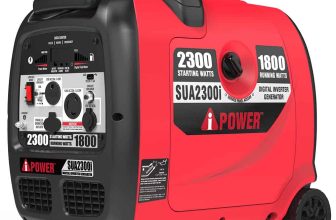
| A-iPower SUA2000iV | 2,000 / 1,600 | Not listed in verified data | Not listed in verified data | Parallel-capable | Low-priced name-brand |
| Westinghouse iGen4500 | 4,500 / 3,700 | 52 dBA | Not listed in verified data | TT-30R RV outlet | 30-amp RV value |
| Champion 200988 | 4,500 / 3,500 gas; 3,150 running propane | 61 dBA | Not listed in verified data | RV-ready | Dual-fuel value |
| Briggs & Stratton Q6500 QuietPower | 6,500 / 5,000 | 66 dBA | 139 lb | L14-30R 120/240V transfer-switch-ready | About $1,368 street |
| GENMAX GM9000iED | 9,000 / 7,600 gas; 8,550 / 7,200 propane | Not listed in verified data | Not listed in verified data | 50-amp outlet | Big dual-fuel value |
| Honda EU7000iS | 7,000 max / 5,500 rated | 52-60 dBA | 263.2 lb | 120/240V | About $4,000-4,900 |
What makes an inverter generator different
A true inverter generator makes power in stages: the engine produces electricity, the generator converts it to DC, and the inverter module turns it back into clean AC sine wave power. The clean-power number to watch is THD, or total harmonic distortion. For sensitive electronics, the good inverter target is under 3% THD.
That’s why this list is limited to true inverter generators. Conventional AVR open-frame generators can be useful for tools, pumps, and motors, but spec databases list some of them with THD figures as high as about 23%. That’s a different class of power, and it doesn’t belong in a roundup for clean inverter output.
The other big difference is engine speed. A conventional generator usually runs at a fixed speed to hold frequency, while an inverter can vary engine speed with the load. At light load, that means less noise and better fuel use.
If you want the full nuts-and-bolts breakdown, read our guide to inverter vs conventional generators. The short version: buy an inverter for quiet campsite power, RV electronics, laptops, routers, TVs, and home essentials where clean power matters.
Starting watts and running watts matter just as much as clean power. Starting watts cover the short surge when a compressor or motor kicks on. Running watts are what the generator can carry continuously, so that’s the number you size around.
Runtime can be slippery because many brands publish it at a 25% load. The Briggs & Stratton Q6500, for example, lists 14 hours at 25% load and 10 hours at 50% load from its 5-gal tank. That doesn’t mean it runs 14 hours while delivering its full 5,000 running watts.
Open-frame inverters also deserve a fair shake. Models like the Champion 200988 and GENMAX GM9000iED trade some noise control for lower price per watt and higher output. If you’re feeding a transfer switch or powering an RV from outside the rig, that trade can make sense.
One old Honda note: the Honda EU3000iS is discontinued. Its successor is the EU3200i, and we’ve covered that machine separately in our Honda EU3200i review.
How we picked
We rebuilt this guide around verified production status, manufacturer spec sheets, spec databases, and retailer listings checked in July 2026. The hard rule was simple: every pick had to be a true inverter generator, not just a popular portable generator.
That rule knocked out two common category mistakes from the old lineup: a conventional generator and a battery power station. Both can be good tools, but neither belongs in a best inverter generators list. An inverter generator burns fuel, makes continuous AC output, and uses inverter electronics to keep that power clean.
We also weighted real homeowner use. Suitcase units are best for light backup, camping, and quiet portable power. Mid-size enclosed inverters make the most sense for 30-amp RV owners. Big enclosed or open-frame inverters are better for home essentials through a transfer switch.
Noise, THD, fuel runtime, outlet layout, and weight all mattered. So did caveats, because no generator is perfect. A quiet suitcase won’t run a whole panel, and a big inverter with 120/240V capability won’t be fun to lift into a truck bed.
Honda EU2200i — best overall inverter generator
The Honda EU2200i is still the benchmark suitcase inverter. Per Honda’s published specs, it makes 2,200 starting watts and 1,800 running watts from a GXR120 121cc engine, weighs 47.4 lb, runs at 48-57 dBA, and keeps THD under 3%.
Check the Honda EU2200i price on Amazon →
The EU2200i’s 0.95-gal tank gives a listed runtime of 3.2-8.1 hours, depending on load. That’s enough for fridge cycling, lights, electronics, campsite use, or short outage duty without dragging out a full-size machine. Current units also add CO-MINDER and a Bluetooth app, which are nice upgrades on a generator people already trusted.
The reason it wins is not raw wattage. It wins because it’s quiet at idle, easy to carry, clean enough for electronics, and famous for resale value. The caveat is price: at about $1,179-1,299, it costs far more than budget suitcase inverters with similar wattage. If you want the safest long-term buy in the 2,000-watt class, though, this is it.
WEN 56203i — best budget inverter generator
The WEN 56203i is the budget pick because it hits the right numbers without pretending to be a premium Honda. WEN’s published specs list 2,000 starting watts, 1,700 running watts, 39 lb weight, 51 dBA noise, and under 1.2% THD.

WEN 56203i Super Quiet 2000-Watt Portable Inverter Generator w/Fuel Shut Off, CARB Compliant, Ultra Lightweight, Black/Orange
Check the WEN 56203i price on Amazon →
That THD figure is the standout. Under 1.2% is the best published THD figure in this group, and it’s better than the under 3% mark we look for in clean inverter power. It also has a parallel port, so owners who want more output later can think about pairing instead of replacing.
For more on how pairing works, see our guide to parallel generators. The caveat is that this is still a small suitcase inverter. It’s a great fit for electronics, a fridge, lights, and campsite loads, but it’s not the right tool for a full RV air-conditioning setup or home transfer switch. Buy it for quiet budget power, not big surge capacity.
A-iPower SUA2000iV — budget alternative
The A-iPower SUA2000iV is the budget alternative for shoppers who find it at a better shelf price than the WEN. It’s rated at 2,000 starting watts and 1,600 running watts, and A-iPower says a paired set delivers roughly 4,000 starting watts and 3,200 running watts combined.

A-iPower Portable Inverter Generator, 2000W Ultra-Quiet RV Ready, EPA Compliant, Small & Ultra Lightweight For Backup Home Use, Tailgating & Camping (SUA2000iV)
Check the A-iPower SUA2000iV price on Amazon →
A-iPower is Senci’s U.S. brand, and this model is regularly one of the lowest-priced name-brand inverter generators at big-box retailers. That matters for homeowners who want a basic outage machine but don’t want to spend Honda money on a generator that may only run a few times a year.
The best use case is simple: light backup, tailgate power, and camping where budget matters more than premium refinement. If camping is the main job, our generator camping features guide can help you sort noise, portability, and outlet needs before you buy.
The caveat is spec transparency. The verified data here gives wattage and parallel capability, but not the same full noise and weight picture as the top suitcase picks. If the WEN is close in price, I’d take the WEN first. If the A-iPower is clearly cheaper, it’s a fair buy.
Westinghouse iGen4500 — best inverter generator for 30-amp RVs
The Westinghouse iGen4500 is the easiest recommendation here for a 30-amp RV. It makes 4,500 starting watts and 3,700 running watts, runs at 52 dBA, includes a TT-30R RV outlet, and has remote start.
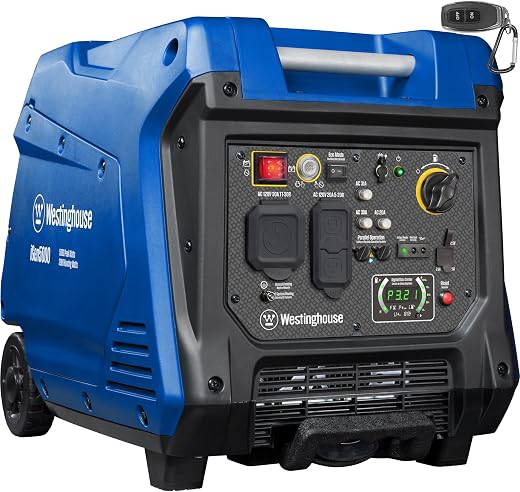
Westinghouse Outdoor Power Equipment 4500 Peak Watt Super Quiet Portable Inverter Generator, Remote Electric Start with Auto Choke, Wheel & Handle Kit, RV Ready, Gas Powered, Parallel Capable
Check the Westinghouse iGen4500 price on Amazon →
That outlet matters because many RV owners don’t want adapter chains just to plug in at camp. The iGen4500 also has enough surge capacity for a 13,500 BTU RV AC unit, which commonly needs about 2,800-3,000 watts to start and up to about 1,500 watts while running. That leaves headroom for normal loads if you manage them with some common sense.
The iGen4500 is not the smallest or cheapest inverter in this guide, but it fits the job better than a 2,000-watt suitcase. RV owners usually regret buying too small before they regret having headroom. The caveat is that big enclosed RV inverters are less convenient to move around than suitcase units. If your main loads are phones, a small fridge, and lights, a smaller inverter is easier to live with.
Champion 200988 — best dual-fuel inverter generator
The Champion 200988 is the best dual-fuel inverter pick for buyers who want gas and propane in one RV-ready machine. Champion rates it at 4,500 starting watts and 3,500 running watts on gas, with 3,150 running watts on propane and 61 dBA noise.

Champion Power Equipment 200988 4500-Watt Dual Fuel RV Ready Portable Inverter Generator, Electric Start
Check the Champion 200988 price on Amazon →
Runtime is the headline. Champion’s published figures list up to 14 hours on gas and up to 21 hours on a 20-lb LP tank. That propane runtime is useful for RV owners who already carry LP and homeowners who store propane more comfortably than gasoline.
This is an open-frame inverter, so don’t expect enclosed-suitcase quiet. The trade is price per watt and dual-fuel flexibility. It’s also RV-ready, which makes it a practical rival to enclosed 30-amp RV inverters if you can accept the extra noise.
If propane capability is high on your list, compare this against more options in our best dual-fuel inverter generator guide. The caveat is simple: 61 dBA is louder than the enclosed RV pick above, and the open frame won’t feel as polished. For value and fuel choice, though, it’s hard to ignore.
Briggs & Stratton Q6500 QuietPower — best value for home backup
The Briggs & Stratton Q6500 QuietPower is the cheap way to put inverter power on a home transfer switch. It delivers 6,500 starting watts and 5,000 running watts from a 306cc Briggs & Stratton engine, keeps THD under 3%, and weighs 139 lb.

Briggs & Stratton Q6500 Quiet Power Series Inverter Generator | CO Guard, 6500 starting watts
Check the Briggs & Stratton Q6500 price on Amazon →
The outlet package is the reason it belongs in a home-backup conversation. It has two duplex 5-20R GFCI outlets plus an L14-30R 120/240V outlet that’s transfer-switch-ready. It also has CO Guard shutdown, which is exactly the kind of safety feature portable backup users should want.
Runtime is strong for this class. Per Briggs & Stratton’s figures, the 5-gal tank runs 14 hours at 25% load and 10 hours at 50% load. Noise is listed at 66 dBA, which is not suitcase quiet, but reasonable for a 5,000-running-watt inverter.
The caveats are important. It is not parallel-capable, it is not RV-ready, and it has no TT-30R outlet, so RV use needs an adapter. The warranty is 2 years, and the street price is about $1,368. For home essentials on a budget, this is one of the smartest buys here.
GENMAX GM9000iED — biggest dual-fuel inverter value
The GENMAX GM9000iED is the value play for big dual-fuel inverter output. It’s rated at 9,000 starting watts and 7,600 running watts on gas, or 8,550 starting watts and 7,200 running watts on propane.
Check the GENMAX GM9000iED price on Amazon →
Those numbers put it in a different class than the small RV and suitcase machines. With a 50-amp outlet, electric start, and a CO Detect sensor, it’s aimed at homeowners who want whole-home-essentials power without paying premium Honda money. It’s also attractive for larger RV setups where big output and propane capability matter.
The phrase “whole-home essentials” is doing real work here. This is not a magic replacement for utility power, and load management still matters. But for refrigerators, lights, electronics, some outlets, and selected hardwired circuits through the right setup, the GM9000iED gives you a lot of clean inverter wattage for the money.
The caveat is that the verified data does not include noise or weight here, so don’t assume it behaves like an enclosed Honda. Big open-frame power usually comes with more sound and more bulk. Buy it for output-per-dollar, not campsite manners.
Honda EU7000iS — premium whole-home inverter generator
The Honda EU7000iS is the premium whole-home pick because it combines big clean output with unusually low noise for its size. Honda lists 7,000 max watts, 5,500 rated watts, 52-60 dBA noise, 120/240V output, electric start, iMonitor, and CO-MINDER.
Check the Honda EU7000iS price on Amazon →
The engine is a fuel-injected GX390 389cc, which means no carburetor to gum up. That matters for homeowners who store a generator for outages and don’t want stale-fuel carb problems every storm season. Its 5.1-gal tank gives a listed runtime of 6.4-16 hours depending on load.
The EU7000iS is also heavy at 263.2 lb, so this is not a casual camping generator. It belongs in a garage, shed, or generator pad setup where it can be rolled into a safe outdoor running position and connected properly. Dealer listings in mid-2026 ran roughly $4,000-4,900, with about $4,500 typical.
The caveat is obvious: price. You can buy more starting watts for less money. You buy the EU7000iS because you want fuel injection, quiet operation, clean 120/240V power, Honda support, and a machine you plan to keep.
Still-sold but discontinued: Yamaha EF2200iS
The Yamaha EF2200iS is worth a look while stock lasts, but it no longer belongs as a main pick. Yamaha transferred its generator business in 2023 and no longer produces these units, even though remaining inventory is still sold.

Check remaining Yamaha EF2200iS stock on Amazon →
As a machine, it was a strong Honda rival. The EF2200iS carried a $1,199 MSRP, delivered 2,200 starting watts and 1,800 running watts, and sat in the 55.4 lb class. Those are still useful suitcase-inverter numbers.
The question mark is the future. Warranty and parts support matter more on a generator than on a small disposable tool. If you find one at a steep discount and have a local service path, it may be a fine buy. At full Honda money, I’d rather buy a generator that’s still in production.
What we removed from this list and why
We removed the Honda EU3000iS because it is discontinued, the DuroMax XP12000EH because it is a conventional non-inverter generator and never belonged on this page, and the Goal Zero Yeti 3000X because it is a battery power station, not a generator. A power station is the right call when you need silent, indoor-safe stored energy, but it cannot match a fuel-burning generator’s continuous output over a long outage unless you have enough stored energy and charging support.
Which size inverter do you need?
The 2,000-watt class is the sweet spot for light backup and portable power. Think phones, routers, lights, a refrigerator, small electronics, and simple campsite loads. The Honda EU2200i, WEN 56203i, and A-iPower SUA2000iV live here.
The 3,500-4,500-watt range is where most 30-amp RV owners should shop. A 13,500 BTU RV AC can need about 2,800-3,000 watts to start and up to about 1,500 watts to run, so a 2,000-watt suitcase is often too small unless you use special load management. The Westinghouse iGen4500 and Champion 200988 are the better fits in this guide.
The 5,000-7,600-running-watt range is for home essentials through a transfer switch. That means selected circuits, not every load in the house at once. The Briggs & Stratton Q6500, Honda EU7000iS, and GENMAX GM9000iED are the serious backup choices here.
If you’re not sure what your loads add up to, use our generator wattage calculator before you buy. RV owners should also check our guide on what size generator for a 30-amp RV, because air-conditioning surge is where many undersized generator mistakes happen.
Bottom line
Buy the Honda EU2200i if you want the best small inverter generator and plan to keep it for years. Buy the WEN 56203i if you want clean, quiet budget power and don’t need RV air-conditioning capacity.
For RVs, the Westinghouse iGen4500 is the best match because it has 4,500 starting watts, 3,700 running watts, and a TT-30R RV outlet. For home backup, choose the Honda EU7000iS if you want the premium machine, the Briggs & Stratton Q6500 if you want transfer-switch-ready value, or the GENMAX GM9000iED if you want the biggest dual-fuel inverter output for the money.
Frequently asked questions
What is the best inverter generator?
The best inverter generator for most people is the Honda EU2200i. It gives you 2,200 starting watts, 1,800 running watts, 48-57 dBA noise, 47.4 lb weight, and under 3% THD. For budget buyers, choose the WEN 56203i; for 30-amp RVs, choose the Westinghouse iGen4500; for premium home backup, choose the Honda EU7000iS.
Are inverter generators worth the extra money?
Yes, if you care about noise, clean power, and fuel use at lighter loads. A good inverter generator keeps THD under 3%, while spec databases list some conventional AVR open-frame generators as high as about 23% THD. If you’re only running rugged tools or motors, a conventional generator can still make sense.
Can an inverter generator run a whole house?
A large inverter generator can run home essentials through a transfer switch, but not usually every load in the house at once. The practical range here is about 5,000-7,600 running watts for selected circuits. Central AC is the big caveat because startup demand can exceed what many portable inverter generators can handle.
What does THD mean on an inverter generator?
THD means total harmonic distortion, which is a measure of how clean the AC waveform is. For sensitive electronics, under 3% THD is the target we look for. Conventional AVR open-frame generators can be much rougher, with spec databases listing some as high as about 23% THD.
Are battery power stations better than inverter generators?
They’re different tools. A battery power station is silent and indoor-safe, which makes it better for apartments, CPAP backup, quiet nighttime use, and short stored-energy jobs. An inverter generator is better for long outages because it can keep making power as long as you have fuel.
Which inverter generators are made by Honda vs re-badged?
Honda EU-series generators like the EU2200i and EU7000iS are Honda-built models. A-iPower is Senci’s U.S. brand, based on the verified data for the SUA2000iV. For the other picks, don’t assume factory origin unless the manufacturer clearly publishes it.
How long do inverter generators run?
Runtime depends on tank size and load, and many brands publish runtime at 25% load. The Honda EU2200i lists 3.2-8.1 hours from its 0.95-gal tank, depending on load. The Briggs & Stratton Q6500 lists 14 hours at 25% load and 10 hours at 50% load from its 5-gal tank.