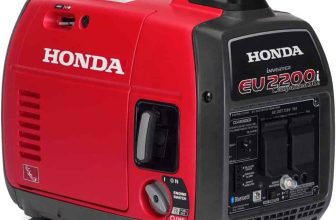
The Champion 200950 is a legitimately good 39-lb, 53-dBA, 2,500-watt inverter generator with 1,850 running watts and clean power under 3% THD. The catch is availability: it’s basically the dealer-channel twin of the Champion 200951, and most online buyers should buy the 200951 instead because it adds a carb-draining fuel shutoff and is actually stocked on Amazon.
If a farm store, dealer, or hardware retailer has the 200950 at a strong price, it’s worth buying. If you’re shopping online in 2026, the 200951 is usually the cleaner pick, while the 200961 is the propane-friendly version for campers who want dual fuel.

Champion 200950 specs at a glance
The 200950 sits in Champion’s ultralight 2,500-watt inverter family. Per Champion’s published specs through dealer listings checked in July 2026, it’s a gas-only, recoil-start inverter built around portability, low noise, and clean power for small loads.
| Spec | Value |
|---|---|
| Starting watts | 2,500 watts |
| Running watts | 1,850 watts |
| Engine | 79cc Champion engine |
| Fuel | Gasoline only |
| Weight | 39 lb |
| Noise rating | 53 dBA at 23 feet |
| Fuel tank | 1.1 gallons |
| Runtime | Up to 11.5 hours at 25% load |
| Power quality | Less than 3% THD |
| AC outlets | Two covered 120V 20A household outlets, 5-20R |
| DC/USB outlets | 12V automotive-style DC outlet plus dual-port USB adapter |
| Parallel capable | Yes, with Champion’s optional ParaLINK parallel kit |
| Start type | Recoil start |
| Warranty | 3-year limited warranty with Champion lifetime technical support |
| Availability | Dealer, farm, and hardware channels; Amazon carries the 200951 and 200961 siblings instead |
The headline specs are the weight, sound rating, and clean inverter output. At 39 lb, the 200950 is one of the lightest 2,500-watt inverters in the industry, and the 53-dBA rating at 23 feet puts it in the quiet-generator category for camping, tailgating, and outage basics.
Its outlet panel is simple. You get two covered 120V 20A household outlets, a 12V automotive-style DC outlet, and a dual-port USB adapter. You do not get a 30A RV outlet, electric start, propane capability, or the 200951’s carb-draining fuel shutoff.
200950 vs 200951 vs 200961: which Champion 2,500 should you buy
This is the real buying question. The Champion 200950, 200951, and 200961 are close enough that shoppers often land on one listing and wonder if they’re missing something. The short version: the 200950 is the dealer-channel gas model, the 200951 is the online-friendly gas model with carb-drain shutoff, and the 200961 is the dual-fuel model.
| Model | Starting/running watts | Fuel | Carb-drain shutoff | Where sold |
|---|---|---|---|---|
| Champion 200950 | 2,500 starting / 1,850 running | Gasoline | No | Mainly dealers, farm stores, hardware retailers |
| Champion 200951 | 2,500 starting / 1,850 running | Gasoline | Yes | Amazon and online retailers |
| Champion 200961 | 2,500 starting / 1,850 running on gasoline; 1,665 running on propane | Gasoline and propane | Not the main advantage | Amazon and online retailers |
Buy the Champion 200950 if you’re standing in front of one at a dealer, farm store, or hardware retailer and the deal makes sense. It has the same core numbers as the 200951: 2,500 starting watts, 1,850 running watts, 79cc engine, 39-lb weight, and 53-dBA rating at 23 feet. Nothing about the 200950 is weak for its class.
Buy the Champion 200951 if you’re shopping online. It’s the same core machine but adds the fuel-shutoff feature that lets the engine run the fuel out of the carburetor before storage. That matters because old gas left in a carburetor is one of the common ways small generators get cranky after sitting.
We cover that model separately in our full Champion 200951 review. For most homeowners and RV owners ordering online, that’s the Champion 2,500-watt inverter to start with.
Check the Champion 200951 price on Amazon →
Buy the Champion 200961 if propane storage matters more than maximum running watts on gas. It gives you the same 2,500 starting watts and 1,850 running watts on gasoline, but propane running output is 1,665 watts. That propane option is handy for campers who already carry bottles and don’t want gasoline sitting around as often.
Check the Champion 200961 dual-fuel price on Amazon →
The 200961 is not automatically better for every buyer. If you only run gasoline and want the lightest, simplest setup, the 200950 or 200951 makes more sense. If fuel storage and camping convenience are high on your list, the 200961 earns its spot.
What the 200950 can actually run
The Champion 200950 gives you 1,850 running watts to work with. That’s enough for a tight but useful home-outage kit, a quiet campsite setup, or a tailgate loadout, as long as you respect startup surge and don’t try to treat it like a large home backup generator.
| Load | Typical wattage | 200950 verdict |
|---|---|---|
| Phone chargers | 10-100W | Easy load |
| LED lights | 10-50W | Easy load |
| TV | 100-300W | Easy load if managed |
| Box fan | About 200W | Good fit |
| CPAP | 30-60W | Good fit |
| Electric cooler | 60-100W | Good fit |
| Refrigerator | 700W running / 2,200W surge | Can start one fridge with other loads off |
| Microwave | 1,000W | Run only with other loads off |
| 13,500 BTU RV air conditioner | 2,800-3,000W starting | Not on one unit |
The refrigerator line is where people get in trouble. A 700W fridge with a 2,200W surge is close to the 200950’s 2,500W starting ceiling. It can start one fridge, but you should not have a microwave, heater, coffee maker, or other heavy load already running when that compressor kicks on.
A 1,000W microwave is also possible, but only if you shut other loads down first. The generator has 1,850 running watts, so the microwave plus lights, fans, chargers, and a cycling fridge can crowd the limit fast.
A 13,500 BTU RV air conditioner is not a realistic single-unit load here. The starting demand of 2,800-3,000W is above this generator’s 2,500W starting rating. That’s where paralleling two compatible Champion units with the optional ParaLINK parallel kit, or stepping up into a larger camping generator class, starts to make sense.
If you’re mapping a full outage panel, use our generator wattage calculator before buying. It’s much easier to catch a bad wattage match on paper than after you’ve filled the tank and started plugging things in.

Noise, weight, and runtime in the real world
Champion rates the 200950 at 53 dBA from 23 feet. That’s quiet-campground friendly for a gas inverter in this wattage class, assuming you place it correctly and follow campground generator-hour rules. For a better sense of what that rating means beside other machines, see our guide on how loud a generator is.
The weight is the bigger day-to-day advantage. At 39 lb, the 200950 is easy to move compared with the 47-lb class of small inverters. That difference matters when you’re lifting it into a truck bed, sliding it into an RV compartment, or carrying it away from a campsite.
Champion’s published runtime is up to 11.5 hours at 25% load from a 1.1-gallon tank. The fuel-use math is simple: 1.1 gallons divided by 11.5 hours works out to roughly 0.10 gal/hr at quarter load. That’s a strong number for overnight light loads, battery charging, fans, CPAP use, and low-draw outage work.
Runtime will drop as load rises. That’s true for every portable generator, but it matters more on a compact inverter with a 1.1-gallon tank. If you’re running a fridge, fan, lights, TV, and chargers, expect less than the published quarter-load number.
The clean-power spec also matters. Champion lists the 200950 at less than 3% THD, which is the inverter-grade range buyers want for sensitive electronics. That makes it a better fit for phones, laptops, TVs, CPAP units, and charging stations than an old-school open-frame generator with rougher output.
What it doesn’t have
The Champion 200950 is light, quiet, and useful, but it’s not loaded with every convenience feature. The missing pieces are exactly why the 200951 and 200961 exist.
First, there’s no electric start. The 200950 uses recoil start, so you’ll be pulling a cord. That keeps the unit simple and light, but buyers who want push-button starting need to look elsewhere.
Second, the 200950 does not have the carb-draining fuel-shutoff feature found on the 200951. That feature lets the generator burn fuel out of the carburetor before shutdown, which helps prevent gum-up during storage. If you use a generator a few times a year and let it sit between trips or storms, that’s a real advantage for the 200951.
Third, the 200950 is gasoline only. That’s fine if you rotate fuel, use stabilizer, and don’t mind gas storage. If you want propane convenience for camping or standby use, the 200961 is the Champion sibling to buy.
Fourth, there’s no 30A RV outlet. The 200950 gives you two covered 120V 20A household outlets, plus the 12V DC outlet and USB adapter. For RV air conditioning and a more complete campsite power setup, look at our camping generator picks and step up into the right class.
Last, the 200950 is sold mainly offline. As of the July 2026 availability check, it appears through dealers, farm and hardware retailers, Norwall-type sellers, farm-store chains, and even some Honda power-equipment dealers. Amazon does not carry the 200950 itself; it carries the 200951 and 200961 siblings.
How it stacks up against non-Champion rivals
The 200950 also competes with compact inverters from WEN, A-iPower, and the broader 2,000-watt class. If you’re comparing outside Champion, the key tradeoff is usually price, output, noise rating, and storage-friendly fuel shutoff. Our broader best 2000-watt generators roundup is a good place to compare the class before you buy.
The WEN 56203i is the value rival that makes the strongest argument on paper. It’s rated at 2,000 starting watts and 1,700 running watts, so it gives up power compared with the Champion 200950’s 2,500 starting watts and 1,850 running watts. But the WEN weighs the same 39 lb, carries a 51-dBA rating, has a 1-gallon tank, runs 7 hours at 50% load and 10.8 hours at 25% load, stays under 1.2% THD, and includes the same style of carb-draining fuel shutoff.
That makes the WEN attractive if you want a cheaper small inverter and don’t need the Champion’s extra starting headroom. The Champion is the better fit if you’re worried about startup surge from a fridge or want to stay inside the Champion parallel ecosystem.
The A-iPower SUA2300i is the budget rival, and it’s worth considering if your priority is keeping cost down in the 2,300-watt class. The caution is noise: A-iPower advertises 52 dBA, but spec databases list 62 dBA, and we flag that discrepancy in our A-iPower SUA2300i inverter review. That doesn’t make it a bad generator, but it does mean quiet-camping buyers should read the fine print.
Against the field, the Champion 200950’s best traits are still clear: 39 lb, 53 dBA at 23 feet, 2,500 starting watts, 1,850 running watts, and less than 3% THD. It’s not the cheapest small inverter and it’s not the most feature-rich sibling, but the core machine is strong. For a wider look at inverter choices beyond this wattage pocket, see our guide to the best inverter generators.
Bottom line
Buy the Champion 200950 if a dealer, farm store, or hardware retailer has it at a good price and you want a 39-lb, 53-dBA, gas-only inverter with 2,500 starting watts and 1,850 running watts. It’s a good machine, but it’s not the smartest online buy for most people.
Buy the Champion 200951 instead if you’re ordering online, because it’s the near-twin with the carb-draining fuel shutoff. Buy the Champion 200961 if propane storage and camping convenience matter more than sticking with gasoline only.
Frequently asked questions
Is the Champion 200950 discontinued?
No. As of the July 2026 availability check, the Champion 200950 sells mainly through dealer, farm, and hardware channels. Amazon carries its siblings instead: the gas Champion 200951 and the dual-fuel Champion 200961.
What’s the difference between the Champion 200950 and 200951?
The 200950 and 200951 share the same core specs: 2,500 starting watts, 1,850 running watts, 79cc engine, 39 lb weight, and 53 dBA at 23 feet. The 200951 adds a fuel-shutoff feature that burns fuel out of the carburetor before storage. That makes the 200951 the better online buy for most people.
Is the Champion 200950 dual fuel?
No. The Champion 200950 runs on gasoline only. If you want the dual-fuel version in this family, look at the Champion 200961, which makes 1,850 running watts on gasoline and 1,665 running watts on propane.
Does the Champion 200950 have electric start?
No. The Champion 200950 uses recoil start. That keeps the generator simple and light at 39 lb, but it means you’ll be pulling a starter cord.
Will the Champion 200950 run a refrigerator?
Yes, it can run one refrigerator if you manage other loads. A 700W fridge with a 2,200W surge is close to the generator’s 2,500W starting ceiling, so start the fridge with other heavy loads off. Don’t run a 1,000W microwave at the same time.
Can you parallel two Champion 200950 generators?
Yes. The Champion 200950 is parallel ready with Champion’s optional ParaLINK parallel kit. Pairing two units gives you more usable power for larger loads, which is the right direction if you’re trying to run equipment beyond one unit’s 2,500W starting limit.
How loud is the Champion 200950 really?
Champion rates the 200950 at 53 dBA from 23 feet. That’s quiet for a compact gas inverter and reasonable for campground use when placed properly. Load level, distance, and surrounding surfaces will affect how loud it feels in practice.