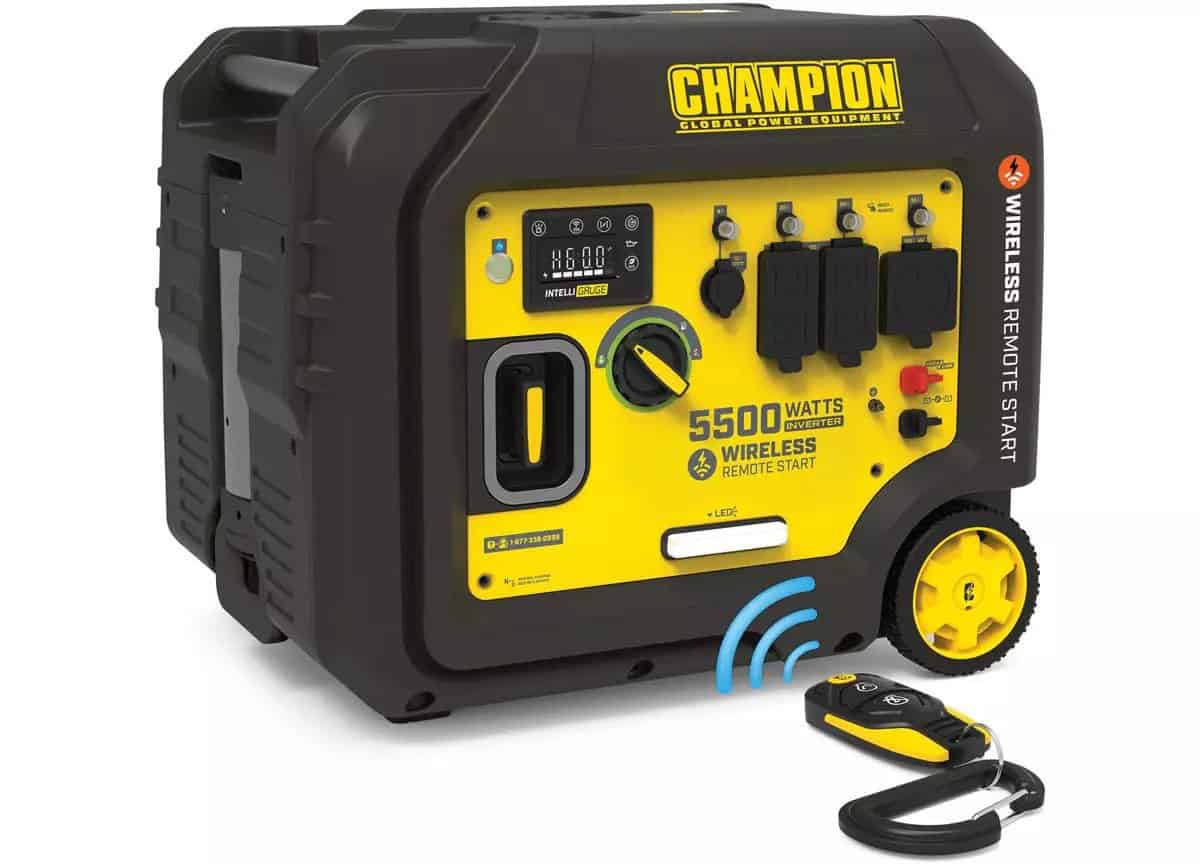
The Champion 201001 is a 5,500-starting-watt, 4,000-running-watt open-frame inverter with wireless remote start from up to 80 feet away. It’s still worth buying used or refurbished at the right price, but new buyers should compare it against the current Champion 201351 first because that model adds CO Shield and sells for $899.99 per Champion’s current catalog.
This is an aging model, so don’t expect normal new-in-box availability from Champion’s active lineup. Most real shopping now means refurbished units, used local listings, or eBay stock, which makes condition and included accessories matter more than they would on a current generator.

Champion 201001 specs at a glance
The Champion 201001 sits in the practical middle ground between small suitcase inverters and louder conventional jobsite generators. It gives you inverter power, enough output for many home backup and RV loads, and the rare convenience of remote start in this watt class.
| Spec | Champion 201001 value |
|---|---|
| Rated output | 4,000 running watts / 5,500 starting watts, 120V inverter |
| Engine | 224cc Champion OHV 4-stroke engine |
| Fuel tank | 3.7 gallons |
| Runtime at 25% load | Up to 20 hours; 25% of 4,000W is about a 1,000W load |
| Weight | About 119 lb with the included wheel kit and folding handle |
| Start type | Wireless remote start/stop from up to 80 feet away |
| Parallel capability | Yes, with Champion’s optional parallel kit |
| Warranty | 3-year limited warranty plus lifetime tech support |
| Original retail price | About $999 |
Champion also lists inverter output suitable for sensitive electronics, using the platform figure of less than 3% total harmonic distortion. That’s the key difference between this and a basic open-frame generator: the 201001 is built to power electronics more cleanly while still using a jobsite-style frame.
The 201001 does not have a CO-shutoff sensor because it predates Champion’s CO Shield rollout, so use it only outdoors with exhaust pointed away from people, doors, windows, and vents.
What 4,000 running watts covers
At 4,000 running watts, the Champion 201001 can handle a sensible emergency circuit plan instead of just charging phones and running a lamp. The smart way to use it is to separate running watts from starting watts, because motors draw more power for a moment when they kick on.
A refrigerator listed around 700W running is an easy fit by itself. From there, you can add critical loads like a sump pump, a furnace blower, a microwave, and TV plus lights, as long as you don’t force every motor and heating load to start at the same time.
The 5,500 starting watts give the 201001 room for short startup surges. That matters for pumps, compressors, and blowers because those loads are usually what trip up smaller generators.
For RV use, a 13,500 BTU air conditioner is within range based on the worksheet numbers Champion buyers usually care about: about 2,800 to 3,000W to start and about 1,500W to run. That leaves room for basic RV loads, though you still need to manage the microwave and other heavy appliances instead of stacking them all at once.
Because sources conflict on the 201001’s exact outlet panel, don’t buy one sight unseen based on a generic product description. Ask the seller for a clear panel photo and verify that the receptacles match how you plan to connect the generator, especially if you’re shopping for RV use.
The remote start is still the selling point
The wireless remote start is the reason the Champion 201001 still gets attention. Per Champion’s published materials, the fob can start and stop the generator from up to 80 feet away, which is a real convenience during bad weather, cold mornings, or overnight RV use.
That feature also separates the 201001 from its current same-platform sibling. The Champion 201351 keeps the same 4,000 running watts and 5,500 starting watts, but Champion’s current catalog lists it as recoil start and does not give it remote start.
For some buyers, CO Shield on the newer model is the better trade. For others, the ability to start the generator without walking outside is exactly why a clean 201001 is still attractive on the used market.
The Fuel Fill Assist LED is another useful touch from the original design. It illuminates the fuel tank and controls for night refueling, which is the kind of small feature you appreciate during a long outage or late campground arrival.
If you’re comparing Champion’s open-frame inverter family more broadly, our Champion 201056 review covers a related 4,250W open-frame inverter that fits a different buyer. The 201001’s edge is the remote-start package, not being the newest or lightest option.
Runtime and fuel
The 201001 has a 3.7-gallon fuel tank and Champion rates it for up to 20 hours at 25% load. Since 25% of 4,000 running watts is about 1,000 watts, that runtime figure describes a light, steady load rather than a full-house backup scenario.
That’s still useful context. A refrigerator, some lights, a TV, and a few charging loads can sit much closer to that light-load range than a microwave, air conditioner, and pump all running together.
As load goes up, runtime goes down. Champion’s published 20-hour figure is not a promise that you’ll get that long while running heavy motor loads or RV air conditioning for long stretches.
For storm prep, plan fuel around your actual load plan instead of the best-case number. The 3.7-gallon tank is generous for this class, but any generator burns more fuel when you ask it to do harder work.
Buying a 201001 used or refurb: checklist
Because the Champion 201001 is mostly a used, refurbished, or eBay buy now, the listing matters as much as the spec sheet. A cheap unit missing the remote fob, wheel hardware, or a clean outlet panel photo can become the wrong deal fast.
If the generator has an hour meter or Intelligauge-style display present, ask for a photo of the hours. Hours don’t tell the whole story, but they help separate a lightly used outage machine from a hard-worked unit that has been sitting in stale fuel.
Verify the remote fob is included and that it pairs with the generator. Since remote start is the headline feature, a 201001 without a working fob is just an older open-frame inverter with fewer reasons to chase it over the current 201351.
Ask for a clear photo of the control panel before you buy. Do not rely on copied outlet descriptions, because published and seller sources conflict on this older model’s panel details.
Check the oil condition, ask whether it starts easily from cold, and listen for surging once it’s running. A seller who can show a clean startup video under load is giving you better evidence than a listing that only says “runs great.”
Look over the spark arrestor if you’ll use the generator around dry grass, campsites, or public lands that require one. Also ask how the generator was stored, because stale fuel is one of the most common problems with portable generators that sit between outages.
A refurbished listing can be a good way to buy this model if the seller clearly states what was inspected and what accessories are included. Used listings are more of a judgment call, so price the missing pieces and the risk before you treat the asking price as the real total cost.
Ebay
201001 vs the current Champion 201351 and 201469
The closest current replacement for the 201001 is the Champion 201351. Champion’s current catalog lists the 201351 with the same 4,000 running watts and 5,500 starting watts, the same 224cc platform, the same 3.7-gallon tank, and the same up-to-20-hour runtime at 25% load.
The trade is straightforward: the 201351 adds CO Shield, ANSI/PGMA G300-2023 listing, a published RV-ready TT-30R outlet, and a lower 109.1 lb weight, but it drops the remote start. Champion publishes 61 dBA for the current same-platform 201351 at 23 feet; Champion does not provide a verified 201001 dBA figure in the materials we’re using here.
| Feature | Champion 201001 | Champion 201351 | Champion 201469 |
|---|---|---|---|
| Running / starting watts | 4,000 running / 5,500 starting | 4,000 running / 5,500 starting | 5,500 starting / 4,000 running on gasoline-and-propane inverter platform |
| Start type | Wireless remote start/stop from up to 80 feet away | Recoil start | Electric start |
| CO Shield | No | Yes | Yes |
| RV TT-30R outlet | Verify the actual panel before purchase | Yes, per Champion’s current catalog | Not verified here |
| Weight | About 119 lb with wheel kit and folding handle | 109.1 lb | Not verified here |
| Price | Original retail about $999; current used/refurb pricing varies | $899.99 current Champion catalog price | Sold at Home Depot; current price not verified here |
Buy the 201001 if the remote start is the feature you care about and the unit is clean, complete, and priced below what you’d pay for a new current model. Buy the 201351 if you want a current-catalog generator with CO Shield, RV-ready outlet support, and a known new-unit warranty path.
The Champion 201469 is the one to consider if dual fuel matters. It’s the gasoline-and-propane evolution of this power class with electric start and CO Shield, but don’t assume propane output or outlet details unless the listing or retailer page states them clearly.
If none of these fit, compare the broader current market before chasing an older remote-start model. Our guide to the best inverter generators is the better place to look if you want currently available alternatives.
Pros and cons
Pros
The 201001 gives you 4,000 running watts and 5,500 starting watts from an inverter platform, which is a strong mix for backup power, RV use, and electronics. Less than 3% total harmonic distortion is Champion’s platform figure for sensitive electronics.
The remote start is the standout advantage. Starting or stopping the generator from up to 80 feet away is convenient in rain, cold, and overnight RV situations where walking outside is the last thing you want to do.
The 3.7-gallon tank and up-to-20-hour rating at 25% load make it efficient for lighter loads. The included wheel kit and folding handle also matter because this is not a small suitcase inverter.
Parallel capability gives you a growth path if you already own compatible Champion equipment. Champion’s optional parallel kit includes a 25-foot 30A 120V cord and an ETL-approved paralleling panel with dual 30A 120V outlets, and our parallel generators guide explains when pairing generators makes sense.
Cons
Availability is the biggest drawback. The 201001 is an aging model, so most shoppers are dealing with used, refurbished, or eBay listings rather than normal current-catalog buying.
It does not have CO Shield. If that safety feature is high on your list, the current 201351 is the cleaner pick.
It is a 120V generator, so don’t buy it for equipment that needs 240V. That makes it a good fit for many RV and household emergency loads, but not every home backup plan.
At about 119 lb with the wheel kit and folding handle, it’s also heavy compared with suitcase inverters. The wheels help, but lifting it into a truck or RV storage bay is still a two-person kind of job for many owners.
Maintenance basics
The 224cc Champion OHV engine needs normal small-engine care: clean oil, clean air, fresh fuel, and regular exercise. If you’re not sure what oil to use, start with our plain-English guide to what kind of oil a generator uses before you service it.
Champion’s maintenance cadence for this class includes a 5-hour break-in oil change, then 50-hour or seasonal oil service. That first oil change matters because break-in oil picks up early wear particles from a new or freshly serviced engine.
Used buyers should assume the maintenance history is incomplete unless the seller has receipts or photos. If the oil is dark, low, or smells like fuel, treat that as a negotiation point or a reason to walk away.
Storage is just as important as runtime. Stale fuel can gum up the carburetor and turn a perfectly good outage generator into a no-start problem right when you need it.
Before long storage, follow a fuel plan, keep the battery situation in mind if your unit uses one for remote/electric functions, and run the generator often enough to catch problems early. Our portable generator maintenance checklist covers the seasonal routine in more detail.
Bottom line
The Champion 201001 is still a smart used/refurb buy if you want a 4,000-running-watt inverter with remote start and you can verify the unit is complete and healthy. The 80-foot wireless start feature is the reason to chase this older model.
If you’re buying new, the Champion 201351 deserves the first look because it keeps the same 5,500 starting watts and adds CO Shield at $899.99, though it loses remote start. For used 201001 listings, make the remote fob, panel photo, starting behavior, oil condition, and price decide the deal.
Frequently asked questions
Is the Champion 201001 discontinued?
The Champion 201001 is an aging model with limited normal availability, so most shoppers find it used, refurbished, or on eBay. Champion’s current same-platform model is the 201351, which keeps the 4,000 running watts and 5,500 starting watts but adds CO Shield and drops remote start.
How many watts is the Champion 201001?
The Champion 201001 is rated at 5,500 starting watts and 4,000 running watts. It is a 120V open-frame inverter generator.
How far does the remote start work?
Champion lists the 201001’s wireless remote start/stop range at up to 80 feet. If you’re buying used, make sure the remote fob is included and works with the generator.
How long does the Champion 201001 run on a tank?
Champion rates the 201001 for up to 20 hours at 25% load from its 3.7-gallon tank. Since 25% of 4,000 running watts is about 1,000 watts, that rating applies to a light load.
Can the Champion 201001 run an RV air conditioner?
Yes, a 13,500 BTU RV air conditioner fits within the 201001’s output, with about 2,800 to 3,000W starting and about 1,500W running. Verify the actual outlet panel on any used unit before you buy, and use the correct adapter if your RV setup needs one.
Does the Champion 201001 have CO Shield?
No. The 201001 predates Champion’s CO Shield rollout, while the current 201351 adds CO Shield.
Can you parallel two Champion 201001 generators?
Yes, the Champion 201001 is parallel-capable with Champion’s optional parallel kit. That kit includes a 25-foot 30A 120V cord and an ETL-approved paralleling panel with dual 30A 120V outlets.