
For hurricane essentials only, buy a generator in the 3,500-4,500 starting-watt inverter class. Add a window AC or sump pump and you move into the 5,000-7,500 W class; whole-home-lite needs 9,500-12,000 W; central AC pushes you past 12,000 W or into a standby generator.
The two numbers that decide everything are running watts and starting surge. Bigger generators also burn more fuel, so buying too much capacity can turn into a storage problem fast.
Running watts vs starting watts: the two numbers that matter
Running watts are what an appliance uses after it is already on. Starting watts are the short surge a motor needs to start, and that surge is the part that surprises people during hurricane prep.
A refrigerator/freezer is the cleanest example. The reference figure used in our calculator is 700 W running, but the compressor can need 2,200 W to start. That does not mean the fridge uses 2,200 W all day; it means your generator has to have room for that start while other loads are already running.
The sizing rule is simple: your generator’s starting capacity must cover the biggest single surge on top of whatever is already running. If your base hurricane load is fridge, lights, TV, and charging, that’s about 1,070 W running. If the fridge compressor starts while those loads are on, the generator needs to handle about 1,070 W plus the 2,200 W fridge surge.
That is why a little generator that looks fine on running watts can still trip, bog down, or force you to play switch-flipping games. Starting watts matter most with compressors and pumps: refrigerators, window AC units, sump pumps, and well pumps.
Microwaves are different. The calculator figure is 1,000 W, and you control when it runs. If you’re using a smaller inverter, you can shut off the window AC or wait for the fridge cycle to settle before heating food.
What “essentials” actually adds up to
Most hurricane households do not need to power every breaker. They need cold food, a few lights, charging, news, and short cooking bursts. Those loads are smaller than people expect, but the surge headroom still matters.
| Appliance | Running W | Starting surge |
|---|---|---|
| Refrigerator/freezer | 700 W | 2,200 W |
| 3 lights | 180 W | None listed |
| 55-inch LED TV | 100 W | None listed |
| Phone/laptop charging | About 90 W combined | None listed |
| Microwave | 1,000 W | None listed |
| Window AC | About 1,200 W | 1,800 W |
| Sump pump | 1,050 W | 2,150 W |
| Well pump | About 1,000 W | 2,000-3,000 W |
Those are the appliance reference figures used by the Electric Ninjas calculator. Your nameplate can vary, but the pattern is what matters: motors surge, resistive or electronic loads are easier, and anything you can control manually can be staggered.
Here is the basic essentials addition. Refrigerator/freezer at 700 W, three lights at 180 W, a TV at 100 W, and phone/laptop charging at about 90 W add up to about 1,070 W running. Turn on the microwave and the load climbs to about 2,070 W while it runs.
The fridge compressor’s 2,200 W surge has to fit on top of whatever else is running. That is why “essentials only” still wants about 3,500-4,500 starting watts of headroom. A 2,000-2,500 W ultralight inverter is the disciplined floor for fridge-plus-lights households that stagger loads, but it is not the comfortable choice.
If you want your own list instead of a rule of thumb, plug your appliances into our generator wattage calculator. Build the list around what you will actually use during the outage, not every device you own.
The four hurricane sizing tiers
Most hurricane generator decisions fall into four tiers. The right tier depends on what you expect to keep running, whether you have pumps, and whether central AC is on the wish list.
| Tier | What it carries | Generator class | Example unit |
|---|---|---|---|
| Tier 1 | Fridge, lights, charging, microwave bursts | 3,500-4,500 starting-watt inverter class | Champion 200988 |
| Tier 2 | Essentials plus window AC or sump pump | 5,000-7,500 W class | Westinghouse iGen5000DF or WGen7500DF |
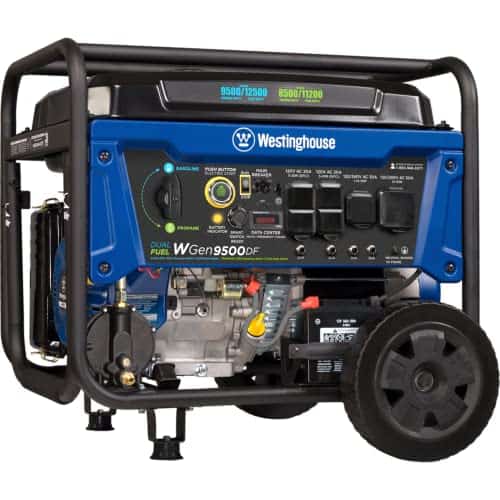
| Tier 3 | Multiple circuits, well pump, no central AC | 9,500-12,000 W portable class | Westinghouse WGen9500DF |
| Tier 4 | True whole house including 3-ton central AC | 12,000+ W portable minimum, realistically standby | DuroMax XP12000EH or Generac Guardian 22kW class |
Tier 1: Essentials only
Tier 1 is the smart minimum for most homeowners who are trying to protect food, charge devices, run lights, watch storm updates, and use a microwave in short bursts. The target is a 3,500-4,500 starting-watt inverter class because the fridge surge can hit while the base load is already running.
The Champion 200988 fits this tier well on paper: 4,500 starting W and 3,500 running W on gas, 3,150 running W on propane, and 61 dBA, per the published figures used on our hurricane hub. That gives an essentials household room for the refrigerator surge without jumping straight to a louder, thirstier open-frame machine.
A 2,000-2,500 W ultralight inverter can work as the floor if you are disciplined. That means fridge plus lights, careful staggering, and no expectation that a window AC, microwave, and compressor start will all play nicely together.
Check the Champion 200988 price on Amazon →
Tier 2: Essentials plus one comfort load
Tier 2 is where you land if you want the basics plus one meaningful comfort or protection load. The common examples are a window AC during a hot outage or a sump pump during heavy rain.
The rough load is about 3,400 W running with surges to manage. That is why the right class is 5,000-7,500 W instead of a tiny inverter that technically runs the fridge when nothing else is happening.
The Westinghouse iGen5000DF sits at the quiet end of this tier with 3,900 running W on gas, 3,500 running W on propane, and 52 dBA, per the published hurricane hub figures. That quiet advantage matters at night when the generator is near bedrooms or neighbors.
The Westinghouse WGen7500DF is the upper bound of this tier, with 7,500 running W on gas, 6,750 running W on propane, and 72 dBA per the same published figures. It is a better fit when the sump pump or window AC is non-negotiable and you want more margin than a mid-size inverter can give.
Tier 3: Whole-home-lite without central AC
Tier 3 is not “run the whole panel like nothing happened.” It is multiple selected circuits through a transfer switch or interlock: refrigerator, kitchen convenience, lights, internet gear if available, sump or well pump if applicable, and maybe a comfort circuit.
This is the 9,500-12,000 W portable class. It is the practical sweet spot for many homes that want a more normal outage setup but are willing to leave central AC off.
The Westinghouse WGen9500DF is the example from our storm portable list: 9,500 running W on gas, 8,500 running W on propane, remote start, and a transfer-switch-ready L14-30R outlet, per the published figures. That L14-30R detail matters because this tier usually belongs on a proper transfer connection, not a tangle of extension cords.
Check the Westinghouse WGen9500DF price on Amazon →
Tier 4: True whole house including central AC
Central AC changes the whole conversation. A 3-ton central AC is a 10,000+ total-watt load with a significant start surge, based on the reference figure used in our calculator. That single load can decide the entire generator tier by itself.
If you are trying to stay portable, the DuroMax XP12000EH is the kind of machine that belongs in the discussion for hard pump loads and upper-end portable capacity. Per GeneratorBible figures used on our hub, it is rated at 12,000 starting W and 9,500 running W on gas, or 10,200 starting W and 8,075 running W on propane.
That still does not make portable central AC backup simple. Once the goal becomes automatic transfer and true whole-house comfort, the Generac Guardian 22kW standby class is the realistic answer, with 19,500 W on natural gas, 22,000 W on propane, and automatic transfer per Generac’s published class figures.
Check the DuroMax XP12000EH price on Amazon →
The oversizing tax nobody mentions
A larger generator is not automatically better in a hurricane. It costs more to buy, is harder to move, makes more noise in many cases, and burns more fuel for the same backup window.
The fuel-burn gap is the part buyers often miss. Using manufacturer figures at 25% load and 12 run-hours per day from our published fuel guide, a 2,500W-class inverter burns about 1.2 gal of gas per day. A 4,500W-class inverter burns about 1.9 gal per day. A 9,500W-class portable burns about 6.6 gal per day.
| Generator class | Fuel burn basis | Gas per day |
|---|---|---|
| 2,500W-class inverter | 25% load, 12 run-hours/day | About 1.2 gal/day |
| 4,500W-class inverter | 25% load, 12 run-hours/day | About 1.9 gal/day |
| 9,500W-class portable | 25% load, 12 run-hours/day | About 6.6 gal/day |
That means oversizing can triple your fuel storage problem compared with a right-sized inverter. During a storm, fuel is not just money; it is cans, storage space, rotation, lines, and risk. Before you buy the biggest machine in the aisle, run the daily burn numbers with our hurricane fuel-storage math.
There is also a budget angle. If the budget caps at four figures, the essentials tier is where the value lives, and you should shop carefully instead of forcing a small budget into a half-baked whole-house plan. Start with our best storm generators under $1,000 if you want cold food, charging, lights, and manageable fuel burn.
The 240V question
Some hurricane loads are not just about watts. Well pumps are typically 240V, and that means you need a generator with a 240V outlet and usually a transfer switch or interlock.
A typical 1 HP well pump runs at about 1,000 W but can surge 2,000-3,000 W, based on the calculator reference figure. The watts do not look huge, but the voltage and surge make it a poor match for a small essentials inverter.
The WGen9500DF’s L14-30R outlet is the standard example of the kind of connection you start looking for in the whole-home-lite tier. The generator still has to be installed and connected correctly; backfeeding a house with cords is dangerous and should not be part of any storm plan.
Central AC pushes even harder toward permanent gear. If you want automatic transfer and whole-house operation, read our portable vs standby breakdown before you buy a large portable and assume it solves everything.
If you are committed to the biggest-portable path, compare models in the 12,000-watt generator roundup. That class can make sense for pump-heavy homes, but it still comes with fuel, noise, storage, and connection tradeoffs.
Bottom line
Buy for your biggest surge plus your real running load, not for the panel’s theoretical max. Most hurricane households are happiest in the 4,500 W inverter class for essentials or the 9,500 W portable class for whole-home-lite backup.
Size the load with the calculator before you spend, then choose the tier that matches your fuel plan and wiring setup. For model picks by use case, start with our main hurricane generator guide.
Frequently asked questions
What size generator do I need for a hurricane?
For essentials only, use a 3,500-4,500 starting-watt inverter class. Add a window AC and you are in the 5,000-7,500 W class. Whole-home-lite is usually 9,500-12,000 W, while central AC pushes you into 12,000+ W portable territory or a standby generator.
Will a 3,500-watt generator run a refrigerator and window AC?
The running load is about 1,900 W, using 700 W for the refrigerator and about 1,200 W for the window AC. The tight part is the refrigerator’s 2,200 W surge on top of a running AC. Stagger the starts and it can work, but 4,500 starting watts is the more comfortable essentials choice.
What size generator runs a whole house during a hurricane?
Without central AC, a 9,500-12,000 W portable with a proper transfer connection is the usual whole-home-lite answer. With a 3-ton central AC, the AC alone is a 10,000+ total-watt load with a significant start surge. That is where standby generators become the more realistic option.
Can a portable generator run a well pump?
Yes, if the generator has the right output and enough surge capacity. A typical 1 HP well pump runs about 1,000 W but surges 2,000-3,000 W and is typically 240V. You need a 240V-outlet generator and a proper transfer connection.
How many watts do hurricane essentials use?
Refrigerator/freezer at 700 W, three lights at 180 W, a TV at 100 W, and phone/laptop charging at about 90 W add up to about 1,070 W running. Add a microwave burst and the load is about 2,070 W. You still need room for the refrigerator’s 2,200 W starting surge.
Is a bigger generator always better for hurricanes?
No. At the same 25% load duty and 12 run-hours per day, a 2,500W-class inverter burns about 1.2 gal/day, while a 9,500W-class unit burns about 6.6 gal/day. Oversizing can multiply the fuel you must store before the storm.


