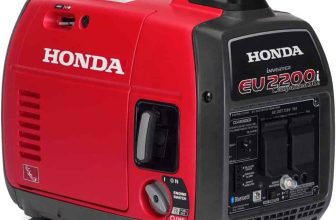
The Honda EM5000SX is the most refined 5,000W-class home-backup generator you can buy, but it’s expensive at around $2,799 at Honda dealers; street prices vary. You get 5,000 max watts, 4,500 rated watts, unusually quiet 63-66 dB(A) operation, and Honda’s iAVR system that can deliver up to 7,000 watts for up to 10 seconds.
Buy it if you want clean-feeling power delivery, quiet open-frame operation, Honda dealer support, and a commercial-grade iGX390 engine more than you want the cheapest watts per dollar. Skip it if your main goal is maximum running wattage for the lowest price, because cheaper higher-wattage generators can roughly double the output.
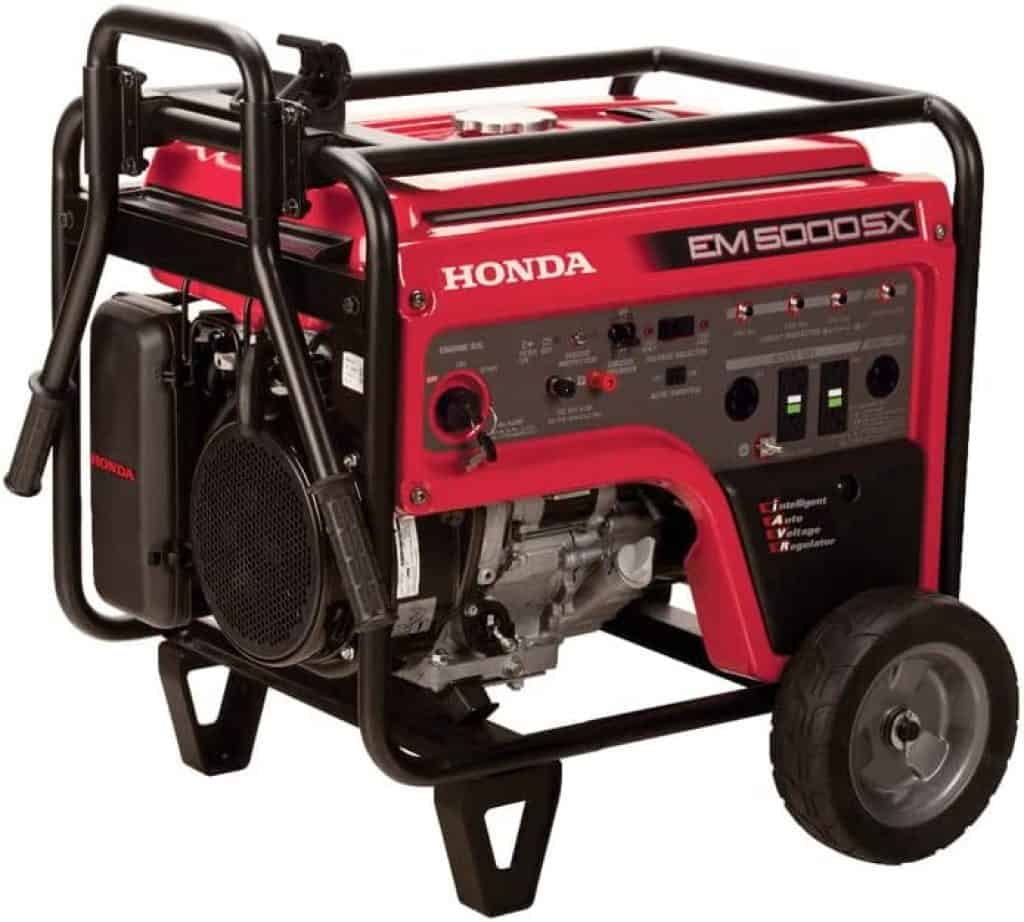
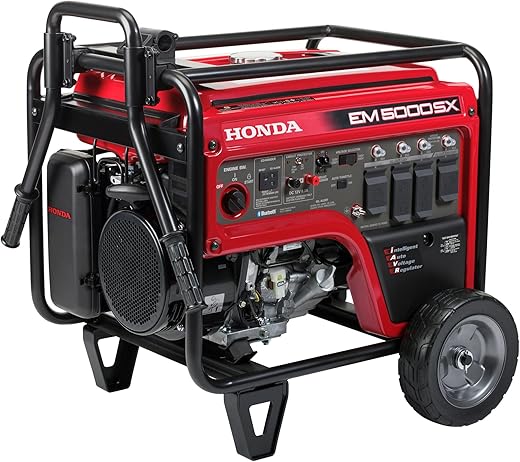
Honda 664350 EM5000SX 120V/240V 5000-Watt 389cc Portable Generator with Co-Minder
Check the Honda EM5000SX price on Amazon →
Honda EM5000SX specs at a glance
The current Honda EM5000SXK3AN is a premium AVR open-frame generator, not an inverter generator. The specs below come from Honda and dealer documentation, including Honda’s official EM5000 model page.
| Spec | Honda EM5000SX |
|---|---|
| Power output | 5,000 max watts / 4,500 rated watts |
| Voltage and amperage | 120/240V; 41.2/20.8A max, 37.5/18.6A rated |
| DC output | 12V 100W |
| Surge system | iAVR delivers up to 7,000 watts for up to 10 seconds |
| Engine | Honda iGX390 commercial-grade 389cc OHV with electronic governor |
| Fuel tank and runtime | 6.2-gallon tank; 10.5 hours at half load, 7.1 hours at rated load |
| Noise | 63-66 dB(A) at rated load |
| Weight and size | 226.4 lb dry; 41.1 x 27.8 x 28.3 in |
| Outlets | Two GFCI-protected 20A 125V duplex receptacles; one 30A 120/240V NEMA L14-30R twist-lock |
| Starting | Electric start with battery included; recoil backup |
| Safety | CO-MINDER carbon monoxide auto-shutoff; Oil Alert low-oil shutdown |
| App features | Bluetooth with Honda My Generator app for remote monitoring and operation |
| Warranty | 3 years residential / 1 year commercial |
| Dealer price | Around $2,799 at Honda dealers; street prices vary |
The spec sheet tells the story: this is not a brute-force generator built to win a wattage race. Honda built the EM5000SX around stable power, lower sound, electric convenience, and long-service hardware.
The iGX390 engine is the heart of that pitch. It’s a commercial-grade 389cc OHV engine with an electronic governor, which is the kind of feature that matters during changing household loads. A refrigerator, sump pump, furnace fan, and charger loads don’t pull power evenly, so steady engine control helps the generator respond cleanly.
Power output and the iAVR advantage
The EM5000SX gives you 4,500 rated watts for continuous use and 5,000 max watts, with 120/240V output for home backup. That’s enough for essential-circuit backup in a typical outage: refrigeration, sump pumping, furnace fan, lighting, TV, chargers, and some general receptacles if you manage loads.
Here’s the practical load math using standard worksheet figures. A refrigerator at 700 running watts with 2,200 starting watts, a 1/2 HP sump pump at 1,050 running watts with 2,150 starting watts, a furnace fan around 700 running watts, and lights/TV/chargers around 300 running watts add up to about 2,750 running watts.
That leaves comfortable running headroom under the generator’s 4,500 rated watts. More importantly, it leaves room for motor starts, which is where many generators feel weaker than their wattage label suggests.
Honda’s iAVR is the big advantage here. Per Honda’s published figure, iAVR can deliver up to 7,000 watts for up to 10 seconds to start high-surge motor loads. That short reserve is exactly what big single motor starts need, such as well pumps, sump pumps, and AC condensers that hit hard for a moment and then settle down.
This does not mean the EM5000SX is a central-air whole-house generator. The smart use case is an essential-load transfer switch or a carefully managed panel setup, not trying to run everything as if the grid were on.
If you’re sizing your own home, use our generator wattage calculator and list the starting loads separately from running loads. Starting surge is where people get surprised, especially with pumps and compressors.
The honest drawback: the EM5000SX is not an inverter generator. It is an AVR open-frame unit with Honda’s iAVR system, and that’s fine for typical home loads, appliances, motors, lights, and battery chargers. But THD is not inverter-grade, so buyers running especially sensitive electronics should understand the difference before paying premium money.
Fuel use and runtime
The EM5000SX carries a 6.2-gallon gasoline tank. Honda’s published runtime is 10.5 hours at half load and 7.1 hours at rated load.
The half-load fuel math is simple: 6.2 gallons divided by 10.5 hours equals about 0.59 gallons per hour. That’s a useful planning number if you’re trying to decide how much fuel to keep on hand before a storm.
At half load, this generator can cover an overnight stretch without refueling. That matters because nobody wants to walk outside in bad weather in the middle of the night to refill a hot generator.
At rated load, Honda’s 7.1-hour figure is still solid for a 4,500-watt open-frame unit. The practical lesson is to avoid running every load all the time. Cycling the refrigerator, pump loads, furnace fan, and general circuits is a better outage strategy than leaving every possible device on.
Gasoline storage is the hidden chore with any generator in this class. If you’re building an outage plan, read our guide to how much gasoline a generator uses so you can estimate fuel needs from tank size, load, and runtime instead of guessing during an outage.
How loud is it really?
Honda rates the EM5000SX at 63-66 dB(A) at rated load. For an open-frame generator this size, that is very quiet.
For context, normal conversation is around 60 dB, and a vacuum is around 70 dB. The Honda sits much closer to conversation than to a harsh jobsite generator sound, at least by the published number.
This is one of the clearest reasons to pay Honda money. A cheaper high-output unit may give you more watts, but the sound can be harder to live with in a tight neighborhood, at night, or during a long outage.
Compare that with the Champion 201110 figure: 74 dBA at 23 ft. Against Honda’s 63-66 dB(A) rating, the Honda is roughly 8-11 dB quieter. Since every 10 dB is perceived as about half as loud, that difference is not just spec-sheet trivia.
Noise also affects where you can place the generator. You still need safe outdoor placement away from doors, windows, garages, and vents, but a quieter machine gives you more flexibility in how annoying the setup is for your household and your neighbors.
Home backup: outlets, transfer switch, and safety
The EM5000SX has the outlet layout a homeowner should want for emergency backup. You get two GFCI-protected 20A 125V duplex receptacles plus one 30A 120/240V NEMA L14-30R twist-lock.
That L14-30R outlet is the one that makes the EM5000SX transfer-switch ready for a proper whole-panel or essential-panel hookup. Use a professionally installed transfer switch or approved interlock setup. Never backfeed through a dryer plug.
With 120/240V output, the Honda can feed both sides of a properly configured backup panel. That’s the right way to run selected household circuits instead of snaking extension cords through the house.
The GFCI-protected duplex outlets are useful for direct plug-in loads, tools, chargers, and temporary outdoor work. For storm backup, though, the cleanest setup is still the twist-lock outlet feeding a transfer switch.
Safety hardware is strong on the current generation. CO-MINDER continuously monitors carbon monoxide and automatically shuts the engine down at dangerous levels. Oil Alert shuts the generator down during low-oil conditions to help protect the engine.
Honda also includes Bluetooth with the Honda My Generator app on the current generation. That gives you remote monitoring and operation from the app, which is convenient when the generator is running outside in bad weather.
None of those features replace common sense. The generator still runs on gasoline, still produces carbon monoxide, and still must run outdoors with proper clearance from living spaces.
Honda EM5000SX vs Champion 201110: refinement vs raw watts
The Champion 201110 is the obvious kind of competitor a budget-minded homeowner will compare against the Honda. It gives you far more output on paper, while the Honda answers with lower sound, iAVR surge behavior, Bluetooth monitoring, and Honda dealer support.
| Spec | Honda EM5000SX | Champion 201110 |
|---|---|---|
| Starting watts | 5,000 max watts; iAVR up to 7,000 watts for up to 10 seconds | 11,500 starting watts |
| Running watts | 4,500 rated watts | 9,200 running watts |
| Engine | Honda iGX390 commercial-grade 389cc OHV | 459cc engine |
| Fuel tank | 6.2 gallons | 7.7 gallons |
| Runtime | 10.5 hours at half load; 7.1 hours at rated load | 10 hours at 50% load |
| Noise | 63-66 dB(A) at rated load | 74 dBA at 23 ft |
| Starting | Electric start with battery included; recoil backup | Electric start |
| CO shutoff | CO-MINDER auto-shutoff | CO Shield auto-shutoff |
| Compliance | Not specified in provided Honda data | EPA + CARB |
| Warranty | 3 years residential / 1 year commercial | 3-year warranty |
The Champion gives you roughly twice the running watts for far less money. If your plan is to power larger loads and you care most about wattage per dollar, read our review of the Champion 9,200W platform before you spend Honda money.
The Honda is the better fit if you’re buying for refinement, lower noise, high-surge starting behavior, and long-haul ownership through Honda’s dealer network. The 8-11 dB noise gap alone may be worth paying for if you live close to neighbors or expect long outages.
This choice is not about one generator being universally better. It’s about the kind of backup plan you’re building. Honda is the polished essential-circuit machine; Champion is the raw-output value play.
Pros and cons
Pros
- Excellent surge support for motor loads: Honda’s iAVR can provide up to 7,000 watts for up to 10 seconds, which helps with hard-starting pumps and compressors.
- Very quiet for its class: The 63-66 dB(A) rating at rated load is unusually low for an open-frame generator in this output range.
- Commercial-grade Honda engine: The iGX390 is a 389cc OHV engine with an electronic governor, a strong match for variable home loads.
- Transfer-switch ready: The 30A 120/240V NEMA L14-30R twist-lock makes it practical for a proper home backup panel connection.
- Strong safety package: CO-MINDER carbon monoxide auto-shutoff and Oil Alert low-oil shutdown are both included.
- Electric start plus recoil backup: The battery is included, and the recoil backup gives you a fallback.
- Bluetooth app support: Honda’s My Generator app adds remote monitoring and operation on the current generation.
Cons
- High price: Around $2,799 at Honda dealers is premium money for a 4,500-rated-watt generator.
- Not a max-watts bargain: Cheaper higher-wattage units can give you much more running wattage for less money.
- 4,500 rated watts won’t run central AC: This is an essential-circuit backup generator, not a run-everything setup.
- Gasoline only: You need to plan fuel storage and refueling around the 6.2-gallon tank and your outage load.
- Heavy: At 226.4 lb dry, it’s not something most people casually lift or reposition without help.
- Not inverter-grade THD: It’s an AVR open-frame generator with iAVR, not an inverter for the most sensitive electronics buyers.
Maintenance is also part of ownership with any gasoline generator. If you’re setting up a long-term backup plan, bookmark our guide to what kind of oil a generator uses before outage season.
Who should buy the EM5000SX
Buy the EM5000SX for quiet-neighborhood home backup. The 63-66 dB(A) rating is the standout feature after the engine and iAVR system. If your generator will run near neighbors during a long outage, lower sound is not a luxury.
Buy it if your home has pump loads that need strong surge support. A refrigerator, sump pump, furnace fan, lights, TV, and chargers can sit around 2,750 running watts using the worksheet example above. The 7,000-watt iAVR reserve for up to 10 seconds gives you a better shot at starting those high-surge loads cleanly.
Buy it if you keep generators for 15+ years. Honda’s value makes the most sense for owners who care about the iGX390 commercial-grade engine, dealer network, and long-haul reliability more than the lowest purchase price. If you only want a storm machine that sits unused most of the time, the premium may be harder to justify.
Don’t buy it if you want maximum watts per dollar. The Champion 201110 class gives you roughly twice the running watts and a much bigger headline number. The tradeoff is noise, refinement, and the lack of Honda’s iGX390/iAVR package.
Don’t buy it if your plan requires central AC or broad whole-home coverage. The EM5000SX is best for selected circuits and disciplined load management. If your outage plan is to live almost normally with large loads running, you’re shopping in the wrong wattage class.
Bottom line
The Honda EM5000SX is the premium pick for homeowners who want a quiet, polished, transfer-switch-ready 5,000W-class generator for essential backup. Its 4,500 rated watts and 7,000-watt iAVR surge reserve make more sense for pumps, refrigeration, furnace fans, and selected circuits than for central AC or full-home coverage.
If you want the most watts for the money, buy a larger value generator. If you want the most refined 5,000W-class home-backup generator, the EM5000SX earns its premium price.
Frequently asked questions
Is the Honda EM5000SX an inverter generator?
No. The Honda EM5000SX is an AVR open-frame generator with Honda’s iAVR system, not an inverter generator. It’s fine for typical home loads, motors, appliances, lights, and chargers, but THD is not inverter-grade for the most sensitive electronics buyers.
How long will the Honda EM5000SX run on a tank?
Honda lists 10.5 hours at half load and 7.1 hours at rated load from the 6.2-gallon tank. At half load, that works out to about 0.59 gallons per hour.
Can the Honda EM5000SX power a whole house?
It can power essential circuits and many normal home loads through a proper transfer switch. With 4,500 rated watts, it is not the right choice for running central AC or every circuit in the house at once.
How loud is the Honda EM5000SX?
Honda rates it at 63-66 dB(A) at rated load. That is unusually quiet for an open-frame generator this size and roughly 8-11 dB quieter than the Champion 201110’s 74 dBA figure.
Does the Honda EM5000SX have carbon monoxide protection?
Yes. The current EM5000SX includes Honda CO-MINDER, which continuously monitors carbon monoxide and automatically shuts the engine down at dangerous levels.
What is iAVR on Honda generators?
iAVR stands for intelligent Automatic Voltage Regulation. On the EM5000SX, Honda says it can deliver up to 7,000 watts for up to 10 seconds to help start high-surge motor loads.
Is the Honda EM5000SX worth the price?
Yes, if you value quiet operation, Honda’s iGX390 commercial-grade engine, iAVR surge support, Bluetooth monitoring, and dealer support. No, if your main goal is the most running watts for the least money, because cheaper higher-wattage generators can deliver much more output.