DeWalt’s current US portable generator line is four models: the DXGNi2200 inverter, DXGNR4000, DXGNR6500, and DXGNR8000, and all four have CO Protect automatic carbon monoxide shutdown. The old Honda-powered DXGN jobsite generators this page used to rank are end-of-line, so the honest short list now is simple: DXGNi2200 for small inverter duty, DXGNR4000 for jobsite value, DXGNR6500 for mid-size backup, and DXGNR8000 for heavier home loads.
If you’re shopping at Home Depot or trying to stay in the DeWalt ecosystem, don’t use old DXGN rankings as your buying map. The DeWalt generator line changed over, and the current DXGNR models are the ones to compare against today’s open-frame backup and jobsite machines.
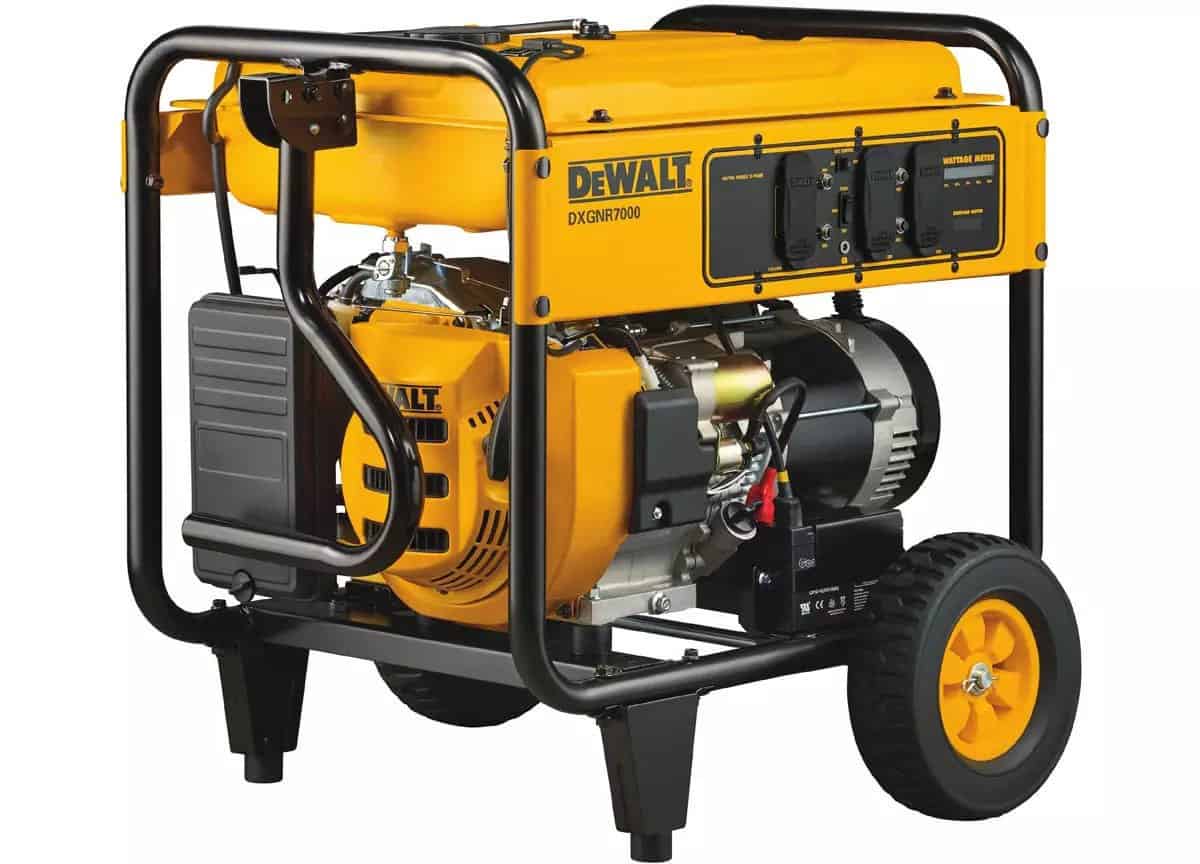
The current DeWalt generator line at a glance
| Model | Starting/running watts | Engine | Start type | Standout features |
|---|---|---|---|---|
| DXGNi2200 | 2,200 starting / 1,700 running watts | 80cc OHV | — | Auto throttle, low-oil shutdown, CO Protect, compact suitcase-style inverter |
| DXGNR4000 | 5,000 starting / 4,000 running watts | 223cc OHV | Recoil start | 3.4-gallon tank, roughly 10 hours at 50% load, covered outlets, never-flat wheels, CO Protect, 50-state model |
| DXGNR6500 | 8,125 starting / 6,500 running watts | — | — | Idle control, covered outlets, hardened 1-1/4 in. steel-tube cradle, never-flat wheels, CO Protect |
| DXGNR8000 | 10,000 starting / 8,000 running watts | 420cc engine | Electric start | Low-oil shutoff, GFCI outlets, idle control, CO Protect |
That table is the cleanest way to understand the 2026 DeWalt portable generator lineup. The generation marker is CO Protect: every current model carries DeWalt’s automatic carbon monoxide shutdown system, while the old Honda-powered DXGN jobsite era is no longer the current US line.
The other big takeaway is that DeWalt does not currently have a deep portable generator catalog. There are four current models, not a long ladder of near-duplicates, so the right pick mostly comes down to how much wattage you need and whether you want inverter output or conventional open-frame power.
DXGNi2200: the compact inverter
The DXGNi2200 is DeWalt’s small inverter generator: 2,200 starting watts and 1,700 running watts from an 80cc OHV engine, per the current DeWalt listing. It has auto throttle, low-oil shutdown, CO Protect, and a compact suitcase-style layout.
This is the DeWalt to look at for charging batteries, running small campsite loads, handling tailgate power, or keeping light RV and home essentials going without dragging out a full open-frame unit. It’s also the only current DeWalt model in this group described as an inverter, which matters if you want cleaner portable power for sensitive electronics.
Don’t oversell it, though. A 1,700-running-watt generator is not the right tool for a big transfer-switch setup, a pile of corded jobsite tools, or whole-house backup expectations. It’s a compact power source, not a home-backup brute.
For a deeper model-specific breakdown, read our full DeWalt DXGNi2200 review. That’s the page to use if you’re deciding whether the small inverter format fits your RV, tailgate, or light emergency kit.
DXGNR4000: the jobsite workhorse pick
The DXGNR4000 is the most practical current DeWalt for buyers who want a straightforward jobsite-style generator without jumping into the larger home-backup sizes. It’s rated at 5,000 starting watts and 4,000 running watts with a 223cc OHV engine, recoil start, covered outlets, never-flat wheels, CO Protect, and 50-state availability.
DeWalt’s published runtime figure is roughly 10 hours at 50% load from a 3.4-gallon tank. The math is simple: 3.4 gallons divided by 10 hours equals about 0.34 gallons per hour at half load. That gives you a useful fuel-planning number for workdays and outage duty, as long as you remember real fuel use rises with load.
This is the DeWalt I’d put first for a contractor-style buyer who wants the brand, needs more muscle than the DXGNi2200, and doesn’t need the extra capacity of the DXGNR6500 or DXGNR8000. It’s also the cleanest fit for shoppers who came looking for the old DeWalt jobsite machines but want a current model instead of hunting discontinued stock.
If you’re open to other brands, the Champion 200988 is the obvious Amazon-available comparison in this wattage class. Champion’s published figures are 4,500 starting watts and 3,500 running watts on gas, 3,150 running watts on propane, 61 dBA, and published runtimes of 14 hours on gas and 21 hours on propane; the tradeoff is that it’s a dual-fuel open-frame inverter rather than a DeWalt-branded conventional jobsite unit.
| Model | Power figures | Fuel/runtime figures | Why compare it |
|---|---|---|---|
| DeWalt DXGNR4000 | 5,000 starting / 4,000 running watts | 3.4-gallon tank, roughly 10 hours at 50% load | Current DeWalt jobsite workhorse |
| Champion 200988 | 4,500 starting / 3,500 running watts on gas; 3,150 running watts on propane | 14 hours gas / 21 hours propane, per Champion’s published figures | Quieter dual-fuel inverter alternative with 61 dBA published noise rating |
Check the Champion 200988 price on Amazon →
DXGNR6500: mid-size home backup and bigger jobs
The DXGNR6500 is the middle-heavy choice in the current DeWalt line. It’s rated at 6,500 running watts, and the Home Depot listing puts starting watts at 8,125.
The feature list is aimed at harder use: idle control, covered outlets, a hardened 1-1/4 in. steel-tube cradle, never-flat wheels, and CO Protect. Idle control is especially useful on an open-frame generator because it can reduce engine speed when loads drop, rather than running flat-out under lighter demand.
This model makes sense if the DXGNR4000 feels tight for your backup plan or jobsite load, but you don’t need the DXGNR8000’s 8,000 running watts. It’s the better DeWalt fit for homeowners who want to cover a larger group of essentials and tradespeople who need more headroom for bigger tools or multiple loads.
The Briggs & Stratton Q6500 is the fair Amazon-available alternative for shoppers who care more about lower noise than staying with DeWalt. Briggs & Stratton lists it as a QuietPower inverter with 6,500 starting watts and 5,000 running watts, so it gives up running wattage against the DXGNR6500 but brings inverter-style quiet-focused design.
| Model | Power figures | Generator type | Why compare it |
|---|---|---|---|
| DeWalt DXGNR6500 | 8,125 starting / 6,500 running watts | Open-frame portable generator | More running wattage in the current DeWalt line |
| Briggs & Stratton Q6500 | 6,500 starting / 5,000 running watts | QuietPower inverter | Lower-noise home-backup alternative |
Check the Briggs & Stratton Q6500 price on Amazon →
DXGNR8000: the big one
The DXGNR8000 is the largest current DeWalt portable generator in this lineup. It’s rated at 10,000 starting watts and 8,000 running watts, with a 420cc engine, electric start, low-oil shutoff, GFCI outlets, idle control, and CO Protect.
This is the model to consider if you’re building a more serious home-backup plan around a portable generator. The 8,000-running-watt rating gives you more room for startup-heavy loads and a larger set of household essentials than the DXGNR4000 or DXGNR6500.
Electric start also matters at this size. Pull-starting smaller engines is one thing; on a bigger backup generator, a key-start setup is a real quality-of-life feature during an outage.
The GFCI outlet note is worth calling out, but don’t assume it tells the whole receptacle story. DeWalt’s current data confirms GFCI outlets, not every plug layout you may need for a transfer switch, RV cord, or tool setup.
Before you buy the DXGNR8000, add up your loads instead of buying by gut feel. Use our generator wattage calculator to check your running and starting-watt needs, then compare that number to the DXGNR8000’s 10,000 starting watts and 8,000 running watts.
What happened to the Honda-powered DeWalts?
The Honda-powered DXGN jobsite era is over in the current US DeWalt generator lineup. The DXGN4500 with the Honda GX270 is end-of-line: DeWalt’s US product page no longer serves, and current spec databases no longer list it among live models.
That matters because a lot of old buying guides still rank those machines like they’re normal retail picks. They’re not. If you’re shopping new today, the live DeWalt line is the DXGNi2200, DXGNR4000, DXGNR6500, and DXGNR8000.
The DXGN4500 can still be worth considering if you find a real new-old-stock discount or a clean used unit. Honda GX engines have wide parts support, but warranty status is the big question, so don’t pay near-current-model money without confirming what coverage you actually get.
We keep a dedicated DeWalt DXGN4500 review for that exact reason. Use it if you’re looking at a used or leftover DXGN4500 and need to judge the older Honda-powered platform on its own merits.
The DXGN6000 and DXGN7000 class is the same story. Those models belong to the older DeWalt jobsite generation, not the current four-model lineup, and our DeWalt DXGN6000 review is the better place to research that used-market lane.
The reason this change feels abrupt is that DeWalt is a licensed name in generators. The tool brand licenses the generator category, which is why entire generations can change wholesale instead of slowly evolving one model at a time.
That licensed-brand pattern is common in the power-equipment aisle, and it’s not automatically bad. It just means you should judge the current generator in front of you instead of assuming it shares the same engine, factory, or parts situation as an older DeWalt-branded unit. Our generator brands guide explains that pattern in more detail.
Which DeWalt should you buy?
Buy the DXGNi2200 if your priority is small, portable inverter power. It’s the right DeWalt for light campsite use, tailgates, charging, and small emergency loads where 2,200 starting watts and 1,700 running watts are enough.
Buy the DXGNR4000 if you want the best current DeWalt jobsite-style pick. The 5,000 starting watts, 4,000 running watts, recoil start, covered outlets, never-flat wheels, CO Protect, and 3.4-gallon tank make it the most straightforward workhorse in the lineup.
If you’re shopping this size and aren’t locked into DeWalt, also check our best 4000-watt generators roundup. The 4,000-watt class is crowded, and DeWalt is only one option among conventional and inverter-style machines.
Buy the DXGNR6500 if you need a bigger home-backup or jobsite generator but don’t want to step all the way to the largest DeWalt. Its 6,500 running watts and Home Depot-listed 8,125 starting watts give you a useful middle ground, while idle control and the hardened 1-1/4 in. steel-tube cradle fit harder use.
Buy the DXGNR8000 if your load calculation says you need the headroom. It’s the strongest current DeWalt portable generator at 10,000 starting watts and 8,000 running watts, and it adds electric start, GFCI outlets, idle control, low-oil shutoff, and CO Protect.
Before buying any of them, pull up the exact spec sheet and confirm the outlets against your cords, RV adapter, transfer-switch inlet, or tool setup. We don’t invent receptacle layouts from partial listings; use our portable generator receptacles guide to decode the outlet types before you spend money.
Also be realistic about where DeWalt generators are sold. DeWalt’s portable generator line is mainly a Home Depot and tool-retailer product, not an Amazon-first lineup, which is why we don’t point you to Amazon links for DeWalt units here.
Bottom line
The best DeWalt portable generator for most jobsite shoppers is the DXGNR4000 because it hits the useful 5,000 starting / 4,000 running-watt range without jumping to the bigger backup models. For small inverter duty, buy the DXGNi2200; for home backup, start with the DXGNR6500 and move to the DXGNR8000 only if your calculated load justifies it.
Skip old “top DeWalt generator” lists that still treat the Honda-powered DXGN units as current retail picks. They can be smart used or new-old-stock buys at the right discount, but the current 2026 DeWalt line is the DXGNi2200, DXGNR4000, DXGNR6500, and DXGNR8000.
Frequently asked questions
Who makes DeWalt generators?
DeWalt licenses the generator category; the units are built to DeWalt’s spec by a licensing partner. That’s why the generator lineup can change in a big way from one generation to the next instead of slowly changing model by model.
Are DeWalt generators any good?
The current DeWalt line is a solid choice if you want a Home Depot/tool-retailer generator with CO Protect across the lineup. The best pick depends on load: DXGNi2200 for small inverter use, DXGNR4000 for jobsite power, DXGNR6500 for mid-size backup, and DXGNR8000 for heavier backup loads.
Is the DeWalt DXGN4500 discontinued?
Yes. As of July 2026, the Honda-powered DXGN4500 is end-of-line, DeWalt’s US product page no longer serves, and current spec databases no longer list it among current models.
What replaced the DXGN7000 and DXGN6000 class?
The current equivalents are the DXGNR6500 and DXGNR8000, depending on how much wattage you need. The DXGNR6500 is rated at 6,500 running watts, while the DXGNR8000 is rated at 10,000 starting watts and 8,000 running watts.
Does DeWalt make an inverter generator?
Yes. The current DeWalt inverter generator is the DXGNi2200, rated at 2,200 starting watts and 1,700 running watts with an 80cc OHV engine, auto throttle, low-oil shutdown, CO Protect, and a compact suitcase-style design.
Do DeWalt generators have CO shutoff?
Yes. All four current DeWalt portable generators verified in July 2026 have CO Protect, DeWalt’s automatic carbon monoxide shutdown system.
Where are DeWalt generators sold?
DeWalt sells its generator line mainly through Home Depot and tool retailers, not as an Amazon-first lineup. That’s why DeWalt units are best compared through current DeWalt and Home Depot listings before buying.